



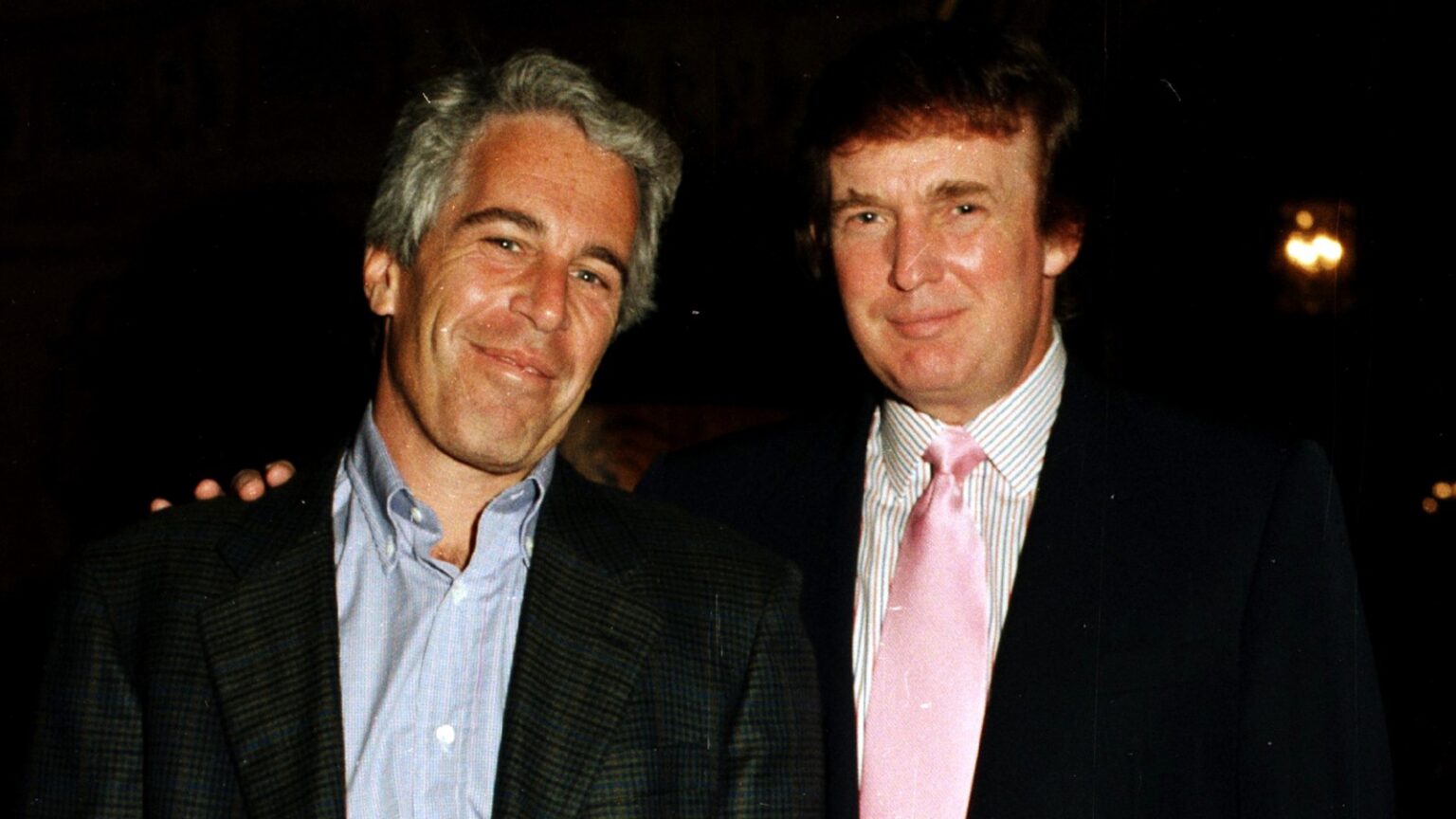

Donald Trump would prefer not to hear the name Jeffrey Epstein ever again. “Are you still talking about Jeffery Epstein?” he asked a reporter who brought up the late sex offender in July. “Are people still talking about this guy, this creep? That is unbelievable.”
Unfortunately for the president, lingering questions about the crimes Epstein committed with his convicted accomplice Ghislaine Maxwell continue to be of national interest. Polling shows that about three-quarters of Americans want the government to release all the materials it has from investigations and prosecutions of Epstein, who died by suicide in a jail cell while awaiting trial on federal sex trafficking charges in 2019. Trump’s own supporters and his allies in Washington have been particularly vocal regarding the so-called “Epstein files,” believing they could implicate various powerful elites in a child sex-trafficking ring, and during his 2024 campaign, Trump indicated that he would make them public if reelected.
The issue is that Trump — a close friend of Epstein’s for more than a decade — is named in these documents himself, as the Justice Department informed him in May. That alone is not evidence of wrongdoing, and Trump has denied knowledge of or participation in any of Epstein’s illegal activities. But the association is damaging nonetheless, and the steady trickle of details about their relationship (in November, House Democrats dropped a 2019 email from Epstein in which he wrote that Trump “knew about the girls,” for example) have not played in his favor. Meanwhile, Trump hasn’t ruled out a pardon for Maxwell, who was moved to a minimum-security prison facility this summer as she continues to serve her 20-year sentence.
Now that Congress has forced the release of the files, things are getting even more complicated. Here’s everything we currently know about Trump’s relationship with Epstein.
1980s: Meeting in Palm Beach
Trump has said that he and Epstein became friends in the late 1980s. The two were neighbors in affluent Palm Beach, Florida — Trump bought his Mar-a-Lago estate there in 1985, initially using it as a residence before its conversion to a country club a decade later — and moved in the same social circles. Often spotted together at high-profile gatherings of the rich and powerful, Epstein and Trump seemed quite close at the time, according to Jack O’Donnell, an executive at Trump Plaza and Casino during this period. “In my mind, [Epstein] was his best friend, you know, [throughout] the time I was there for four years,” O’Donnell told CNN in 2025. He further claimed that Epstein and Trump once illegally brought underage girls into Trump’s Atlantic City casino, where they often spent time together.
1990s: The Party Circuit
The most widely circulated footage of Trump and Epstein together comes from a November 1992 party that the future president held at Mar-a-Lago, with NFL cheerleaders in attendance. Trump invited NBC to document the soirée; following Epstein’s 2019 arrest, the network aired archival clips of the pair evidently assessing the women at the event. “Look at her, back there … she’s hot,” Trump appears to tell Epstein at one point. Another snippet shows Epstein doubling over with laughter at something Trump whispers to him. Trump can also be seen dancing with a woman and patting her buttocks.
Epstein was a guest at Trump’s 1993 wedding to Marla Maples at New York’s Plaza hotel, and Trump flew between Palm Beach and New York on Epstein’s private jets seven times between 1993 and 1997, according to flight logs presented as evidence in Maxwell’s 2021 trial.
Other images linking Trump and Epstein come from a 1997 Victoria’s Secret party in New York (Epstein was a business associate of Les Wexner, then the CEO of L Brands, which owned the fashion company) and a 2000 charity fundraiser at Mar-a-Lago. At that party, Trump posed for a photo with his future wife Melania, Epstein, and Maxwell. Also in attendance at that party was Andrew Mountbatten-Windsor, a prince of the British royal family until he was stripped of his royal titles this October, following the settlement of a sexual assault lawsuit from the late Epstein accuser Virginia Giuffre, who alleged that Epstein had trafficked her to him.
2000s: Falling Out
In the early aughts, Epstein and Trump were still the best of pals. “I’ve known Jeff for 15 years. Terrific guy,” Trump said in an interview for a 2002 New York Magazine profile of Epstein as a well-connected “International Moneyman of Mystery.”
“He’s a lot of fun to be with,” Trump added. “It is even said that he likes beautiful women as much as I do, and many of them are on the younger side. No doubt about it — Jeffrey enjoys his social life.”
The following year, Epstein celebrated his 50th birthday. To mark the occasion, Maxwell had his friends contribute letters, photos, and drawings to a scrapbook, the full contents of which were made public by the House Oversight Committee in September. A note that appears to be from Trump (though he has denied writing it) consisted of the drawing of a nude female figure and an imagined dialogue between the two men. “We have certain things in common, Jeffrey,” “Donald” says in the exchange, which is typed out. “Enigmas never age, have you noticed that?” reads another line. The letter concludes: “A pal is a wonderful thing. Happy Birthday — and may every day be another wonderful secret.” Trump’s signature appears below the drawing and words.
Trump and Epstein grew apart in the following years, however. Their 2004 competition to buy an oceanfront Palm Beach mansion at a foreclosure auction likely helped to sour the relationship, though in July, Trump said that he had cut ties with his former friend because Epstein “stole” young female employees of the Mar-a-Lago spa. He indicated that Giuffre, recruited as a teenager by Maxwell to be a masseuse for Epstein in 2000, was one of the spa workers hired away by the financier. Epstein remained a member of Mar-a-Lago until 2007, when Trump banned him from the club, reportedly after Epstein sexually harassed the teenage daughter of another member.
By that point, Epstein had been indicted in Florida for solicitation of prostitution following an investigation opened by Palm Beach police in 2005, and the FBI was preparing federal charges against him. His lawyers angled for a plea agreement with Alexander Acosta, the U.S. attorney for the Southern District of Florida. In return for the federal case being dropped, Epstein pleaded guilty to two state charges in 2008, receiving an 18-month sentence, and was required to register as a convicted sex offender. When Epstein was arrested in July 2019 and federally charged for the sex trafficking of minors, Acosta — then serving as President Trump’s labor secretary — faced significant blowback for Epstein’s earlier nonprosecution agreement, often referred to as a “sweetheart deal.” He resigned from the cabinet that same month.
2010s: A Lawsuit, Federal Charges, and Epstein’s Death
In 2016, an anonymous Jane Doe filed a lawsuit claiming that Trump and Epstein had sexually assaulted and raped her at Epstein’s New York residence multiple times in 1994, when she was 13 years old. The suit was withdrawn days before Trump won the presidential election. (Trump has been accused of sexual misconduct by 28 women — though none were under age — and in 2023 was found liable for sexual abuse and defamation in a lawsuit brought by writer E. Jean Carroll, a judgment he has been trying to overturn ever since.)
In 2017, Epstein spoke to author Michael Wolff about being Trump’s “closest friend.” In the taped interview, published in 2024, he claimed that Trump had first slept with Melania on his private plane. Although Epstein described Trump as charismatic, he was critical of his performance as president and said he was a serial adulterer. “He’s a horrible human being,” Epstein said. “He does nasty things to his best friends, best friends’ wives, anyone who he first tries to gain their trust and uses it to do bad things to them.” He also claimed that Trump was “functionally illiterate.”
Epstein’s arrest in July 2019 prompted Trump to further distance himself from his former friend, claiming they had not been in touch for 15 years. The following month, Epstein hanged himself in a federal prison facility in Manhattan. According to Bill Barr, the U.S. attorney general at the time, Trump was shocked to learn of his death. He called for an investigation into how Epstein could have died while in custody, meanwhile amplifying unfounded conspiracy theories implying that Bill Clinton, another acquaintance of Epstein, may have had something to do with it.
2020s: Conspiracy Theories
Conspiracy theories began circulating around Epstein’s death as soon as it made headlines, with believers insisting that he was murdered as part of a cover-up to protect his associates. MAGA loyalists proved especially keen on the idea that prominent Democrats and various wealthy liberal elites are behind this supposed plot and need to be exposed for their links to Epstein. This commentary typically comes along with repeated calls to release the “Epstein files,” or all the material related to criminal investigations and prosecutions of Epstein dating back to 2005, though some have demanded the publication of a hypothetical “Epstein list” naming clients of his sex trafficking operation that he may have been blackmailing. There is no evidence that such a list exists.
After Maxwell was federally charged for sex trafficking in 2020, Trump raised eyebrows by lending her words of support. “I haven’t really been following it too much,” he said of the case. “I just wish her well, frankly.” In 2025, as she was appealing her conviction and seeking a pardon from a reelected Trump, Maxwell told Justice Department officials that she had never seen the president “in any inappropriate setting.”
In October 2024, former Sports Illustrated swimsuit model Stacey Williams went public with an allegation that in 1993, Epstein, whom she’d met the year before, brought her to visit Trump at Trump Tower in New York, where Trump brazenly groped her as the two men continued to talk casually, “smiling at one another and continuing on in their conversation,” as she put it. Williams called the encounter part of a “twisted game” between them. The Trump campaign denied the allegation.
January-June 2025: Epstein Files Fiasco
Once Trump was back in the Oval Office, his supporters expected him to make good on his campaign promise to reveal everything the government knows about Epstein. To that end, Attorney General Pam Bondi in February invited a number of right-wing influencers to the White House and gave them binders of documents labeled “The Epstein Files: Phase One,” with the understanding that they would share any findings with their followers. It quickly emerged, however, that they had only received material that was already a matter of public record, including Epstein’s address book, which was first published in 2015. Conspiracy theorists were livid, not least because Bondi had promised revelatory information.
The botched stunt brought renewed scrutiny of the relationship between Trump and Epstein, with Trump officials working to tamp down discontent over their failure to disclose anything new about the Epstein case. In May, FBI Director Kash Patel and Deputy Director Dan Bongino — both of whom had stoked Epstein conspiracy theories before Trump appointed them to lead the bureau — said that footage from the jail where he was being held prove that his death was a suicide. A week later, amid their escalating public feud, Trump megadonor Elon Musk, recently departed from his advisory position in the administration, said that Trump was named in the Epstein files. “That is the real reason they have not been made public,” he posted on X, his social media platform. (He later deleted these comments.)
July-September 2025: Justice Department Closes Investigation, Trump Claims ‘Hoax’
In early July, the Justice Department attempted to put the Epstein story to bed with a brief memo explaining that he had indeed died by suicide while in custody, that there is no reason to believe a “client list” exists, and that their investigation was effectively closed. The DOJ also provided surveillance footage from the prison where Epstein was being held on the night of his death, which did not show anyone entering his cell after him. Conspiracy theorists found the video unconvincing and were enraged that the DOJ wasn’t prosecuting anyone else in connection with Epstein’s sex trafficking operation.
The memo caused a schism within the administration as well, and it led to Trump lashing out at his supporters for caring about the “bullshit” Epstein files. He and White House officials tried, without much success, to spin them as some kind of Democrat-engineered “hoax.” At the same time, The Wall Street Journal broke the story about Trump’s 2003 birthday book letter to Epstein; the president dismissed it as “a fake thing.” Then it emerged that Bondi had told Trump in May that his name appeared in the Epstein files, contrary to his claim to a reporter in July that the DOJ had not informed him of this.
As Epstein victims spoke out against the administration’s handling of the case, Trump privately fumed that they were “Democrats” and out to make him look bad. Meanwhile, Maxwell was moved in August to a more comfortable prison where she is reportedly “much happier,” though the Federal Bureau of Prisons gave no reason for the transfer. This came after Trump told the press that he was “allowed” to pardon Maxwell if he wanted to. She additionally gave an interview to Deputy Attorney General Todd Blanche, formerly Trump’s personal attorney, in which she had only flattering things to say about the president. (The Supreme Court declined to hear Maxwell’s appeal to overturn her conviction in October, leaving her reliant on the president to commute her sentence.)
In September, House Speaker Mike Johnson came under fire for alleged attempts to mislead the public on the Epstein case and block further disclosures about it. First, he bizarrely stated that Trump was “an FBI informant” trying to take down Epstein — a claim he later retracted. Then he led House Republicans in refusing to swear in newly elected Democratic Rep. Adelita Grijalva (D-Ariz.) for more than a month during a record-breaking U.S. government shutdown. Because Grijalva would have been the last signature needed on a discharge petition that would ultimately force a vote on a bill mandating the DOJ and other federal agencies release files pertaining to Epstein. Given Trump’s public opposition to the measure, some political observers considered this a stonewalling strategy. Grijalva was ultimately sworn in over six weeks after her election, clearing the path for a vote on the Epstein Files Transparency Act.
November 2025: Epstein’s Emails and a Congressional Intervention
November brought the release of more than 20,000 Epstein documents by Democrats on the House Oversight Committee, which obtained them directly from Epstein’s estate. The tranche included emails in which the late sex offender discussed Trump. In a 2011 email to Maxwell, for example, he wrote, “I want you to realize that that dog that hasn’t barked is Trump,” claiming that Trump once “spent hours at my house” with a young woman who went on to accuse Epstein of trafficking and abusing her. Elsewhere, in a 2018 message, he wrote: “you see, i know how dirty Donald is.” Epstein even called Trump “borderline insane” in his digital correspondence.
As Trump ran for president in 2015 and 2016, Epstein regularly strategized with Wolff about whether to engage with the media regarding his relationship with the insurgent candidate. In one exchange, Wolff alerted Epstein that CNN was planning to ask Trump about their connection. “I think you should let him hang himself,” Wolff wrote. “If he says he hasn’t been on the plane or to the house, then that gives you a valuable PR and political currency. You can hang him in a way that potentially generates a positive benefit for you, or, if it really looks like he could win, you could save him, generating a debt.” Late in the campaign, once a 2005 audio recording from an Access Hollywood taping in which Trump made crass remarks about women and sexual assault became public, Wolff advised Epstein that he had an “opportunity to come forward this week and talk about Trump in such a way that could garner you great sympathy and help finish him.”
Rarely did Epstein mince words about his long-time confidant. Shortly into Trump’s first term, he emailed economist and former Treasury Secretary Larry Summers and called the president “dangerous,” writing: “i have met some very bad people […] none as bad as trump. not one decent cell in his body.” In other messages alluding to Trump, Epstein seemed to suggest that he had compromising information on Trump. “I am meticulous about documentation and backup,” he wrote to Wolff in 2018. In 2015 messages to New York Times reporter Landon Thomas Jr., he offered to share photos “of donald and girls in bikinis in my kitchen” and told him he should ask a member of his house staff about Trump “almost walking through the door leaving his nose print on the glass as young women were swimming in the pool and he was so focused he walked straight into the door.”
Once more, Trump and his administration sought to wave away the direct links to Epstein. White House Press Secretary Karoline Leavitt called the emails a “clear distraction,” with the president saying much the same. “The Democrats are trying to bring up the Jeffrey Epstein Hoax again because they’ll do anything at all to deflect on how badly they’ve done on the Shutdown, and so many other subjects,” he complained on Truth Social. “Only a very bad, or stupid, Republican would fall into that trap.”
The release of the emails continue to build pressure and support for the congressional effort to force a vote on the release of the files. Despite reports that Trump attempted to pressure Reps. Lauren Boebert (R-Co.) and Nancy Mace (R-S.C.), to drop their support for the discharge petition, the Epstein Files Transparency Act received the necessary support in the House to be brought to a vote over the objections of Republican leadership. In a last minute reversal, President Trump wrote on Truth Social that “Republicans should vote to release the Epstein files, because we have nothing to hide, and it’s time to move on from this Democrat Hoax.”
The Epstein Files Transparency Act passed through the House via a unanimous vote, and a near unanimous vote in the Senate. Trump signed it into law the next day, kicking off a 30 day countdown towards the release of the files.
December 2025: (Partial) Info Dumps
The law mandated that the attorney general make all the qualifying evidence in the federal government’s possession related to the Epstein case available in a publicly searchable database within 30 days. The DOJ was granted a limited slate of exceptions: Content could be withheld or redacted if it would potentially compromise a survivor, national security, or an ongoing criminal case.
On Dec. 19, the DOJ announced that it would not be complying with the law, and releasing the files in periodic info dumps over the course of an indeterminate amount of weeks. The first dump, containing about 4,000 files, was heavily redacted (without the legally mandated explanations to Congress), and seemed selectively curated to avoid mentions of depictions of President Trump.
Hours after the initial release, about a dozen files — including a photo of Trump, Epstein, and Maxwell — were removed from the database. The photo of Trump was restored following public outcry.
On Dec. 23, the DOJ dumped another batch of heavily redacted documents, and preempted their release with a statement asserting that “untrue and sensationalist claims made against President Trump that were submitted to the FBI right before the 2020 election. To be clear: the claims are unfounded and false, and if they had a shred of credibility, they certainly would have been weaponized against President Trump already.”
The new files contained an uncorroborated allegation submitted to the FBI accusing the president of sexual assault in the 1990s. The tranche also contained an unauthenticated letter allegedly written by Epstein to fellow convicted sex offender Larry Nassar, as well as emails potentially referring to “inappropriate” friendships procured by Maxwell for Andrew Mountbatten-Windsor, formerly known as Prince Andrew.
The documents released so far contain no indication that the president was being treated as a potential criminal suspect, but his involvement with Epstein did draw the eye of investigators. One file contained an email from a federal prosecutor involved in the case against Maxwell to an unidentified individual, warning that “flight records we received yesterday reflect that Donald Trump traveled on Epstein’s private jet many more times than previously has been reported (or that we were aware), including during the period we would expect to charge in a Maxwell case.”
The message indicates that Trump flew on Epstein’s jet at least eight times over a three year period. “On one flight in 1993, he and Epstein are the only two listed passengers; on another, the only three passengers are Epstein, Trump, and then-20-year-old [redacted]. On two other flights, two of the passengers, respectively, were women who would be possible witnesses in a Maxwell case,” the email says. While Trump’s history with Epstein’s infamous private plane was already known, the email — written during Trump’s first administration — indicated prosecutors may have warned individuals in Trump’s orbit about potential negative stories stemming from Maxwell’s case.
For his part, Trump has continued to bemoan the public release of the files, focusing on the possibility that innocent acquaintances of Epstein’s or those who had a chance encounter with him would be subjected to reputational damage.
“A lot of people are very angry that pictures are being released of other people that really had nothing to do with Epstein. But they’re in a picture with him because he was at a party, and you ruined a reputation of somebody,” Trump complained on Dec. 22. “A lot of people are very angry that this continues. A lot of Republicans.”
If the Epstein saga has taught us anything, however, it’s that you can’t easily sweep this mess under the rug — not after years of feverish speculation, misinformation, and accusations of shielding sexual predators from accountability while ignoring the stories of survivors. Slowly but surely, more is coming to light, and the demand for answers is as loud as it’s ever been.
This story was originally published on Nov. 12, 2025, and updated on Dec. 26.


