
By using this site, you agree to the Privacy Policy and Terms of Use.
Accept
Stay Current on Political News—The US FutureStay Current on Political News—The US FutureStay Current on Political News—The US Future
  • Home
  • USA
  • World
  • Business
    • Realtor
    • CEO
    • Founder
    • Entrepreneur
    • Journalist
  • Sports
    • Athlete
    • Coach
    • Fitness trainer
    • Life Style
  • Education
  • Health
    • Doctor
    • Plastic surgeon
    • Beauty cosmetics
  • Politics
  • Technology
    • Space
    • Cryptocurrency
  • Weather
Reading: Scientists detect X-ray glow from interstellar comet 3I/ATLAS extending 250,000 miles into space
Share
Font ResizerAa
Font ResizerAa
Stay Current on Political News—The US FutureStay Current on Political News—The US Future
  • Home
  • USA
  • World
  • Business
  • Cryptocurrency
  • Economy
  • Life Style
  • Health
  • Politics
  • Space
  • Sports
  • Technology
  • Weather
  • Entertainment
  • Cybersecurity
Search
  • Home
  • USA
  • World
  • Business
    • Realtor
    • CEO
    • Founder
    • Entrepreneur
    • Journalist
  • Sports
    • Athlete
    • Coach
    • Fitness trainer
    • Life Style
  • Education
  • Health
    • Doctor
    • Plastic surgeon
    • Beauty cosmetics
  • Politics
  • Technology
    • Space
    • Cryptocurrency
  • Weather
Follow US
Stay Current on Political News—The US Future > Blog > Space > Scientists detect X-ray glow from interstellar comet 3I/ATLAS extending 250,000 miles into space
Space

Scientists detect X-ray glow from interstellar comet 3I/ATLAS extending 250,000 miles into space

Sophia Martin
Sophia Martin
Published December 18, 2025
Share

For the first time, astronomers have captured two distinct X-ray views of an interstellar comet, providing an unprecedented view of the interaction between a visitor from beyond our solar system and the solar wind.

Interstellar comet 3I/ATLASthe third confirmed object known to have originated outside our own solar systemIt has now been imaged in X-ray light by both the European Space Agency’s (ESA) XMM-Newton observatory and the X-ray Imaging and Spectroscopy Mission (XRISM) led by the Japanese space agency JAXA in partnership with NASA and ESA. These X-ray observations allow scientists to detect and study gases that other instruments cannot easily detect, according to a statement of the ESA.

kites They glow in visible light when sunlight reflects off dust and gas escaping from their icy core, while X-ray light tells a very different story. In space, the interaction between fast-moving charged particles from the sun, also known as solar wind – and the cloud of gas surrounding a comet produces X-ray emissions. Detecting that glow allows scientists to track where and how these interactions occur and what types of gases are present at levels that optical telescopes might miss.

you may like

While NASA James Webb Telescope and other instruments have already detected abundant water vapor, carbon monoxide and carbon dioxide in the 3I/ATLAS coma, X-ray observations are exceptionally sensitive to lighter gases such as hydrogen and nitrogen that would otherwise be difficult to detect.

The first X-ray observation of 3I/ATLAS was made by the XRISM Space Telescopewho observed the comet for 17 hours between November 26 and 28. The resulting image was captured using XRISM’s soft X-ray telescope, Xtend, whose field of view spans approximately 1.2 million square miles (3 million square kilometers), revealing a statement of ESA publishing the image.

A blue, violet and green X-ray image of comet 3I/ATLAS, showing a square of blue, green and violet colors on a black background.

An image of comet 3I/ATLAS from the X-ray Imaging and Spectroscopy Mission (XRISM). (Image credit: JAXA)

The XRISM data also contains spectral signatures of elements such as carbon, nitrogen and oxygen, helping scientists begin to unravel the mix of particles released from the comet’s nucleus and how they interact with the nearby high-energy environment. the sunESA officials said in the statement.

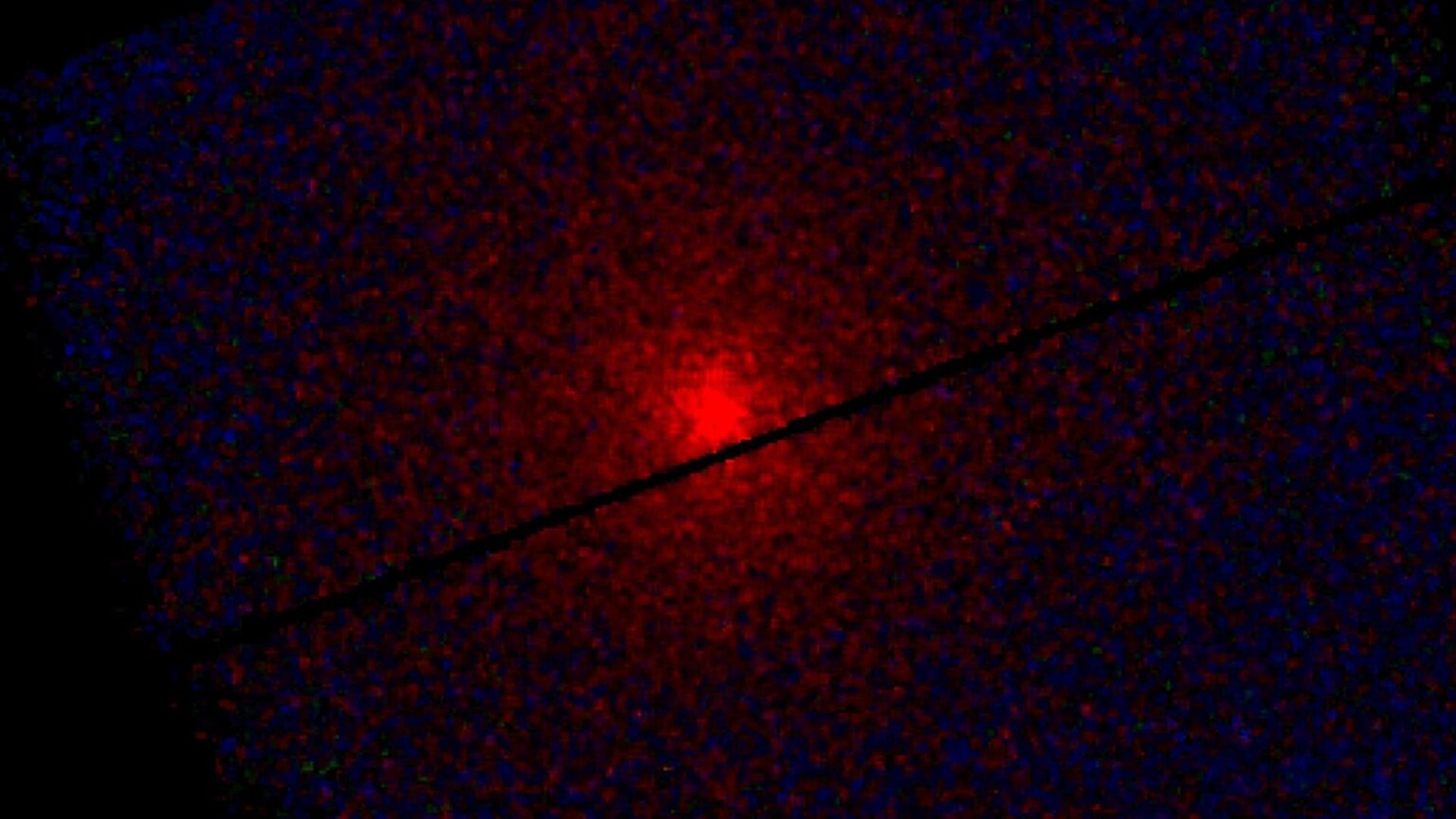
Shortly after, the ESAs Newton XMM The X-ray observatory studied 3I/ATLAS for about 20 hours on December 3, when the comet was approximately 175-177 million miles (282-285 million kilometers) from the spacecraft. The image was captured using the telescope’s most sensitive X-ray instrument, the European Photon Imaging Camera (EPIC)-pn, and reveals a distinctive X-ray glow (shown in red) surrounded by fainter gradients. These features mark regions where the solar wind interacts with the gas coming out of the comet, according to a statement of ESA publishing the image.

Breaking space news, the latest updates on rocket launches, skywatching events and more!

This image shows an X-ray view of interstellar comet 3I/ATLAS, captured by ESA's XMM-Newton spacecraft. In the center of the image, a bright red dot stands out against a dark background, like a beacon of fire. From this core, faint gradients of purple and blue extend outward, creating a slightly rotated rectangular frame, divided by a thin horizontal line, the detector gap. Red shows low energy X-rays, blue marks empty space with very few X-rays. A yellow arrow labeled

Another X-ray image of the interstellar comet 3I/ATLAS (Image credit: ESA/XMM-Newton/C. Lisse, S. Cabot and the XMM ISO team)

“3I/ATLAS presents a new opportunity to study an interstellar object, and observations in X-ray light will complement other observations to help scientists discover what it is made of,” ESA officials said in the statement.

Together, the X-ray, optical, infrared and radio observations offer new insights into 3I/ATLAS as it makes its strange journey through the inner solar system, with its next closest approach to Earth It is expected around December 19.

Popular News
USA

30 best budget-friendly Wayfair Way Day sale picks under $200

Sophia Martin
Sophia Martin
April 26, 2025
GOOD ON GRANDSLAM TRACK BUT LET’S LOOK BACK BACK ON TRACK’S BAD OLD DAYS
Walton Goggins On Getting To Pull Off Some Of Television’s Most Absurd Lines In ‘The Righteous Gemstones’: “Danny McBride Spins Gold”
Carrie Ann Inaba Biography: From Dance Icon to Wellness Advocate
La caféine peut-elle améliorer vos performances sportives ? – Blog Polar
Stay Current on Political News—The US Future
The USA Future offers real-time updates, expert analysis, and breaking stories on U.S. politics, culture, and current events.
  • USA
  • World
  • Politics
  • Education
  • Weather
  • Business
  • Entrepreneur
  • Founder
  • Journalist
  • Realtor
  • Health
  • Doctor
  • Beauty cosmetics
  • Plastic surgeon
  • Sports
  • Athlete
  • Coach
  • Fitness trainer
© 2017-2025 The USA Future . All Rights Reserved.
Welcome Back!

Sign in to your account

Username or Email Address
Password

Lost your password?
