




Fifty-seven years ago, three American astronauts embarked on one of the most daring and inspiring journeys in human history.
In late December 1968, NASA astronauts Frank Borman, James Lovelland William Anders went to the moon aboard Apollo 8becoming the first humans to break free from Earth’s gravity and travel to another world.
In a bold decision, surprising in both its simplicity and its audacity, NASA decided to “bet the farm” to mitigate Soviet lunar ambitions in the space race to the Moon. Still recovering from the devastating crisis of 1967 Fire on the Apollo 1 launch pad which killed three astronauts (including Mercury astronaut Gus Grissom), the space agency abandoned its careful, methodical building-block approach to the increasingly complex Apollo orbital missions to Earth and launched a “Hail Mary pass.”
Hail Mary to the moon

Around Christmas 1968, the United States would launch Apollo 8 to orbit the moon in the first manned flight of the Saturn V – then the most powerful rocket ever built – into a small spacecraft powered by a single engine that absolutely had to work.
It was brilliant. It took guts. And it was extraordinarily risky.
No space mission, neither before nor since, had such a clear and simple objective. Two and a half hours after launch came words never before spoken during a space mission: “Apollo 8, you’re going TLI” (translunar insertion). They were “going” to the moon.
Historian Dwayne A. Day, who has written extensively on space history and Cold War intelligence programs, puts NASA’s decision in perspective.
“Frank Borman has said that a CIA report (which maintained that the Soviet Union was planning a manned lunar flyby by the end of the year) led to the Apollo 8 mission orbiting the moon. But nothing I have found proves it,” Day said. “What is clear is that the Lunar Module was not ready and NASA was not going to keep Apollo 8 on the ground. In the moon race, NASA had put the pedal to the metal and it didn’t matter if the Soviet Union was gaining on them in their rearview mirror, they weren’t going to slow down.”
After a three-day journey, Borman, Lovell and Anders fired the single engine of Apollo 8’s service propulsion system to slow their spacecraft as it approached the moon, allowing lunar gravity to capture them in orbit.
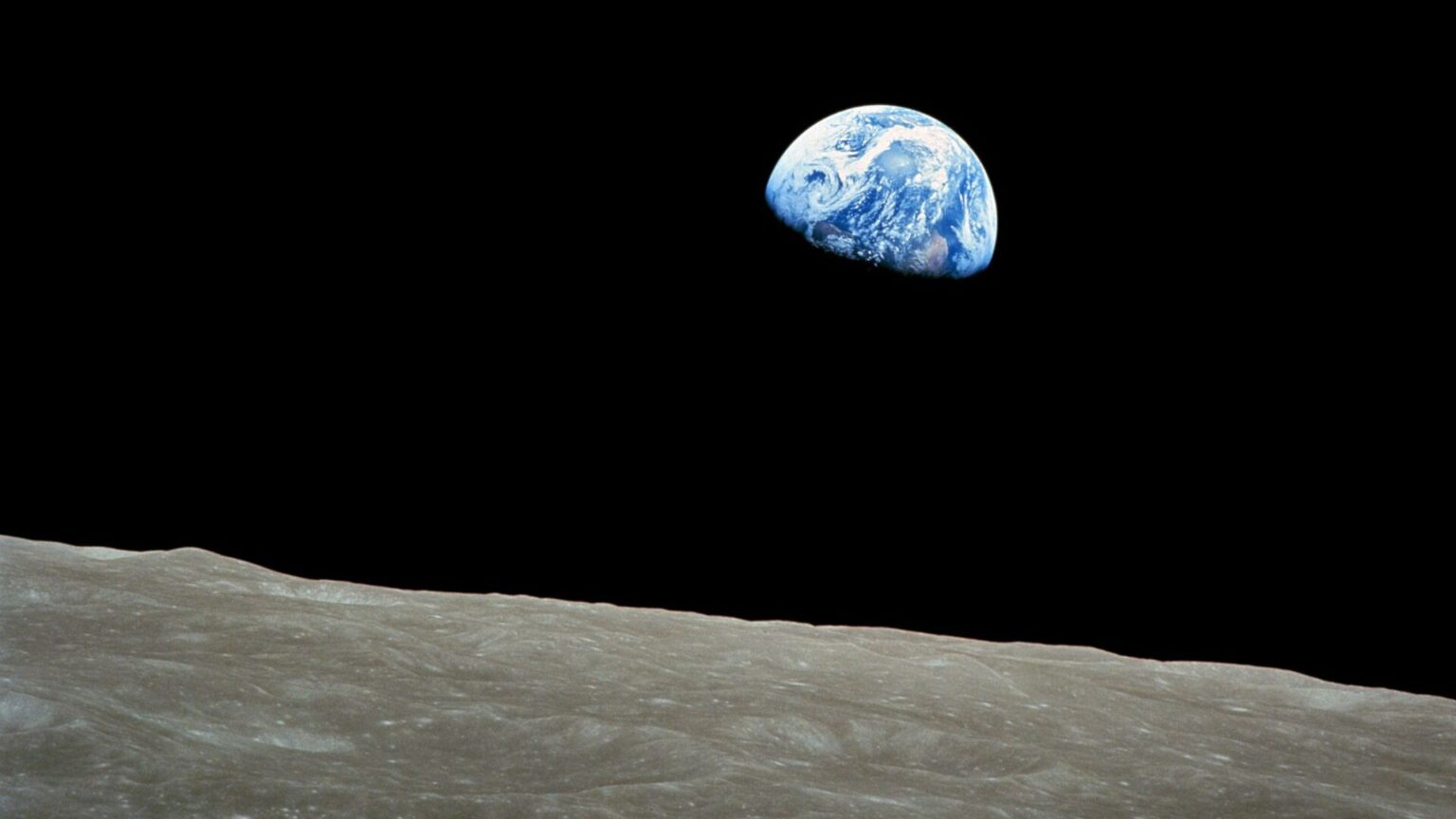
From just 60 miles above the surface, the astronauts became the first humans to gaze upon the Moon’s rugged mountains and cratered plains. Then came a moment none of them expected: the blue marble of the Earth rising above the lunar horizon. In a single photograph: the now iconic “exit from the earth“—humanity saw itself from a quarter of a million miles away, fragile and alone in the darkness.

On Christmas Eve, the crew pointed their black-and-white television camera at the lunar surface, transmitting grainy images of craters and ancient seas floating silently below. As families around the world paused from Christmas celebrations, astronauts unexpectedly began reading from the Book of Genesis: “In the beginning, God created the heavens and the earth…”
The fusion of ancient scriptures, the spirit of the season and the stark beauty of the moon transformed the television broadcast into an indelible moment. For many, Christmas Eve 1968 would forever be remembered as “lunar christmas“.

When the new year arrived, the brave crew of Apollo 8 returned safely to Earth and their mission was hailed as an inspiring and extraordinary achievement. Time magazine stopped its printing presses to name Borman, Lovell and Anders “Men of the Year.” A telegram to the astronauts succinctly reflected the mood: “They saved 1968.”
Andrew Chaikin, author of “A man on the moon: the voyages of the Apollo astronauts“he later reflected on the Apollo era.
“How is it possible that the most futuristic thing humans have ever done happened in such a distant past? In the narrative of the space age, Apollo is a chapter that seems strikingly out of sequence.”
Artemis 2 to the moon

Today, NASA stands on the brink of a new lunar chapter. Artemis 2 — the first crewed mission of the Artemis program — scheduled to launch in early 2026. The 10-day flight will take astronauts around the moon to test the Orion spacecraft and Space launch system rocket in deep space.
NASA astronauts Reid Wiseman, Victor Glover and Christina Koch, along with Canadian astronaut Jeremy Hansen, will become the first humans to venture to the vicinity of the Moon since 1972 aboard their orion spaceshipappropriately named “Integrity“.
Glen E. Swanson, former chief historian of the Johnson Space Center and author of the recently published book “Inspired Enterprise: How NASA, the Smithsonian, and the Aerospace Community Helped Launch Star Trek“draws a direct parallel between Apollo 8 and current challenges.
“Apollo 8 was about leaving Earth and Apollo 11 “It was about reaching the moon,” Swanson said. “If we look at it from the point of view of time, now that more than half a century has passed since both events occurred, one might pause and ask which was more important.”
Swanson invokes the oft-repeated phrase: “If we can put a man on the moon, we can…” What can we do now as a nation other than sit back and watch each other? like chinago back to where we once were but now we can’t return immediately even if we tried?
“Apollo was political at its finest, and as a result, NASA both succeeded and suffered because of it,” Swanson said. “He succeeded with his signature event: the technologically astonishing and audacious achievement of landing on the moon. But he has paid a very high price for that feat, especially when it came to formulating sustained long-range plans for human spaceflight.”
Day strikes a similar note when comparing Apollo 8 to Artemis 2.
“History doesn’t echo, but sometimes it rhymes,” he said. “Some historians have claimed that Apollo 8 was the true end of the lunar race. But that is only because the Soviet Union had no chance of landing a cosmonaut on the moon before Apollo 11.”
“Today we have a similar but different situation: NASA could send humans around the moon again, but China could still win Artemis 3 land on the moon. Does that really matter? It could symbolize Chinese dominance in technology. “But we have many different measures of technological supremacy compared to the 1960s, so it’s not clear that the impact will be as large as that of the first race to the moon.”
NASA’s great comeback?
Fast forward to 2025, there is Serious problems affecting NASA.. When the current administration proposed cutting its budget, the agency lacked a full-time administrator for 11 months beforehand. Confirmation of Jared Issacman on December 17. Morale among its workforce is at a low point; Many highly qualified and valuable staff have been laid off or simply left. A respected group of former astronauts has warned that such reductions could put crew safety at greater risk. These factors combined raise the specter of what the future of NASA will look like.
Still, Apollo 8 offers a reminder that leadership in space is not defined solely by who gets there first, but by who dares to step forward when the outcome is uncertain. In 1968, three astronauts took a divided world to the Moon and, in doing so, helped a weary planet rediscover its sense of possibility. As Artemis 2 prepares to embark on a journey “From the Earth to the Moon,” the question is not whether history can repeat itself but whether its quiet courage can be reassembled.


