

I wanted to look at the relationship between family structure and student achievement based on family income. Single-parent families are much more common in low-income communities, and I didn’t want to confront achievement gaps by income with achievement gaps by family structure. For example, 43 percent of low-income eighth graders live with a single parent compared to 13 percent of their high-income peers. I wanted to know if children who live with a single parent do worse than children with the same family income who live with both parents.
To analyze the most recent data from the 2024 NAEP exam, I used the NAEP Data Explorera public tool developed by the ETS testing organization for the National Center for Education Statistics (NCES). I told an ETS researcher what I wanted to know, and he showed me how to generate the crosstabulations, which I then replicated independently on four tests: fourth- and eighth-grade reading and math. Finally, I verified the results with a former senior NCES official and a current board staff member who oversees the NAEP assessment.
The analysis reveals a surprising pattern.
Among low-income students, achievement differs little by family structure. Fourth- and eighth-graders from low-income households score about the same whether they live with both parents or just one parent. Two-parent households do not confer a measurable academic advantage in this group. Fourth grade reading is a great example. Among the lowest socioeconomic third of students, those living with both parents scored 199. Those living with only their mother scored 200. The results are almost identical and, if anything, slightly higher for children of single mothers.
However, as socioeconomic status increases, differences by family structure become more pronounced. Among middle- and high-income students, those who live with both parents tend to score higher than their peers who live with only one parent. The gap is greater among wealthier students. In fourth-grade reading, for example, higher-income children who live with both parents scored 238, 10 points higher than their peers who live with only their mothers. Experts argue about the meaning of one NAEP point, but some equate 10 NAEP points with a school year’s worth of learning. It is substantial.
Family Structure Matters Less for Low-Income Student Achievement
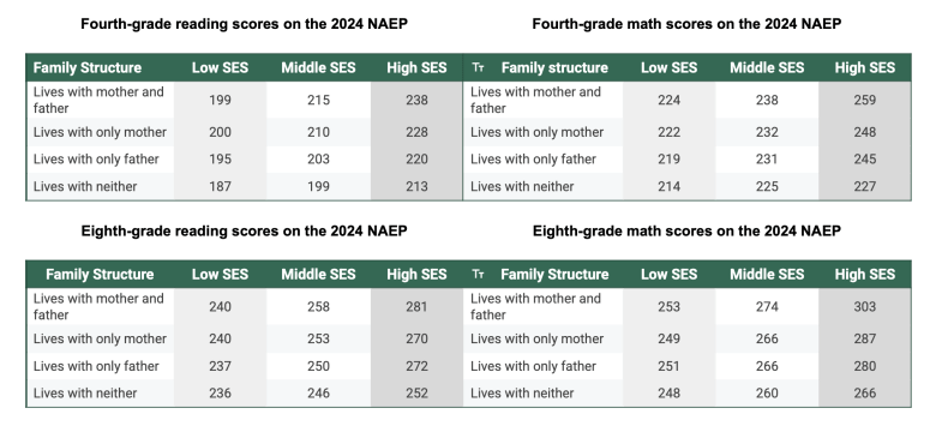
Still, it is better to be rich in a single-parent home than poor in a two-parent home. High-income students raised by a single parent substantially outperform low-income students living with both parents by at least 20 points, underscoring that money and the advantages it brings (such as access to resources, stable housing, and educational support) matter far more than household composition alone. In other words, income far outweighs family structure when it comes to student achievement.
Despite the NAEP data, Jonathan Butcher, acting director of the Heritage Foundation’s education policy center, defends the claim that family structure is very important to student outcomes. He points out that the investigation since the milestone 1966 Coleman Report has consistently found a relationship between the two. More recently, in a American Enterprise Institute-Brookings Report 202215 scholars concluded that children “raised in stable families with married parents are more likely to excel in school and generally earn higher grade point averages” than children who are not. Two recent books, “Get Married” (2024) by Brad Wilcox and “The Two-Parent Privilege” (2023) by Melissa Kearney, also make the case, noting that children raised by married parents are about twice as likely to graduate from college as children who are not. However, it is not clear to me whether all of this analysis has broken down student achievement by family income as I did with the NAEP data.
Family structure is a persistent issue for conservatives. Last week the Heritage Foundation published a report on strengthening and rebuilding American families. In July 2025 fact sheetRobert Pondiscio, a senior fellow at the American Enterprise Institute, a conservative think tank, wrote that “the most effective intervention in education is not another literacy coach or an SEL program. It’s Dad.” He cited a report from June 2025: “Good parents, flourishing children,” by academics and advocates. (Disclosure: A group led by one of the authors of this report, Richard Reeves, is among the funders of the Hechinger Report.)
That conclusion is partially supported by NAEP data, but only for a relatively small proportion of students from higher-income families (the share of high-income children living with only their mother ranges from 7 to 10 percent. The rate of single parents is higher for eighth graders than for fourth graders). For low-income students, who are the main concern of Pondiscio and academics, that is not the case.
The data has limitations. The NAEP survey does not distinguish between divorced families, households headed by grandparents, or same-sex parents. Shared custody arrangements are likely lumped together in two-parent households because the children can say they live with the mother and father, if not at the same time. Still, these nuances are unlikely to alter the main conclusion: For low-income students, academic outcomes are largely similar regardless of whether they live with both parents all the time, part of the time, or only live with one parent.
The bottom line is that calls for new collection of federal data by family structure, like those outlined in Project 2025, may not reveal what advocates hope. A family’s bank account matters more than a wedding ring.