





By JEFF GOLDSMITH
It’s happened at least a dozen times. I mention John Arnold and my knowledgeable healthcare colleagues greet me with a blank stare. Houston billionaire John Arnold is the most powerful man in American healthcare that no one has ever heard of. Arnold, an investment expert, made $50,000 trading high school collectors’ hockey cards over the Internet. He became Enron’s star natural gas trader in his early twenties. Arnold, who played no role in Enron’s historic collapse, left the company in 2001 with an $8 million bonus. In 2002, at age 28, Arnold founded a hedge fund, Centaurus Advisors, focused on energy investing, and released a decade or 100% annual profitability.
Bored with investing and by then a billionaire, Arnold closed Centaurus in 2012 and decided to change the world. With his wife Laura, a Yale-trained lawyer, John created a family foundation. and he financed it with a large part of his personal wealth. For reasons we’ll explore in more detail below, in 2019, Arnold converted his foundation into a “for-profit charity” known as Arnold Ventures. With nearly $4.7 billion in assets in 2024, Arnold Ventures was about a third the size of the lions of the foundation world: Robert Wood Johnson ($14.7 billion in 2023) and Ford ($13.7 billion in 2024). Arnold Ventures’ 501c3 grant arm donated a whopping $194 million in 2024 to a bewildering array of grantees, from the American Enterprise Institute to Families USA.
But Arnold The business model is fundamentally different. than these inherited charitable foundations.
Arnold Ventures, the parent company, is a for-profit company with limited financial disclosure requirements. It has two main subsidiaries, the Laura and John Arnold Foundation, a traditional 501c3, and the Action Now Initiative, a 501c4 nonprofit, which funds community-based policy advocacy. Arnold’s for-profit parent company makes contributions to political campaigns and funds class-action lawsuits against political targets, the funding of which is not disclosed as to targets or amounts. Thus, Arnold Ventures is actually closer to a diversified political action committee/public interest lobbyist with a focused policy research agenda than a traditional foundation. As Arnold himself said in defense of the flexibility created by his structure: “If we want to attack an issue, we will do what is necessary.”

Arnold Ventures has a bold political agenda covering a wide range of domestic issues: criminal justice, housing, nutrition, infrastructure development (e.g., pipelines and power grids), substance abuse, tax policy, education, retirement policy, and healthcare. Some of his first promotional activities were on behalf of charter schoolsbut also research integrity, through the Reproducibility Project and the Open Science Center, seeking to determine whether the research findings are actually real, or whether commercial interests have filtered what reaches the public from the laboratory table.
It is difficult to pin down Arnold’s agenda on the ideological spectrum. Arnold was a major donor to both Obama campaigns and has apparently fallen into disrepair during the Trump era. While Arnold’s agenda is broadly progressive and advocates multinational government activism, his advocacy has also funded projects at the American Enterprise Institute, Oren Cass’s libertarian American Compass project, and Brian Blase’s Paragon Health Institute. You can find all Arnold Ventures 990 listing their research funding activities. here courtesy of ProPublica.
However, its extensive health agenda appears to consume a large fraction of its project funding. In 2017, Arnold hired Mark Millerwho was for fifteen years executive director of MedPac, the congressional policy advisory body that oversees the Medicare program. Miller brought with him what used to be called an excellent Rolodex of contacts in the health services research community, and he has spent the last eight years showering his colleagues with funding from Arnold Ventures. The biggest beneficiaries of Arnold’s health policy funding reside, unsurprisingly, at the country’s elite universities.
ARNOLD VENTURES HEALTH POLICY GRANT ACTIVITY AT SELECTED UNIVERSITIES 2020-2025
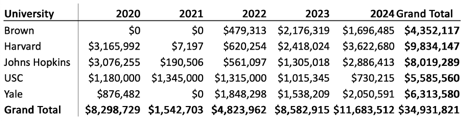
Source: ProPublica Nonprofit Explorer, 2026
The short list of health policy experts Arnold has funded is star-studded: Michael Chernew (Harvard University and current president of MedPac), David Cutler (also Harvard), Jamie Robinson (UC Berkeley), Paul Ginsberg and Glenn Melnick (USC), Larry Casalino (Cornell), Amy Finkelstein (MIT), Gerard Anderson and Ge Bai (Johns Hopkins), Roslyn Murray and Chris Whaley (Brown), and Zack Cooper (Yale). As one of these distinguished researchers told me when asked what Arnold was looking for: “If you want to wage war on the medical-industrial complex, Arnold is your man.”
A longer list includes dozens of younger, lesser-known health researchers who represent the next generation of health policy movers and shakers. Arnold’s reach is broad enough to exert widespread influence on the pool of peer reviewers of health policy articles for major journals such as JAMA, New England Journal of Medicine and Health issues. As a refugee from academia, I can tell you that hard work needs to be done to appoint leaders in health services research who have not been funded by Arnold.
In the spirit of vertical integration, Arnold has also generously funded an impressive array of healthcare foundations, nonprofit organizations, and media outlets that publicize Arnold-funded findings: Health Affairs, Kaiser Health News and Kaiser Family Foundation, Academy Health, ProPublica, Third Way, Rand Corporation, National Bureau of Economic Research, National Association of State Health Policy, Altarum Institute, Brookings Institution, Health Care Cost Institute, National Conference of State Legislatures, and Lown Institute.
These organizations are key parts of the Arnold political “ecosystem,” because they amplify and legitimize the writings of Arnold Ventures grantees and/or organize conferences where Arnold-funded experts gain access to the mainstream media. You almost have to have been hiding under a rock to avoid having Arnold Ventures-funded content rained down on you, often without attribution, in the well-orchestrated post-publication media coverage!
Referring to his early work on scientific integrity a decade ago, Arnold posted in X: “‘New study shows’… are the four most dangerous words.” However, on his own political agenda, Arnold seems well aware that “A new study of… The name of the elite university scholar goes here. . . .” It is an almost irresistible advertising magnet. By incorporating the brands of elite university researchers into his political agenda, he has followed the classic progressive playbook.
In Part II of this Report we take a closer look at how this process works.
Jeff Goldsmith is a veteran healthcare futurist, president of Health Futures Inc and a regular contributor to THCB. This comes from your personal substack


