



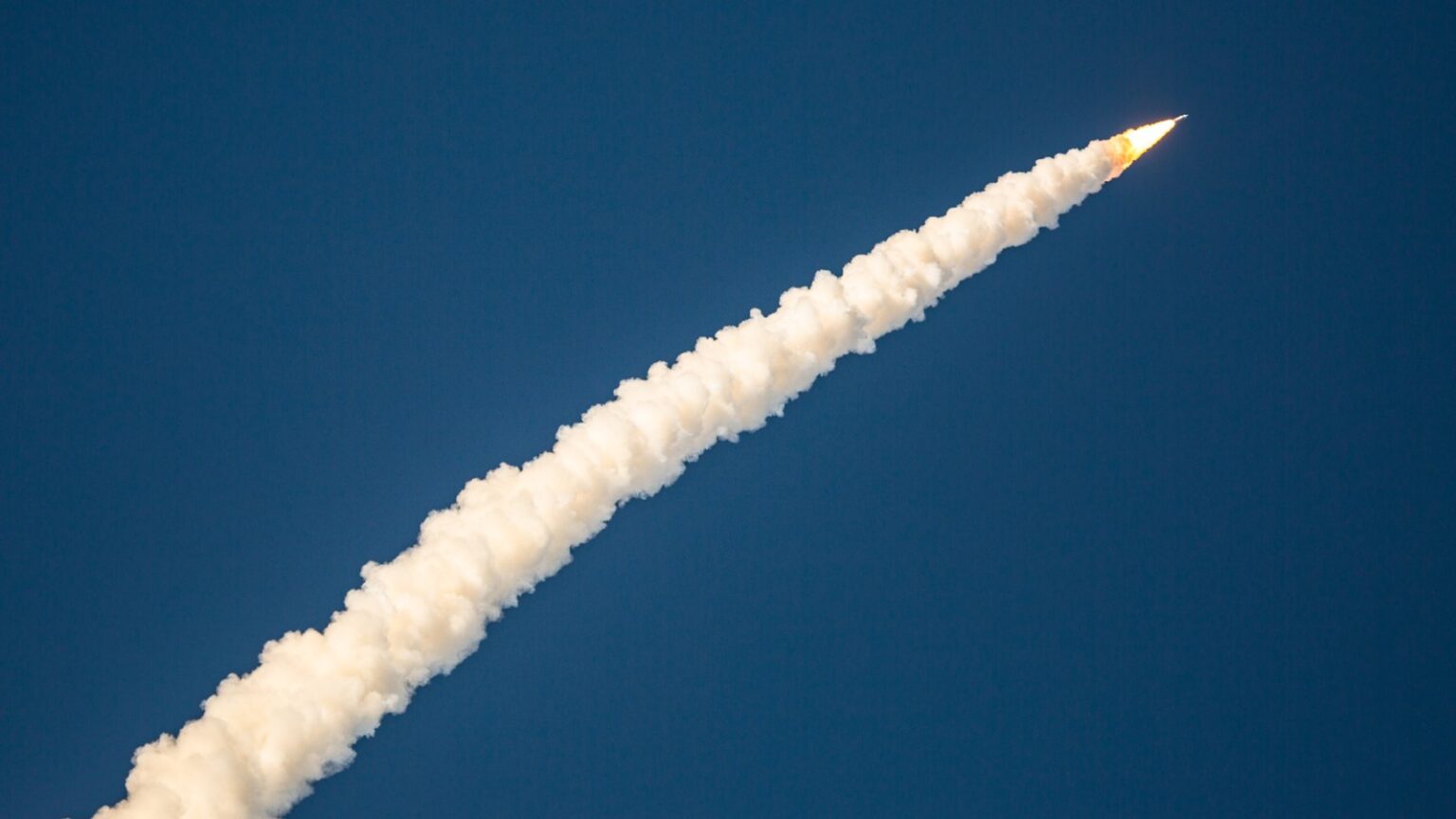

when he Artemis II The lunar mission launched Wednesday afternoon at 6:35 p.m. Eastern Time marked humanity’s first foray to the moon in more than 50 years.
“We’re going for our families,” said Victor Glover, the Californian who is the spacecraft’s pilot.
“We’re going for our teammates,” said Christina Koch, a mission specialist at Michigan.
“We are coming for all of humanity,” said Jeremy Hansen, the first Canadian astronaut aboard a lunar mission.
“Alright Charlie, your Artemis II crew is ready for launch. Shipment complete,” said Reid Wiseman, the mission commander, originally from Baltimore.
Two minutes later, NASA mission control monitored the mission’s twin solid-fuel boosters separating. Six minutes later, the rocket core finished burning and also separated. All aspects of space flight are dangerous; but this initial process of propelling Artemis II to escape velocity at speeds of up to 40,000 kilometers per hour is especially critical.
To put a spacecraft into orbit you need a multi-stage rocket, in this case the SLS super heavy launch vehicle. The SLS has been in development since 2011, but of course it is based on rocket propulsion and guidance technology that dates back to the dawn of the space age.
The American space program traces its origins to the Nazi V-2 rockets used to bomb London during World War II, and the history of rocket and missile technology used by NASA’s civilian spaceflight program has been intertwined with its military applications ever since.
At 9 p.m., Artemis II completed another critical stage in its journey to the moon: apogee, in which the vehicle rises to the highest point in its Earth orbit, positioning it to escape Earth’s gravity and begin its multi-day flight to the moon.
Almost at the same time – in the White House, here on our confused and bloody Earth – the president of the United States began to talk about the war he had started in Iran.
“Over the next two or three weeks, we will return them to the Stone Age, where they belong,” the president said. donald trump.
Just a few weeks before Artemis began to ascend towards the stars, another team of specialists would have been monitoring the launch of a similar rocket. They were sailors from a ship sailing somewhere near Iran, most likely aboard one of more than a dozen U.S. Navy Arleigh Burke-class destroyers deployed to the region.
That ship carried Tomahawk land attack cruise missiles.
As with the SLS launch sequence that began the Artemis II mission, the initial flight of the Tomahawks begins with solid-fuel rocket boosters that lift the vehicle into the sky.
At an altitude of about 1,500 feet, the Tomahawk separates from its booster, which falls into the sea, and there ends any similarity to civilian spaceflight.
The wings unfold and a telescope extends, channeling oxygen to an F107 turbofan engine that ignites and begins producing thrust. The missile launches toward Earth, dropping to an altitude of about 500 feet to avoid radar, before beginning its flight toward a waypoint that marks the true beginning of its journey. Once it reaches that point, the missile begins following a programmed course, cruising at speeds of up to 570 miles per hour (similar to a civilian aircraft) toward a predetermined target.
That target is selected not by the sailors executing the missile launch, but by teams of analysts far away at a Combined Air Operations Center, or CAOC, whose staff are busy putting together strike lists—that is, deciding what to blow up. The attack lists are sent to a Cruise Missile Support Activity, which uses them to create encrypted data files called target data packets. Some target data packets are personally delivered to a ship before departure, others are transmitted by satellite when the ship is underway.
When the decision is made to carry out an attack, the ship receives an order called an Indigo message, which tells it which target data packet to load onto which missile and where the ship must be for a specific period of time to begin firing its missiles.
On February 28, the first day of the war, an American ship received its Indigo message and entered the identified target’s data packet into its computer, launching Tomahawks at a military installation in a city called Minab, in southern Iran.
The facility was a sprawling complex of buildings used by the navy of the Islamic Revolutionary Guard Corps, the maritime branch of the paramilitary whose primary job is to protect the survival of the Iranian regime.
But not all the buildings were being used by the military.
One building had previously been part of the IRGCN complex, but had been converted into a school 10 years ago and, at some point, had been walled off separately.
The precise sequence of events is unclear and a formal investigation is underway. Firsthand accounts suggest that the school was attacked at least once, possibly twice, as were other buildings in the complex.
The attacks killed more than 170 people, most of them schoolchildren.
Video evidence shows that at least one of the attacks in the area at the time was almost certainly a Tomahawk, a weapon used exclusively by the United States in this conflict.
The CAOC that drew up the target list for the first day of the war in Iran would likely have been the Al Udeid air base in Qatar. They would have been using images and intelligence from many agencies. It’s possible that some of it was outdated.
By now, the personnel manning the CAOC at Al Udeid have likely dispersed, as the base has been attacked by long-range attack drones and Iranian ballistic missiles.
The Islamic Republic regime began building missiles like those it is launching against its Gulf State neighbors (and Israel) in the midst of the Iran-Iraq war in 1984. The ballistic missile program is based on reverse-engineered Scud-Bs provided by Libya. The Scud series of missiles were designed and built by the Soviet Union and, like early American ballistic missiles, were largely based on Nazi Germany’s V-2 rockets.
Lethal technologies developed in war never go away. They spread everywhere from one conflict to another; More and more refined and improving, they become better and better at killing.
America can kill like no one else. It invests billions and billions every year to ensure that no nation on Earth is better at carrying high explosives to distant lands, to cause death and destruction with fire and steel.
“Make America great again,” they say. This administration wants to spend $1.5 trillion on the military next year. Never in history has the United States been so good at causing destruction.
When man first landed on the Moon aboard Apollo 11 on July 20, 1969, it was the height of the Vietnam War. More than 549,000 American troops were on the ground, fighting in what Washington already knew was a disaster. About 33,000 Americans and their South Vietnamese allies would die in combat that year, despite the election of President Richard Nixon and his promise to begin peace talks with North Vietnam and achieve “peace with honor.”
The process of withdrawal and “Vietnamization” (a weasel word if there ever was one, as if the North and South Vietnamese were not already fighting and dying by the dozens) had begun. What it really meant was that the United States saw no path to victory and was walking away. It would take years to do it.
The Apollo program that had taken Neil Armstrong and subsequent astronauts to the moon ended before official US involvement in Vietnam did, on March 29, 1973.
Roughly half a century later, NASA has marshalled the wealth, knowledge and support of 61 nations to send humans back to the Moon. As we watch the Artemis II mission progress, one can’t help but think of the schizophrenia that marks our American psyche.
The same country that produces pioneers who will take “a giant leap for humanity” produces leaders who want to bomb their fellow human beings “back to the Stone Age.”
To men like these leaders, the Iranians under the bombs are not people. They are just objectives. The America they represent is small. It’s bad and ugly. It is a land of ignorance and xenophobia, of people mired in meanness and corruption, insensitive to the violence they sow and insensitive to the poverty and suffering they see around them. It is a land consumed by arrogance and hatred.
Sometimes war can be a necessity. The little men who lead us now never trusted the American people or their allies enough (and certainly never cared enough about innocent Iranian lives) to argue that this war is necessary.
It is the same point of origin (the same research, technology and investment) that takes us to the moon or to dead schoolchildren, murdered at our hands. The final decision about war or peace may be made by our leaders, but ultimately it is our responsibility, and it is our vision of the future that will define America as a country.
The Apollo 11 mission patch did not have any American flag on it. He had an eagle carrying an olive branch.
America can be great; We have seen his greatness. On Wednesday, that greatness was expressed in the noblest way, not by the American president, but by a Canadian astronaut:
“For all humanity.”


