



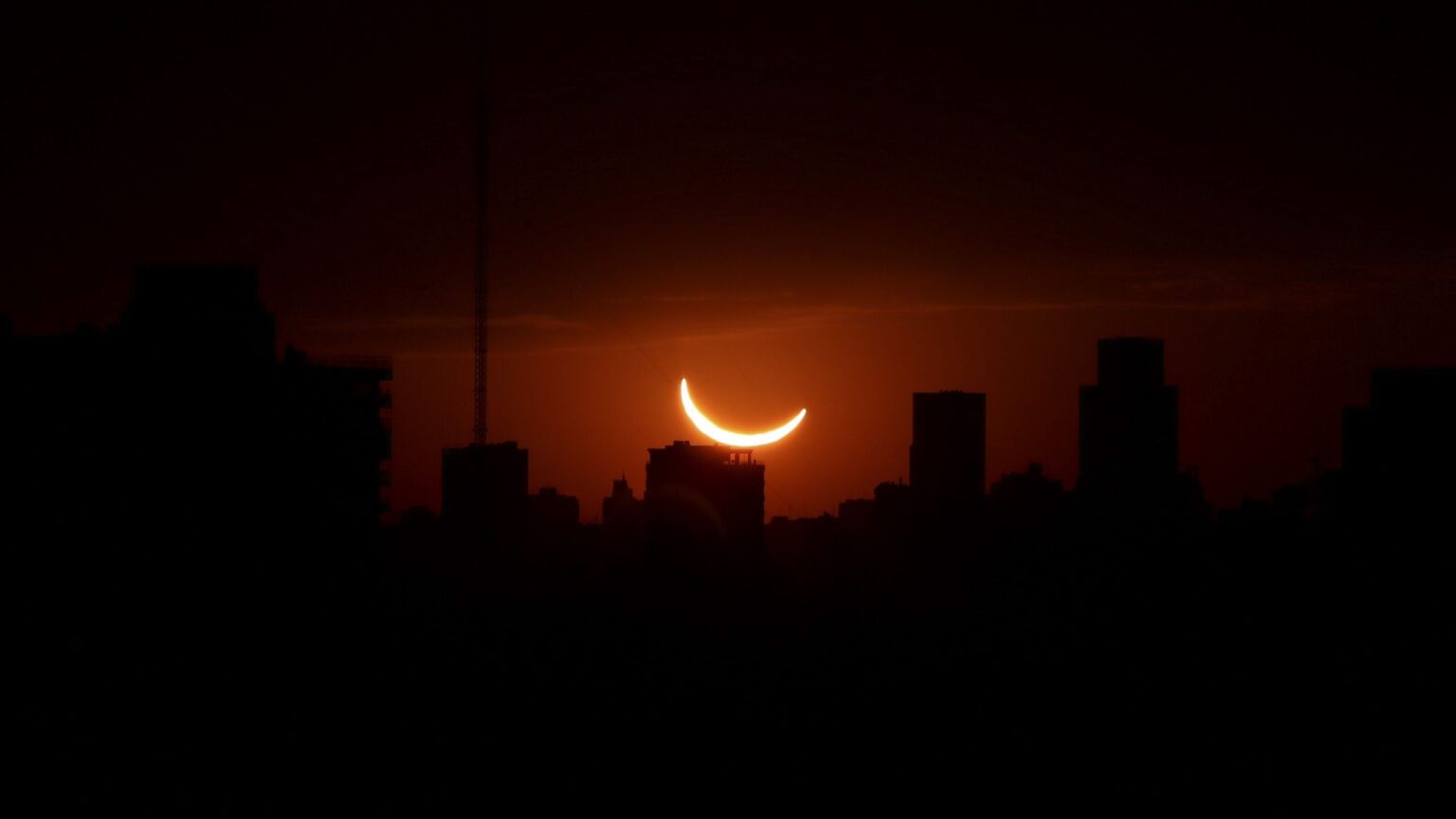

On August 12, 2026, a total solar eclipse will be visible in eastern Greenland, western Iceland and northern Spain. Eclipse chasers will flock to the trail, eager to witness a relatively brief but ultimately dramatic totality. From Spain, eclipse chasers on the east coast will witness the rare spectacle on land of a completely eclipsed sun just a couple of degrees above the western horizon, minutes from sunset.
Read more: Total solar eclipse of 2026: everything you need to know
how many eclipse Hunters (and those who can’t travel the path of totality) may miss the huge partial solar eclipse visible across Europe. In almost the entire continent, a large part of the sun will appear eclipsed. Even rarer, a partially eclipsed sunset will be visible in France, Belgium, Germany, Poland, Estonia, Latvia, Lithuania, Belarus, Russia, Finland, Ukraine, Slovakia, Austria, Croatia, Hungary, Romania, Serbia, Italy, Kosovo, North Macedonia and Albania. In northwest Africa, a similar vision awaits Morocco, Western Sahara, Mauritania, Algeria, Tunisia, Mali, Senegal, Gambia, Guinea-Bissau, Guinea, Sierra Leone, Liberia, Ivory Coast and Burkina Faso.
This promises to be a huge event that millions of people will be able to see in some form, but do many still know about it? Here’s what you need to know about how to watch a partial solar eclipse in Europe on August 12, 2026.
How to read an eclipse map
The black line on the map above shows where the maximum partial eclipse will occur at sunset. In Warsaw, Poland, for example, the sun will be eclipsed by 83% (the maximum there) as it sets. For locations just east of the black line, the sun sets before the partial eclipse ends. Just to the west, sunset occurs as the partial eclipse deepens.

So where should you be? For the best photos of deep partial eclipses at sunset, position yourself west of the black line. Being on the line or just to the east will also work. It is less strict than the path of totality. Still, being close to the line on the northwest side is ideal.
Just remember that despite focusing on the lines on a map, the spectacle itself (the partially eclipsed deep sunset) will take place on the horizon in the west-northwest.
“People who live along the black sunset line will experience a beautiful, deep partial eclipse at sunset,” eclipse cartographer Michael Zeiler told Space.com. “Some ideal places to see this over the water are Algiers, Corsica, the Italian coast along the Ligurian Sea and Venice, while locations in the High Alps in eastern Austria will also have a spectacular sunset – a photographer’s dream.”
However, there are some unexpected things to consider if you want to get the perfect view. “One interesting thing about this is that all eclipse maps calculate those lines for geometric sunset, which is when the center of the sun is at the true horizon, ignoring refraction,” Stephen Trainor in The photographer’s anniversarieshe told Space.com. “So what you tend to find is that the line isn’t actually the line because refraction raises the sun a little bit, so you can usually crawl a little bit on the ‘wrong’ side of the line and you’ll still be able to get the sun.”

The best places to see the eclipsed sunset in Europe
Below are some places in Europe where you can enjoy views of a partially eclipsed sunset. At selected sites, maximum darkening occurs 10 to 15 minutes before sunset. From Europe, the rising sun will turn “horns down”, a “sad face” (or an upside down “smiley face”).
- Village d’Occi, Corsica, France (96% at 20:25 CEST, 24% chance of clouds, according to Timeanddate.com)
- La Spezia, Ligurian Sea, Italy (94% at 20:22 CEST, 43% chance of clouds)
- Modena, Italy (92% at 20:21 CEST, 38% chance of cloud)
- Venice, Italy (91% at 20:19 CEST, 43% chance of clouds)
- Kitzsteinhorn, Austria (89% at 20:16 CEST, 68% chance of clouds)
- Olympiaberg, Munich, Germany (88% at 20:15 CEST, 61% chance of cloud)
- Letná Park, Prague, Czechia (86% at 20:11 CEST, 65% chance of clouds)
- Ostrów Tumski, Wrocław, Poland (84% at 20:09 CEST, 66% chance of clouds)
- Warsaw, Poland (83% at 20:02 CEST, 61% chance of cloud)
- Kaunas, Lithuania (81% at 8:56 pm EEST, 66% chance of cloud)
- Lilastes pludmale, Gulf of Riga, Latvia (80% at 8:57 pm EEST, 63% chance of clouds)
Best Places to See the Eclipsed Sunset in Africa
Below are some great places to be in northwest Africa, where you can enjoy views of a partially eclipsed sunset. Selected sites will experience maximum darkening no more than 30 minutes before sunset (the sunset line largely passes through the remote Sahara Desert). From Africa, the crescent will slide below the horizon in the shape of the letter “C.”
- Cape Matifou, Tamentfoust, Algeria (98.5% at 19:42 CET, 49% chance of clouds)
- Essaouira, Morocco (81% at 7:47 pm WEST, 15% chance of cloud)
- Dakar, Senegal (37% at 19:12 GMT, 82% chance of clouds)
- Banjul, Gambia (34% at 7:13 pm GMT, 80% chance of clouds)
The best places to see the eclipsed sunset in Spain
On August 12, mainland Spain will host a full trail for the first time since 1905. The trail, about 182 miles (293 km) wide, will barely pass through Barcelona and Madrid. Some eclipse chasers will focus on seeing a fully eclipsed sun a few degrees above the horizon (minutes after sunset) from the Balearic Islands (Mallorca, Ibiza, Menorca and Formentera). It will be spectacular if the horizon is clear. But what some may miss is this: In some areas, a partially eclipsed sunset will follow totality.
Watch the eclipse from Spain’s Meseta region, including Burgos and León, and you’ll see its totality, followed by a partial eclipse that ends minutes before sunset. In Soria, Sigüenza, Zaragoza, Teruel and further east, towards the coast, you will see a total and then partially eclipsed sunset. The further east you are, the more eclipsed the sun will be as it sinks below the horizon.
Are you planning a trip to see the eclipsed sunset?
A low, unobstructed western horizon is essential. So are clear skies because even distant clouds can block the view of the sunset. For the horizon, try this tip: Look for “sunset spots nearby” [location] in August” to find recommendations from locals and tourists. However, as Trainor says, “go out and explore the location two or three nights beforehand so you can develop an alternative if it’s not going to work on the ground.” He also advises using his precision planning tool, which helps photographers visualize the sun, moon and natural light, and a “sanity check” on Google Street View, just to prove that taking a photo is possible.
Related: Spain’s 2026 total solar eclipse has a downside: here’s how to avoid ruining your view
For weather, patience is required: all you can do is check the forecasts three days before August 12, when the predictions become quite reliable. However, predicting low clouds along the horizon is difficult. You will need clear weather for many hundreds of miles west-northwest.


