



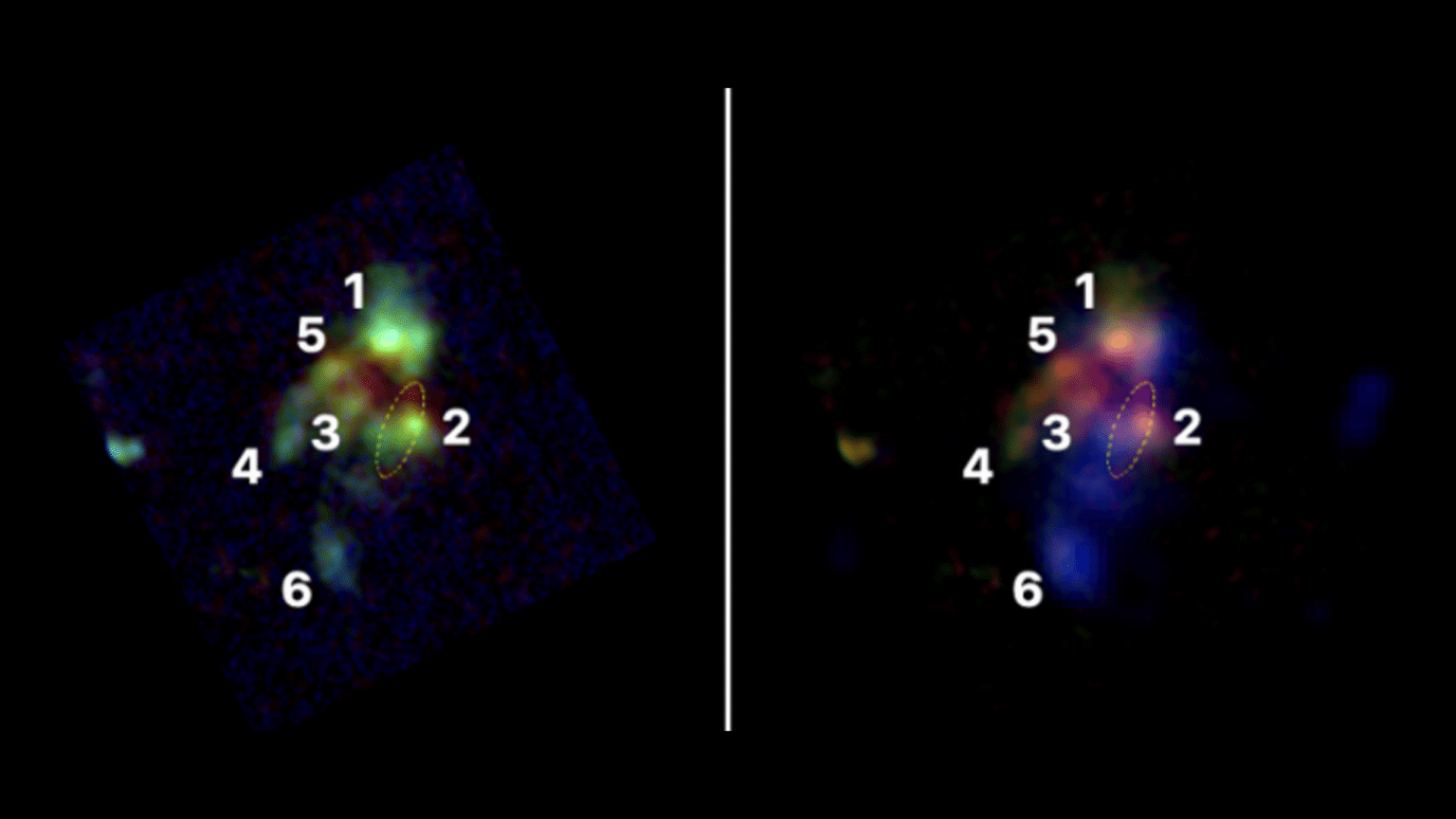

The James Webb Space Telescope has discovered an intense demolition derby in which at least six galaxies collide with each other in the early universe. This merger is also expected to fuel the growth of a supermassive black hole and trigger the formation of what will eventually become one of the most massive galaxies in the cosmos.
“What makes this special is that we can follow both the construction of a giant galaxy and the growth of black hole at its center,” said Huub Röttgering, an astronomer at the Leiden Observatory in the Netherlands, in a statement.
The discovery came after a tip from radio astronomers who had noticed emissions that appeared to come from an undiscovered active black hole. When the James Webb Space Telescope (JWST) looked closer, it found a surprise.
“We did not find a single galaxy, but an entire complex of at least six galaxies,” said Aayush Saxena of the University of Oxford.
These six galaxies are located in one redshift of 4.0, which is equivalent to a time of about 12 billion years ago, only 1.8 billion years after the big explosion.
Through the vision of JWSTWith the near-infrared camera, the six galaxies appear blurred, reminiscent of a distant version of Stephan Quintetwhich is a collection of five galaxies, four of which form a compact group that is on its way to merging to become a giant elliptical galaxy.
Similarly, the six galaxies detected by JWST, and collectively named TGSSJ1530+1049, will undergo a series of rapid mergers to become what is known as a “brighter cluster galaxy,” which is a huge elliptical galaxy of the type found in the center of galaxy clusters.
“We call structures like these protoclusters – the precursors to the vast collections of galaxies we see today,” said Roderik Overzier from Leiden. “These are places where matter came together very early. We think we are seeing a rare moment in which several massive galaxies still exist separately, but are already in the process of forming a much larger galaxy.”
Already a supermassive black hole has formed at the heart of this galactic maelstrom, and radio observations with the European VLBI (Very Long Baseline Interferometer) network and the UK’s e-MERLIN (Enhanced Multi-Element Remotely Linked Interferometer Network) at resolution on the scale of 100 milliarcseconds have identified radio lobes and hot spots typical of the jet of an active black hole interacting with the surrounding gas.
“Using a network of connected radio telescopes, we were able to produce a very sharp image of TGSSJ1530+1049,” said Krisztina Gabányi of Eötvös Loránd University in Budapest, Hungary. “Radio emission occurs when material falls into the black hole, while a part of it is ejected again at high speed.”
The jet does not appear to extend to all the galaxies in TGSSJ1530+1049 yet, implying that the black hole is still quite young.
The six galaxies in TGSSJ1530+1049 span a volume of only a few tens of thousands of light years wide, which is narrower than our Milky Way galaxy and yet contain an enormous number of stars, equivalent to hundreds of billions of stars. solar masses and a star formation rate of between 70 and 163 solar masses per year. This is a frenetic pace compared to the Milky Way, which produces much less than ten solar masses per year.
TGSSJ1530+1049 is one of the densest collections of heavy galaxies yet found in the early universe, and is providing interesting clues about how the universe’s most massive galaxies, clusters, and black holes formed.
JWST observations are reported in The open journal of astrophysicswhile the radius measurements are described in an article in Astronomy and Astrophysics.


