






Anti-bullying and social-emotional learning have not reduced school violence. Minimizing public attention on the shooters could do that.

(Jeff Swensen/Getty Images)
Scientists rarely announce that one of their oldest ideas has failed.
But that’s exactly what Ron Avi Astor, one of the nation’s leading scholars of school violence and a professor at the University of California, Los Angeles, told his fellow researchers at the April annual meeting of the American Educational Research Association (AERA).
“We were wrong,” Astor told the audience.
For decades, Astor believed that improving school climate and reducing bullying would help prevent school shootings. Advised national policy makers and issued recommendations. Schools responded by investing heavily in social-emotional learning, restorative justice, trauma-informed care, counseling, and other efforts to make schools safer and more welcoming.
Those initiatives have benefited students in many ways. Fewer students report bringing guns or knives to school, and schools have generally become safer.
But school shootings have not decreased.
“I’ve had a complete change” in my thinking, Astor told me in an interview after the conference.
That change came after he stepped back and looked at the evidence. During his presentation at AERA, Astor showed a slide with two clear graphs. One of them tracked a steady decline in the number of students bringing guns to California schools over the quarter century since the Columbine High School massacre in Colorado. The other graph showed a sharp increase in school shootings across the country.
Divergent trends
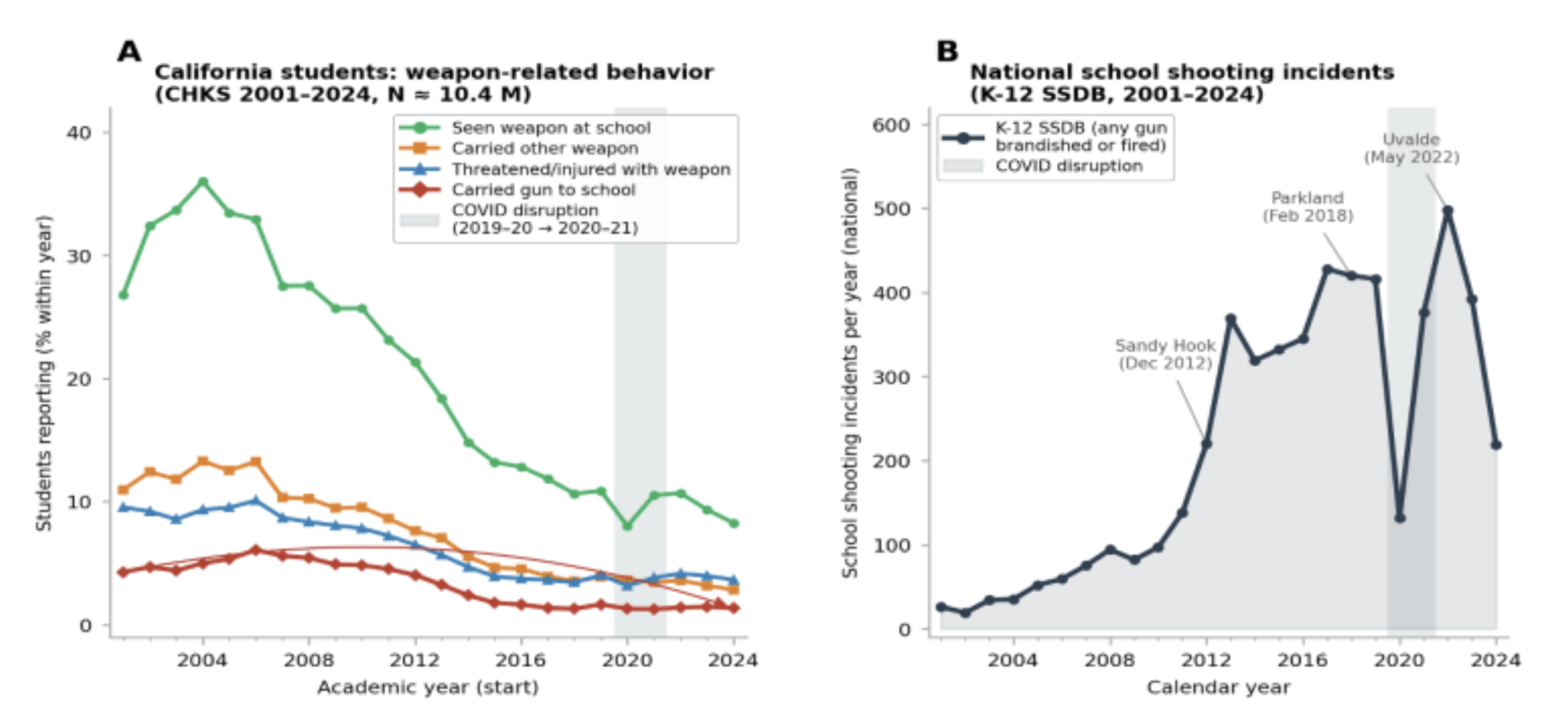
Source: A slide from Ron Avi Astor’s presentation during a AERA Session on April 11, 2026, “School Active Shooter Drills: Mitigating Mental, Emotional, and Behavioral Health Risks: Report from the National Academies of Sciences, Engineering, and Medicine.”
The graphics capture a painful realization. Astor says he and other researchers had misunderstood what was driving many school shootings.
Astor noted that many school shooters had been bullied, were bullies themselves, or had experienced trauma, and believed that shootings would decrease if educators reduced bullying and strengthened relationships between students at the local level, one school building at a time. “We were adamant,” Astor said. “Let’s focus on prevention.”
“I think what was overlooked was that every shooter wanted to make sure this was national,” Astor said. “His number one audience was the media. That’s very clear to me now.”
Astor now believes that many perpetrators are motivated by a desire for notoriety. Shooters study previous massacres, learn from online communities and seek the publicity that follows a mass attack.
“Most of them are suicidal and decided to be homicidal to be remembered,” Astor said.
That new way of thinking has led to a very different recommendation. Instead of focusing on prevention within schools, Astor believes journalists and social media companies should adopt guidelines that reduce attention to perpetrators, delay the release of manifestos and videos, and focus more coverage on victims.
“I’m not saying we don’t do social-emotional or anti-gun efforts,” Astor said. “Those things are important. But if we want to see a reduction in school shootings, we need to work with the media.”
Astor compares school shootings to suicidal infections or waves of terrorism, where widespread publicity can inspire imitators. He acknowledges that persuading social media companies or the dark web to change is a long shot, and he cannot prove that change will work to reduce school shootings. “But it’s worth a try,” he said.
What makes Astor’s argument noteworthy is not simply his new hypothesis. It’s your willingness to publicly abandon an old one after concluding that the evidence no longer supports it. It’s never easy to change course, but Astor’s opening could save lives.
This story about prevent school shootings was produced by The Hechinger Reportan independent, nonprofit news organization covering education. Enroll in Test points and others Hechinger Newsletters.


