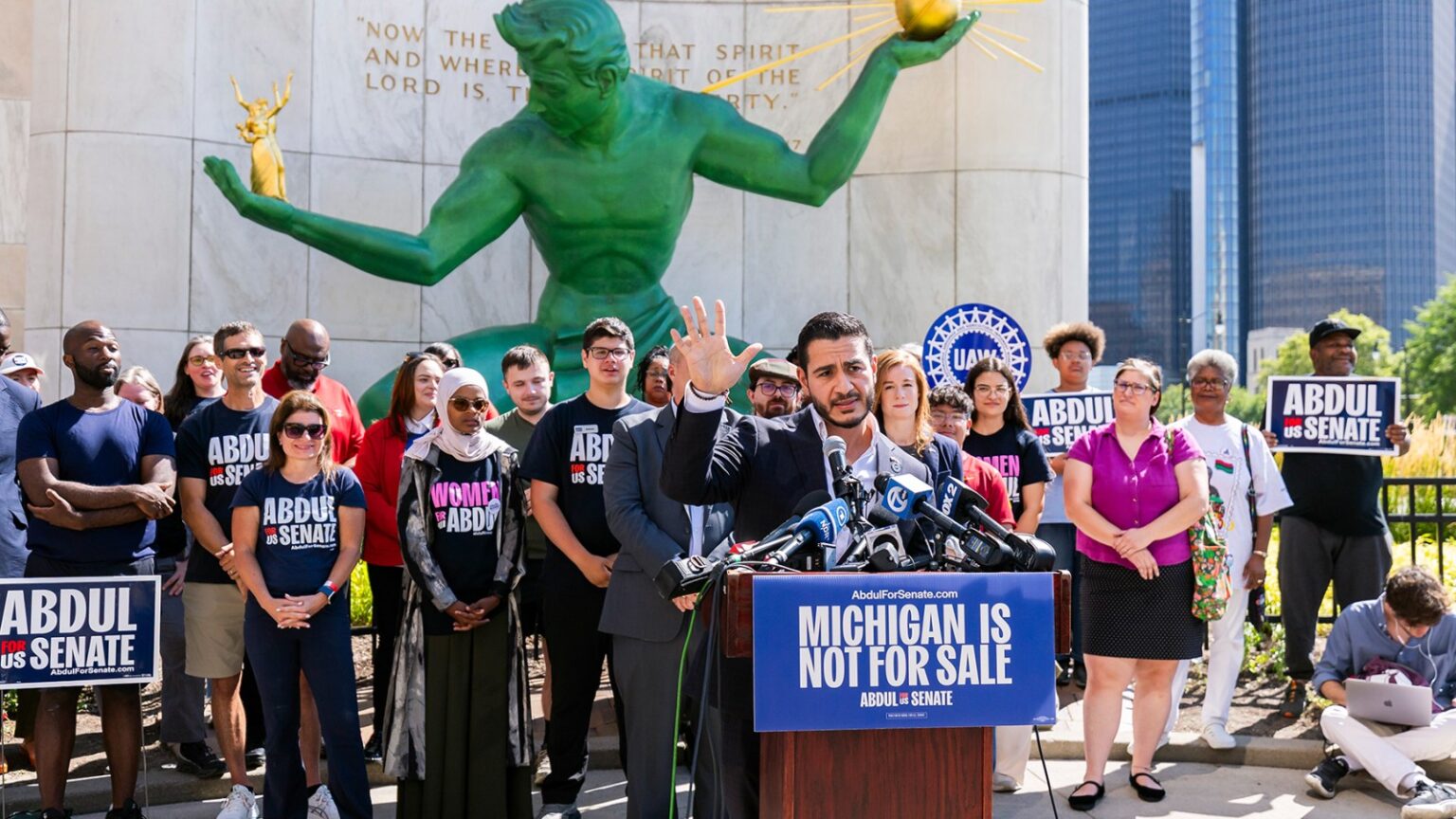

T
here are many ways to tell the story of how Dr. Abdul El-Sayed defeated Rep. Haley Stevens in the Michigan Democratic primary for Senate. We could start with AIPAC, Stevens’ viral stick-it-to-’em video, or an electorate frustrated out of their minds about the Democratic Party’s endless obsession with the mushy middle.
But let’s go somewhere else.
It’s a week before Election Day. The summer wind moves silently through the Michigan corn outside of Saline, about 20 miles southwest of Ann Arbor. A farmhouse is selling eggs on the honor system. Another one flies banners for America’s 250th. I am in the Platonic ideal of bucolic America, the one seen in a thousand Republican ads and squawked about by right-wing pundits dreamily — and not so dreamily — wishing we could return to this version of the USA.
I eventually turn onto dusty Braun Road and hit a dead end after a mile. The cornfields are gone. Construction noise echoes through the fields. Behind a fence, 575 acres of blight — roughly the size of Princeton University — is rising out of the earth. Contractors in hard hats look at plans. Multiple cement trucks pass each other, their spinning drums painted red, white, and blue.
This is The Barn — an Orwellian euphemism if there ever was one — where Oracle is constructing a massive data center for its OpenAI empire. It is being built against the wishes of the locals — both citizens and the town board, which voted against the building plan. Oracle essentially said fuck off and sued the board into capitulating. A groundbreaking ceremony occurred on June 1 and was attended by Michigan Gov. Gretchen Whitmer and OpenAI CEO Sam Altman.
“This could very well turn into the site where cancer gets cured,” said Altman, pushing his self-serving myth that “as AI goes, so goes the nation.” Notably, Altman did not say, “This could very well turn into the site where OpenAI finally turns a profit.”
I am waiting here a week before the primary for Dr. Abdul El-Sayed. But let’s go back 24 hours before that.
Rep. Haley Stevens, his opponent, is speaking at the Lansing Chamber of Commerce. Stevens has been criticized by El-Sayed, sometimes brutally, claiming she has an inability to string two sentences together. I didn’t find this to be the case. She is just a Michigan chatterbox — something I know a little about from going to high school in the state. Someone tells her I write for Rolling Stone and she insists on taking a photo to send to her dad. (I feel special until learning she has previously done this with another general interest magazine writer.) We share an elevator going up to a conference room and a late arrival is hit by the closing door.
“Geez, sometimes elevator doors are too vigorous,” says Haley to no one in particular. We reach our floor and she turns to me and asks, “Did you know there is an elevator union?”
I did not.
Stevens speaks and takes questions ping-ponging between her first Oldsmobile, a love of manufacturing, and — somewhat out of nowhere — the thought that “we are in a real Seneca Falls moment,” citing the 1848 meeting that began the women’s suffrage movement. It was an odd metaphor from perhaps Congress’ quintessential incrementalist.
Afterward, she takes questions from reporters. Detroit News political reporter Craig Mauger asks if she supports the Saline data center. Stevens pauses for a moment.
“What is the status of that?”
Mauger informs her that it is, uh, under construction. (We are six weeks out from the Whitmer/Altman groundbreaking.) She dodges with some mush about how the data center building process needs to be more transparent and is ready for a different subject. Perhaps not coincidentally, Whitmer recently endorsed her. Mauger has a follow-up, but Stevens moves on to a question about her LinkedIn profile before an aide ends the conversation.
Standing at the gates of The Barn the next afternoon, I suddenly become convinced Stevens is going to lose. There are 20 to 30 residents and their children sweating in the afternoon sun, waiting as I am for El-Sayed to arrive. Over the years, I’ve been to dozens of rallies like this where the mood is defiant, but all I find here is despair.
“We did things the right way,” says Naomi Ernest, a local artist and activist. “No one wanted this. They just did what they wanted and ignored us.” She wears sunglasses, but I can tell from her voice that she is on the verge of tears.
She isn’t the only one. Sarah Brabbs, a lanky local resident, lists all the potential downsides about living near a data center, from the endless white noise to initial studies that suggest the endless throbbing and energy suck has a damaging impact on farm animals and crops (not to mention the potential environmental disaster). The project is requesting that treated industrial water be allowed to be released into the nearby Saline River.
“This is a new type of monstrosity for Michigan,” says Brabb. “It’s a new type of monstrosity wherever it begins in whatever state, and you have local people who didn’t ask to be experts that literally have to become a pretend expert overnight.”
Eventually Abdul El-Sayed speaks. He wears a white shirt and on his wrist are a series of beady bracelets, one reads best dad and is from his daughters and another proclaims “Servant Leader,” an Arabic translation of his last name. El-Sayed is the first to admit that he is not tall but conveys a muscular energy — so muscular he allowed The New York Times to watch him lift weights — that sometimes borders on bro overload. Today, he’s in a white dress shirt, not his usual form-fitting black T-shirt.
He gives a quick lesson in how AI stocks now dominate the American economy and set up a potential “too big to fail” moment where the need for expansion and revenue supersede the desire of actual people. El-Sayed argues for federal legislation to place a moratorium on the building of data centers until there are laws in place protecting the rights of communities. He suggests already approved sites like The Barn — which Whitmer has proclaimed will bring thousands of construction jobs to the area — can be shut down if they do not meet environmental and safety standards.
A reporter notes that some Democratic politicians, both here and in Washington, are pro-data center and asks what he would tell them if he is elected.
“Talk to your people,” says El-Sayed with a smirk. “I mean, you might be a proponent. Have you talked to the people in your community? Are they proponents? I have got to tell you, there’s not an event that I’ve done where I haven’t gotten a question about a data center. It is never a positive one. … You’ve got to represent the public, and it’s exactly this problem where too often representatives don’t represent the public; they represent the people who pay for their campaigns, and that’s exactly why we’ve got to get money out of politics.”
Then, El-Sayed shakes some hands and heads to an SUV waiting to take him to the next campaign site.
“Too often representatives don’t represent the public; they represent the people who pay for their campaigns, and that’s exactly why we’ve got to get money out of politics.”
Can El-Sayed stop the data center invasion if elected to the Senate in November? Probably not, just like his Medicare for All demand is more a dream than a realistic political goal.
But then I look at Ernest and Brabb’s faces. Despair has, perhaps momentarily, turned to hope. In 2026, that ain’t nothing.
CAMPAIGNS OFTEN reduce states into one-dimensional characters, filled with the equivalent of background actors in the latest Spider-Man movie.
Here’s the thing: Actual people live here, not just voter targets on a canvassing list. I moved to the Flint suburbs in 1980 as a boy and Michigan has been in various stages of decay ever since. Since 2000, the state’s population growth has been stuck at 10 million while the rest of America has grown by 20 percent. The reasons are many. The auto industry shipped jobs overseas and zero population growth left the state with an aging infrastructure with not enough revenue to maintain hospitals and schools. Gretchen Whitmer ran for governor in 2018 under the slogan “Fix the Damn Roads.” The aching undercarriage of my rental car regrets to inform you that the roads are still broken.
A Michigan friend suggests I reach out to Saeed Khan, a Wayne State professor of Mideast studies and host of a popular Detroit political podcast. He returned my call promptly and told me that we had met before: My Flint Powers Catholic quiz bowl team had beaten Khan’s Lapeer West team in a match watched by dozens on Flint’s public television station. We reminisced about parallel childhoods. I had moved to Flushing, outside Flint, after my navy pilot dad was killed in the Indian Ocean while flying a training mission predicated by the Iranian hostage crisis. Khan moved to Lapeer the same year after a childhood in London and House and was called “Ayatollah” by his schoolmates despite being Pakistani American.
We talked of going to our hometowns and seeing once-vibrant commercial neighborhoods deserted except for the ubiquitous dollar store. Every year, Khan asks his Wayne State students how many plan on leaving Michigan, and the number is now near 40 percent.
“It used to be that they would leave for a few years and then come back to raise families,” says Khan. “Now they are just leaving and not coming back.”
It should be noted that Abdul El-Sayed was born and raised in suburban Detroit and went to the University of Michigan. His children were born here. He had made his life here.
That matters to Michiganders, not so much to the parachuting-in pundits. One of the thumb-sucking themes that emerge in these bellwether races is the electability concept. Can the insurgent candidate really win the general election in a swing state? It is a question that was thrown at Abdul El-Sayed constantly in his ultimately victorious campaign against Stevens as he tries to become the first Muslim-American elected to the Senate. And it’s one he will face 24/7 in his fall campaign against GOP nominee Mike Rogers.
Other politicians worry that El-Sayed is too “hot” for Michigan, and has too much anger for the state. (They swear it has nothing to do with the fact he is Muslim and Arab American.) I had a conversation with a well-connected Michigan political figure early in the week before the primary. He was not sold on an El-Sayed victory.
“I’d approach folks at Kroger and get in their face if I thought that worked, but people are not like that here,” the politico told me. “People just want to raise their kids and go up north and enjoy their life. Maybe that’s a fault, but people here just don’t like anger in their politics.”
He is not wrong and while El-Sayed repeatedly emphasizes he isn’t a member of the Democratic Socialists of America — “I’m not a socialist, I’m just a capitalist who understands how capitalism works” — his affinity for their positions will be featured in thousands of negative political ads.
And yet. What if a botched 2024 presidential bid, an unwanted war, Gaza, and the white noise of the undesired data center changed things? Maybe Michigan Democrats are past their boiling point and just wanted to blow things up? It’s that or finally giving up on the state and retreating to a nonunion job and renting a tract home outside Atlanta.
The condescension comes when critics suggest his supporters don’t know the risks involved by backing his campaign. No, the risks are all around them. Before I started following the two candidates, I made a trip out to Milford, Michigan, where President Donald Trump was speaking at a quasi-governmental rally at the General Motors Proving Grounds. Trump called up several Republican candidates, including Rogers, all who suggested, apropos of nothing, that Trump had been cheated in Michigan during the 2020 election despite years of reporting that this is just a Trump-promoted lie. A few miles away, I stopped at a Milford-area gas station where Trump swag was being sold out of a repurposed food truck.
“We have to stop Abdul,” says the woman proprietor in a “Trump vs. Everyone” T-shirt. She then names two Michigan cities with large Arab American communities. “We’ve already lost Dearborn and Hamtramck. If he wins, we’re gonna lose the whole state.” A few feet away, a young man named Dylan is negotiating for a discount on a volume purchase. He mentions the Egyptian American El-Sayed’s heritage. “There’s no way he’s a citizen, Trump needs to deport his ass.”
To suggest Michigan Democrats do not understand what El-Sayed is up against in November is suggesting they live on Pluto not in Traverse City.

The Barn, a $16 billion Oracle and OpenAI data center, in Saline, Michigan
Jim West/UCG/Universal Images Group/Getty Images
EL-SAYED WAS already fed up when I first talked with him in June 2020.
I was writing about how Covid-19 was impacting Michigan’s working class, and his background as an epidemiologist and the former executive director of the City of Detroit’s Health Department made him a great source.
What I didn’t know was he had a flair for the dramatic. He suggested we meet at the Herman Kiefer Hospital in Detroit, a decrepit, giant, and ornate building that served as Detroit’s main public hospital until it closed in 2013.
El-Sayed brought a copy of his book, Healing Politics: A Doctor’s Journey into the Heart of Our Political Epidemic, which had been published that March and somewhat lost amid the Covid crisis. We talked in a hallway outside of rat-infested offices and abandoned filing cabinets.
“The framework that epidemiologists use to think about a pandemic is three things: agents, host, and environment,” El-Sayed told me. “In Detroit, it is the story of how an environment beats up the host over a long period of time to make them vulnerable.” He offered a painful smile. “They say that when America gets a cold, Black America gets the flu. And that’s when Detroit gets pneumonia.”
El-Sayed ran for governor in 2018 on many of the same issues being stressed in his 2026 senatorial campaign. Whitmer smoked him by 22 points that time. In 2020, El-Sayed supported Bernie Sanders for president, but vowed he would work for Joe Biden’s election. But he said that wasn’t a given for others.
“Votes have to be earned,” said El-Sayed. “There has to be a message sent of how we are going to make the future better, how it is going to be different.”
Spoiler alert, things were not different. In the years that followed, El-Sayed hosted a health podcast, erased nearly $60 million in medical debt as Wayne County health director, and became one of the leading voices behind Michigan’s “uncommitted” movement protesting U.S. support for Israel’s war in Gaza in the Michigan Democratic primary for president in 2024. (He endorsed Kamala Harris’ ascension to the top of the Democratic ticket within 24 hours of her announcement.)
I asked El-Sayed after a rally in Canton last week what has changed in the eight years since he ran for governor and what he has learned.
“Don’t be 32 and never have run for office before,” he says with a laugh. “When I first ran, I was 32, living in my in-laws’ basement. This time, I’m 41 with two kids and a mortgage.”
The American financing of Israel’s war in Gaza was the fire that provided the El-Sayed campaign the heat it needed. For decades, the backing of the American Israel Public Affairs Committee was a stamp of approval for any liberal campaign. (Decades ago, I worked on the campaign of an insurgent candidate trying to unseat a clearly antisemitic congressman. It was AIPAC money, some bundled by a now nationally known politician, that kept the lights on.) But that was then. Now, AIPAC has morphed from a good government pro-Israel organization to one that demands complete loyalty to any and all of Israel’s military campaigns.
Stevens is happy to oblige. In 2023, she proclaimed at a ceremony in Detroit lighting the menorah for the first night of Hanukkah that “I see Israel in my dreams.”
This might not be a metaphor. In 2022, AIPAC spent millions helping Stevens defeat fellow Democratic incumbent Andy Levin, the president of his synagogue. (Stevens thanked AIPAC that night in a cringey video.) Four years later Levin was campaigning for El-Sayed. I asked him what had changed. He gave a succinct answer: “Gaza.”
El-Sayed recognized something Stevens didn’t. Previous generations of Democrats treated AIPAC’s support as a credential. He treated it as Stevens’ millstone. El-Sayed’s campaign slogan is “money out of politics, money in your pockets, Medicare for All.” AIPAC’s decision to spend at least $30 million against him suggested he wasn’t bullshitting. Most campaigns ignore AIPAC intervention, but El-Sayed leaned in, comparing himself to David battling Goliath.
The appropriation of an Old Testament icon by a Muslim-American candidate calling Israel genocidal murderers undoubtedly chapped AIPAC’s ass. This wasn’t by accident. El-Sayed’s style is in-your-face defiance. It serves him well when he is attacking AIPAC or AI interests, less so when he makes it personal. El-Sayed snarked that he hoped all the AIPAC money could teach Stevens “how to string two sentences together.” That opening allowed AIPAC to stitch together an ad suggesting El-Sayed was misogynistic. The ad was flimsy, citing mild criticism of Michelle Obama’s anti-obesity campaign and a legit attack on Whitmer for taking money from corporate interests.
El-Sayed’s supporters, mostly young and college-educated, didn’t help, mercilessly booing Stevens at the Michigan Democratic Endorsement Convention in Detroit in April. He responded by asking his followers to not be unkind. Personally, he toned down as the primary approached. “You notice I never mention my opponent, I talk about my ideas,” El-Sayed told me last week. Then the nasty side resurfaced. On a podcast, El-Sayed said AIPAC had chosen “the least capable candidate in America.” Stevens fired back: “Everyone in America understands you want to blame all of your problems on Jewish Americans.”
It left a mark. A childhood Michigan friend told me she was leaning toward Stevens.
“She’s not ideal by any means but as a female I’m sick of the patriarchy and if he even smells like he’s dismissive of women I have a problem with it. I agree with his platform on Israel and healthcare — I just wish he wasn’t another bro.”
To me, El-Sayed comes off in his worst moments not as misogynistic but as an equal opportunity jackwagon. During El-Sayed’s 2018 gubernatorial campaign, Saeed Khan was asked by a member of the Michigan Muslim community to meet with the candidate. They talked for 90 minutes, and it did not go well. Khan remembers him going after another potential candidate with an unwarranted level of vitriol.
“I guess immaturity is wasted on the youth,” Khan tells me. “He was very strident, patronizing, and in full campaign mode, just in a regular conversation.”
I asked El-Sayed last weekend if he fears that his message might get lost in his verbal body slams of his opponents. We met at Otono in Grand Rapids, a progressive vintage store and coffee shop that was lovely, but also gave off a certain Portlandia vibe, with a matcha drink named after El-Sayed on the menu. (A better lefty cliché is El-Sayed’s Detroit campaign office is sandwiched between a comic book shop and a storefront advertising abortion pills by mail.)
El-Sayed pointed out that the podcast where he called Stevens “least capable” had been recorded a month ago but did not offer an apology.
I’m a big boy. I’ve been around, and I understand that not all is taken in the intent that it’s meant, and what you say will be taken out of context to imply the worst about your intentions,” said El-Sayed, his wife Sarah, a psychiatrist and physician, sitting a table away.
“More of my frustrations are just about the cynicism of this campaign. There is no doubt in anybody’s mind that this has been the most cynical campaign for the U.S. Senate we have ever seen. Seventy million dollars of outside spending is insane money. I do think that the big question all of us should be asking is should this be how politics is transactioned?”
El-Sayed is not wrong, but I struggled to understand what part of his remark about Stevens being “the least capable candidate in America” had been taken out of context. He tightropes a fine line, between righteous anger and a childlike glee at poking the establishment in the eye just because he can. The most public example was his decision to campaign with progressive content creator Hasan Piker earlier in the year. That pissed off Stevens and AIPAC, who consider Piker radioactive for what they see as criticism of Israel based in antisemitism. El-Sayed’s alliance with Piker, who recently declared his love for Mao, will undoubtedly pop up in a 30-second negative ad this fall. El-Sayed clearly is in DGAF mode. The question is whether 50 percent of Michigan voters in the fall are in the same place.
He tightropes a fine line, between righteous anger and a childlike glee at poking the establishment in the eye just because he can.
EL-SAYED’S PARENTS immigrated from Egypt to Detroit a few years before he was born in 1984, his father attending engineering school at Wayne State University. His parents split up shortly after his birth and he was mainly raised by his dad and his stepmother, a white woman who was a member of the Daughters of the American Revolution. His childhood was on both sides of the American kaleidoscope. He’d spend months in Alexandria, Egypt, with his father’s family. One summer in Alexandria, his father wired him money so he could buy some new Nikes. His uncle saw the price and gasped: that was more than he made in a month.
“I would go from my one grandmother, who was illiterate, never who never got to go to school, raise six kids of eight to whom she gave birth,” says El-Sayed. She would cook over in effect a Bunsen burner in this tiny little room of a kitchen. He smiles at the memory. “And then I’d come back and I’d spend like the last two weeks of the summer in a cottage on a lake that my family has had for generations.”
I ask him if negotiating two worlds ever left him lost or conflicted.
“That implies there’s a conflict. The things my Egyptian cousins wanted were the same things that my cousins in America wanted.”
After the Saline appearance, El-Sayed travels to Ypsilanti, a hardscrabble college town. It is the last day of July, and he speaks in the basement of the Michigan Firehouse Museum. The room reverberates with the babble of echoing conversations and the scream of a crabby toddler. That ends when El-Sayed speaks with notes about the country’s 250th birthday. He begins with a joke about Trump during the 250th into a tacky carnival but he has more important things on his mind.
El-Sayed acknowledges America’s “moral errors” — the dispossession of Native Americans, slavery, and the long struggle to expand the definition of who could fully belong — before pivoting to something unexpected. He argues that true patriotism means correcting the country’s failures rather than pretending they never existed.
“We have an opportunity to do what the patriots of this country … have been doing for 250 years, looking at her mistakes and doing the painstaking work to organize to correct things.”
He pauses and smiles.
“What a glorious opportunity!”
People in the crowd cry and clap, hugging each other and then reach out toward El-Sayed as if his mere touch might pay their bills, make their schools better, or bring their child home from the Middle East.
Later in Grand Rapids I ask El-Sayed what he wanted someone to take away from that speech.
“Trying to paper over either the history or the president is not patriotism,” he says. “It’s not love. It’s this false sense of pride, or even hubris. Hubris is not patriotism. Love and investment is patriotism. I take it very personally when people say, ‘Oh, you don’t love Americans.’ Like you have no idea what it means to love America. They have no concept of my love.”
THE YPSILANTI SPEECH is one of the few El-Sayed’s events I attend where the audience is equally Black and white. It’s been a struggle for him to make headway with Michigan African Americans, as many still remain loyal to the establishment wing of the Democratic Party.
This loyalty is never more evident than last Wednesday afternoon, when Stevens visits Detroit Councilwoman Mary Waters’ 5th Annual Senior Summer Sizzler at Detroit’s Eastern Market. There are easily a thousand African American seniors there, a few nattily dressed in regatta gear, others in long gowns.
One older man in a white suit and captain’s cap tells me, “If Barack Obama is with Haley, so am I,” mentioning the AIPAC-sponsored ad running a clip of Obama saying nice things about Stevens, but not endorsing her. Stevens arrives a few minutes later, says hello to a Michael Jackson impersonator, and hugs some grannies. She seems more at ease than at any other time on the campaign trail.
The Stevens campaign heralds the endorsement of legendary South Carolina congressman Jim Clyburn. They also put me in touch with Keith Williams, chairman of the Michigan Democratic Party Black Caucus. Williams told me before the primary that El-Sayed’s friends did not help him with Blacks in Detroit.
He spat out “Bernie Sanders” and “AOC” as if he had bitten into a rotten peanut.
“They haven’t done anything here in Detroit.”
He then told me a story about approaching Sanders at the 2024 Democratic Convention in Chicago.
“I went up to him, and he started talking about Scandinavian healthcare,” claims Williams. “Now why do I want to know about that? I brought up reparations and he just walked away.”
Right after Steven’s senior dance party, I jump into my car and sped to Lansing, where El-Sayed is hosting with congressional candidate William Lawrence, a climate activist, at a get-out-the-vote rally at The Fledge. The former church has transformed into a crunchy community center with a food pantry, and funky art on the wall. It is a nearly all-white crowd including many bearded men in sandals seemingly straight out of the Shire. (This is not to be confused with a Grand Rapids rally where a white guy in shorts and Hokas banged his bass drum while his sidekick shook a tambourine until a campaign volunteer begged them to stop.)
El-Sayed attempted to shore up his Black support in the last week with appearances by multiple African American congressional members, including Massachusetts Rep. Ayanna Pressley, Pennsylvania’s Summer Lee, and Florida’s Maxwell Frost, the youngest member of Congress. I ask Frost after an event if El-Sayed’s struggles with Black voters was a concern.
“When you have a bunch of money being spent essentially lying to people, saying that Barack Obama endorsed you sometimes it’s a challenge,” said Frost. “I don’t want to say it’s easy, but these are things we can get over.”
On Sunday, El-Sayed’s campaign invites me to hear him speak at The Church of the Messiah, a beautiful 150-year-old church on Detroit’s near east side. I was the only reporter there. Like much of Detroit, the church is equally stunning and falling apart. The buzz of fans echoed through the church that could hold 500, but today there were about 80 parishioners. The congregation is an eclectic collection of African Americans, members of the transgender community, and a few older whites who have refused to leave the city.
“Amazing Grace” is played and the gospel tells the parable of Jesus feeding the masses with just two fishes and five loaves of bread. The pastor speaks of how “out of a little, big things happen with the help of God.” El-Sayed arrives in a suit and tie with his wife Sarah and Representatives Pressley and Lee, and Yusef Jackson, Jesse’s son and current chairman of the Rainbow Coalition, just before Communion. There was bread and wine and then the entire congregation prayed for a weeping mother who had recently lost a child to gun violence.
El-Sayed speaks to the congregation, but he doesn’t seek the oratorical heights of his Ypsilanti speech. He simply lists his campaign’s priorities. I was baffled, but then Pressley, Lee, and Jackson spoke in the classic Black church style, linking the current political struggle to the stories of hardships suffered by Jesus and Moses.
“Right next to God’s throne is a marble slab,” said Jackson. And on that marble slab, each of your names are etched in that. And you were here in 2026. And the Lord’s gonna ask you one day, ‘What did you do?’”
The congregation rises to its feet and lets out a joyful noise. El-Sayed and Sarah make their way over to the grieving mother and give her a hug.
For once, El-Sayed listened more than he talked.

El-Sayed talking poolside with streamer Hasan Piker at a party for content creators supporting his campaign in Detroit on Aug. 3
Julia Demaree Nikhinson/AP
I HAVE TO IMAGINE auto legend Henry Ford would be pissed off to know that he put all his time and energy into being a raving antisemite and instead his beloved Dearborn became majority Arab American. What a waste of hate.
Today his 1,400-acre former estate, complete with a limestone mansion, is about four miles from the Bint Jebail Cultural Center. The center hosts a Friday-before-Election Day rally for Abdul El-Sayed featuring what seemed like every elected Arab American leader in the United States.
I arrived hoping for political theater. Hasan Piker was back along with Olivia Reingold, a reporter from Bari Weiss’s Free Press who had previously tangled with both men in a viral moment. I hunger for another circus. Instead, Abbas Alawieh reminds me I am asking the wrong questions.
“Do you know where you’re sitting right now?” says Alaieh, who is Lebanese American. “This is the Bint Jebal Cultural Center. I grew up three minutes from here. Bint Jebal is the village that I’m from on my mom’s side. Bint Jebal is actively experiencing an ethnic cleansing by the Israeli military. They just demolished the school that my grandfather was a principal at for years and years. That my mom and my uncles went to. That is Bint Jebal.”
I looked up the town, and the first headline is about an Israeli strike in the town that killed 12 medical workers earlier this year. Speaker after speaker hammered AIPAC for funding the attacks against El-Sayed, the number rising from $30 million to $50 million to $100 million.
El-Sayed spoke last.
“My whole name is Abdulrahman Mohamed El-Sayed,” he says. “My first name alone has 11 letters in it. It’s got sounds that come out of parts of people’s throats they don’t know they have.”
He tells an oft-repeated story of giving the commencement speech at the University of Michigan in 2007 and being told by Bill Clinton, the keynote speaker, that he had a gift for oratory and should skip med school and consider a life in politics. “Have you seen my name?” El-Sayed told the former president.
El-Sayed maneuvers around to the word that will haunt the next three months of his life.
“I get really pissed off when they say, ‘Oh, you’re unelectable because your name is Abdul.’ Because for me, I push back and say, ‘You don’t know Michigan like I know Michigan, you don’t know Michiganders like I know Michiganders. You don’t know what our state needs and deserves like I know what our state needs and deserves.’”
El-Sayed leaves the stage and for the first time in a week does not hold a press availability. There would be no circus.
I’ll admit at first the anger of Dearborn unnerved me, a middle-aged white guy with mostly squishy moderate Democratic beliefs. But then I thought of what I saw driving in on Schlaff Street, a couple blocks away. There were three Arab American kids selling red Kool-Aid on the corner. Maybe their parents were at the speech. And maybe, like the Irish, the Italians, the Jews, and Blacks before them all they were asking was to be seen as real Americans. And maybe you’ve got to yell and stomp to get your piece of the American dream.
AND THEN IT almost doesn’t happen. With most every public and private poll suggesting he is up for at least 10 points, El-Sayed’s campaign did a pivot toward Republican opponent Mike Rogers. He also pursued one of his key demographics that don’t actually vote, spending a portion of his election eve at a pool party with social influencers who supported his campaign.
On Tuesday night, about 500 people gathered at Detroit’s Majestic Theatre expecting an early call. Hasan Piker was there as well as Kat Abughazaleh, the fiery political influencer who nearly won a Chicago congressional seat in March. There is a noticeable lack of what political elders would call the beer and shot crowd. The loudest cheers early in the night for action on a big screen are for DSA member Cori Bush who was trying to win back her congressional seat from an AIPAC-backed opponent. I doubt that a Missouri race is high on the priority list of Detroiters. (Bush lost her primary.)
The numbers look promising at first. El-Sayed is up by the suggested 10 points and the massive media turnout chatter among themselves about getting home by midnight. And then votes from the Black sections of Wayne County start to trickle in. El-Sayed’s lead slumps from 10 to five to two. The mood changes dramatically, panic sets in. Unfortunately, this is a dry event and liquor is visible but tantalizingly locked away. Piker adjourns to an adjacent restaurant in a VIP and livestreams his doomscrolling anxiety. Nervous El-Sayed workers adjourn to an adjacent McDonald’s and piss off both patrons and employees by en masse walking through the drive-in pursuing comfort food.
The numbers are hard to digest in real-time, but El-Sayed is underperforming his modest expectations in Black areas of Detroit. Dearborn’s support for El-Sayed is high, but turnout is dismal. Resentment about the Biden administration’s handling of the Gaza tragedy remains. Around 1 a.m., Stevens speaks. The sound is off, but she looks giddy, knowing that, at the very least, she’s a threat not a punchline.
Then El-Sayed emerges. He looks exhausted, rings under his eyes, a union pin on his suit jacket. He brings up some of the America 250 rhetoric from Ypsilanti but quickly moves to a conciliatory tone.
“I’m going to ask all of us as we think about where we go from here,” says El-Sayed. “Always magnanimity in victory. So if your instinct is to be, ‘I told you so,’ no. Let’s come together to build a movement that’s even bigger, that’s even stronger, that’s even more powerful, that reaches into the very depths of this state, that reminds us the best of who we are and who we can be.”
He then beats the shit out of Mike Rogers, but everyone is too exhausted. The crowd heads home, uncertain of the result. Through the night, El-Sayed’s lead doesn’t grow, but it maintains. Mid-morning, El-Sayed is declared the winner by less than 14,000 votes, roughly a single percentage point. The noise of electability grows exponentially louder.
Just before noon, El-Sayed, wearing the same suit jacket, gives his delayed victory speech outside of Detroit’s Coleman A. Young Municipal Center. He references Muhammad Ali and how his campaign “shook up the world.” El-Sayed thanks his “colleague and friend” Stevens and states that they shared “a great conversation this morning.” He then turns to his Jewish friends and foes in Michigan.
“I want you to know that my commitment to your safety, my commitment to Jewish safety, is the same commitment that I have to the safety of my own daughters,” he says.
I get back to my hotel and the Mike Rogers anti-Sayed ads are already on my television. Abdul El-Sayed’s journey is only halfway complete. Whether he reaches the promised land remains to be seen.