




This is Part 2 of a four-part series on the semi-truck parking business. In Part 1, I covered what this business is, who rents these spots, and why the shortage makes it one of the most overlooked real estate niches. If you missed it, start with Part 1 here. This part covers the single decision that makes or breaks one of these deals: location.
Quick Recap of Part 1
The whole reason this business opportunity exists is that semi-trucks are too big to park almost anywhere.
It doesn’t fit in a driveway. Most neighborhoods won’t allow it on the street. Many retail parking lots don’t want trucks sitting there overnight. And for owner-operators or small trucking companies, there usually isn’t a company terminal where they can leave the equipment when they’re done working.
That’s the problem.
The business is basically self-storage for semi-trucks. Instead of renting someone a 10-by-20 storage unit, you’re renting them a fenced, secure, well-lit outdoor parking space where they can keep a tractor, trailer, box truck, RV, or other large commercial vehicle.
In Part 1, we talked about why the demand exists, who the tenants are, why monthly parking is different from nightly truck-stop parking, and why this niche is still so under the radar.
Now let’s talk about the next obvious question.
If you’re going to do this, what kind of property actually works?
What makes a good piece of land for semi-truck parking?
When you first hear about this business, it’s easy to oversimplify it.
“Just find cheap land near a highway and rent it to truckers.”
I understand why people say that, because there is some truth to it. But it’s also way oversimplified, because not every cheap piece of land near a highway makes a good truck parking lot.
A property can look perfect on paper and still fail for all kinds of reasons:
- Trucks can’t turn into it safely
- The zoning doesn’t allow it
- The land is shaped wrong
- The price is too high
- The highway nearby has plenty of cars, but not much actual truck traffic
So when you’re looking at a property for this use, you can’t ask just one question. You need to ask a bunch of smaller questions that all have to work together.
The big ones are:
- Size. Is there enough usable acreage to fit enough trucks to make the numbers work?
- Shape. Is the land laid out in a way that trucks can actually use, or is half the site wasted in weird corners?
- Access. Can a semi-truck safely get in and out without blocking traffic or tearing up the entrance?
- Location. Is it near the people and businesses that actually create truck parking demand?
- Highway proximity. Is it close enough to a major truck route to be useful, without being so close that the land is overpriced?
- Road frontage. Does the road in front matter? As it turns out, probably a lot less than most people think.
- Traffic counts. Are we looking at total traffic, or the number of trucks specifically?
- Price. Can you buy or lease it cheaply enough that the rent per parking space actually produces a good return?
- Zoning. Are you legally allowed to use it this way, or is the whole idea dead before it starts?
That last one, zoning, is so important that I’m saving most of it for Part 3. But for now, just know this: the best-looking property in the world is worthless for this business if the city won’t let you park trucks on it.
With that said, let’s start with the easier stuff first.
Size matters, but not in the way most people think.
A one-acre lot might sound like plenty of land until you remember what we’re dealing with.
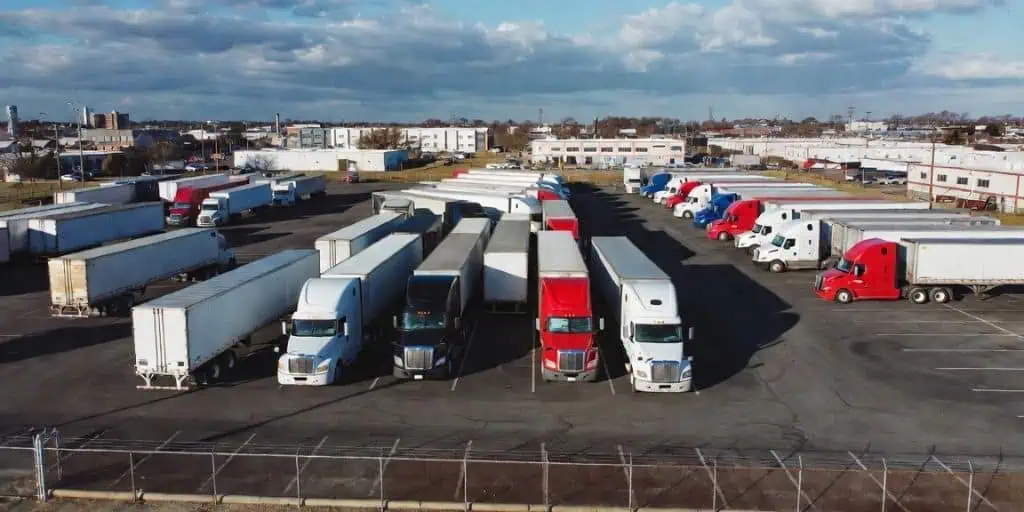
A semi-truck with a trailer is roughly 70 feet long. It doesn’t turn like a car. It needs wide drive aisles, long spaces, and enough room to swing around without clipping another truck, a fence, a gate, or a building.
So yes, acreage matters.
A rule of thumb I’ve found is that four acres is a comfortable floor for a standalone truck parking facility. That’s not a law. It’s just where the math starts to make more sense with every property I’ve looked at.
The reason is pretty simple. Your fixed costs don’t shrink very much just because the lot is small. You still need a fence. You still need a gate. You still need cameras. You still need lighting. You still need some kind of software and payment system. You still need somebody available when something breaks.
If you have only one or two acres, you may not have enough rentable space to justify all that.
This is why I wouldn’t get too excited about a tiny lot unless a few things are already true:
- The gravel/asphalt/cement parking lot is already there
- A fence is already around the perimeter
- A gate is already there
- The property is already being used for trucks, so you’re not starting from zero or trying to rezone anything
A small lot can work. But a small lot where you have to pay for all the development from scratch is much harder to make pencil.
A Real-World Case Study In What Works
Recently, I took one of the larger specialized semi-truck parking operators I could find and mapped out every location they had across nine states.
I pulled county parcel records, state traffic counts, and satellite imagery for each site to see what they actually had in common.
Some of what I found confirmed the normal advice, but some of it surprised me.
For example, this operator runs several lots in the 2- to 4-acre range, and those lots appear to work. One of their yards fits 86 trucks on 3.8 acres of gravel, which is a pretty efficient use of the land.
But here’s the key detail: those smaller lots usually weren’t raw land they developed from scratch.
In most cases, the expensive stuff was already there. The site was already cleared. The gravel or pavement already existed. The access was already workable. And sometimes, they had several lots clustered near the same highway exit, so one manager or local contractor could help cover multiple sites.
That’s a very different situation than buying a random 2-acre field and trying to turn it into a truck parking facility from nothing.
As a first purchase, I would still feel better with four or more usable acres. Or, if it’s smaller than that, I would want the site improvements already in place.
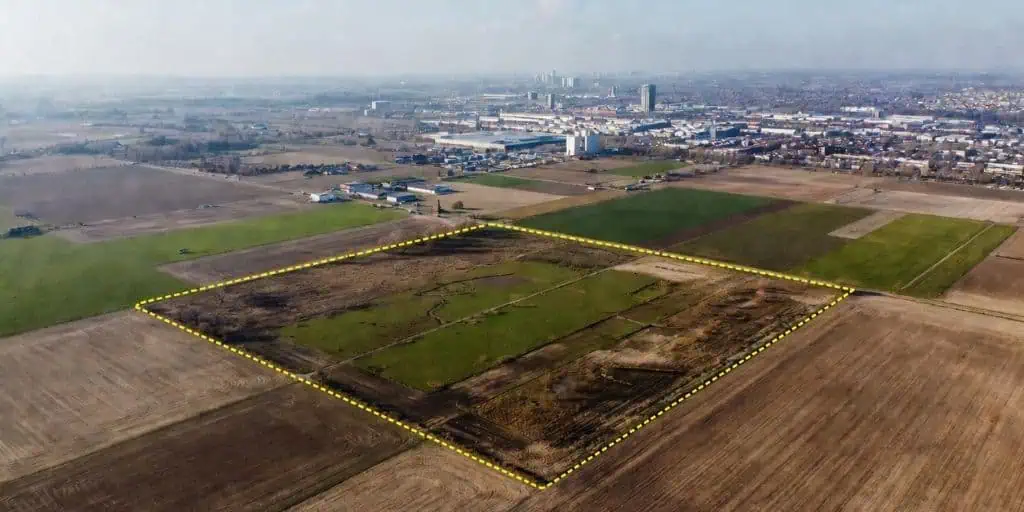
Shape matters almost as much as size.
A clean rectangle is your friend.
A triangle, sliver, or weird leftover parcel can quietly wreck the whole layout, because trucks don’t fit neatly into odd corners. You may own three acres on paper, but if a third of it is wasted because of the shape, drainage, setbacks, or awkward turning angles, you don’t really have three usable acres.
I looked hard at a 3.15-acre former trucking property in Muskegon, Michigan. The zoning was already sorted out. It had a fence. It even had a small building.
At first glance, it seemed like the kind of property I should be excited about.
But the more I looked at it, the worse it got. It was too small for what it cost, and it was shaped like a triangle. That meant a lot of the land couldn’t be used efficiently for 70-foot vehicles. By the time I accounted for the wasted corners and the drive aisles, the numbers just didn’t make enough sense.

That’s one of those things you only start to notice after staring at enough aerial maps.
You can fit roughly 20 to 25 trucks per acre on a clean rectangular lot.
That number is worth remembering, because it gives you a quick way to size up a property.
If you have four usable acres, you’re probably looking at something like 80 to 100 spaces. Maybe a little more if the layout is tight. Maybe less if the shape is awkward or you need wider aisles.
That 86-truck lot on 3.8 acres works out to about 22 spaces per acre, which lines up pretty well with this rule of thumb.
A comfortable parking space is about 20 feet wide by 80 feet deep. You can go tighter than that. One operator told me he uses 11 feet wide by 75 feet deep, and that 11 feet is his sweet spot, because at 10 feet drivers start getting nervous and things get clipped.
Tighter spaces mean more income per acre, but they also make the lot harder to use. And if drivers hate using your lot enough, they’ll eventually find somewhere else.
Access is one of those boring details that can make or break the site.
This is easy to miss if you’re used to thinking about normal cars.
A regular driveway might work fine for a small office building or a retail property, but that doesn’t mean it works for semi-trucks. A truck may need to pull in, stop at a keypad, wait for a gate to open, and then keep moving without blocking the road behind it.
That means you need enough throat depth at the entrance. In plain English, the driveway needs to be long enough between the road and the gate for a truck to sit there without hanging out into traffic.
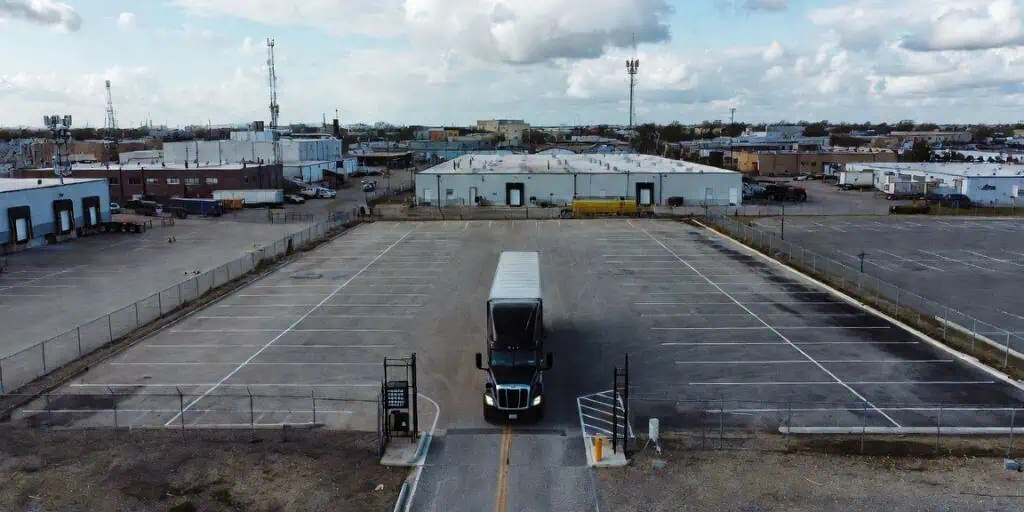
Ideally, you also want enough width for one truck to come in while another truck is leaving. That doesn’t always happen, but if your entrance is too tight, it creates friction every single day.
I learned this the hard way on a property I looked at in Frankenmuth, Michigan. The site had a normal driveway that made sense for normal vehicles, but it wasn’t designed for semis. Once we started thinking through where the fence, gate, and keypad would go, it became obvious that the entrance would need more room than we first assumed, which also meant we wouldn’t be able to fit in as many parking spots as we wanted.
That’s the kind of thing that doesn’t show up in a spreadsheet, but it absolutely matters in real life.
The traffic on the road in front of the property matters a lot less than I expected.
This was probably the most surprising thing I found.
Most real estate investors are trained to care about road frontage and traffic counts. If you’re building a retail store, restaurant, gas station, or car wash, that makes total sense. You want people to see you. You want drive-by traffic.
But truck parking doesn’t seem to work that way.
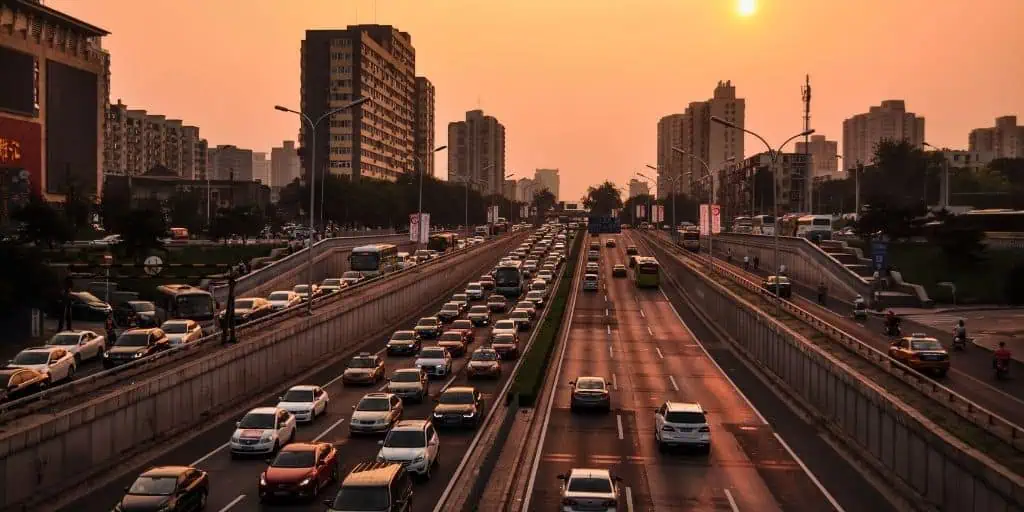
When I pulled the state traffic counts for all the successful sites I could find, more than half sat on roads so minor the state didn’t even publish a traffic count for them.
We’re talking industrial back streets, gravel roads, dead-end roads, and little roads tucked behind the obvious commercial corridor.
Granted, they usually weren’t far from a road with heavier traffic, but the road in front of the property itself was not necessarily a high-traffic road.
This is an important thing to note. These tenants are NOT finding the lot because they randomly drove past it and saw a sign. They’re finding it because they need a place to park, they searched for one, they heard about it from another driver, or somebody marketed it directly to them.
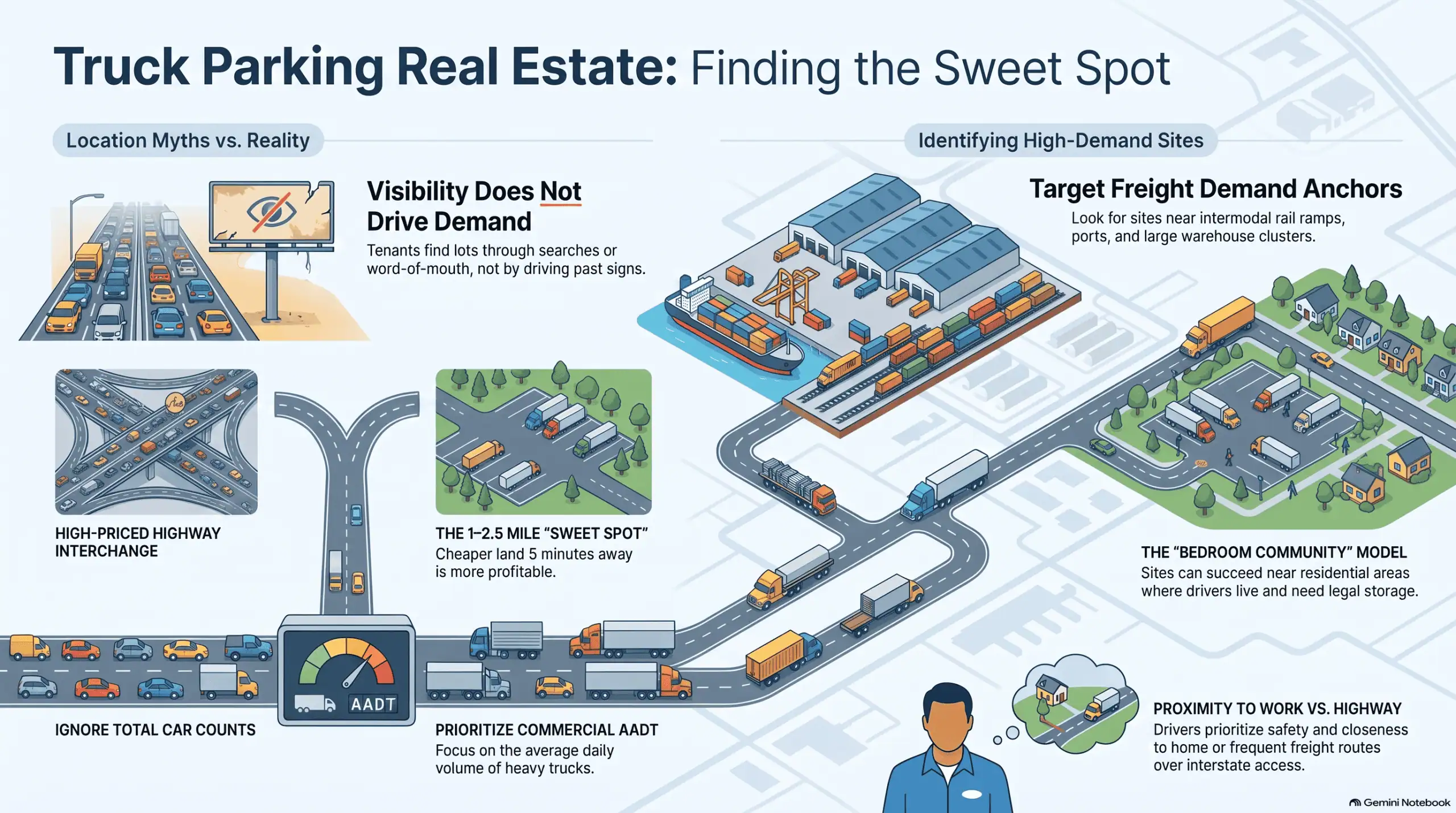
In this business, visibility is nice, but it doesn’t seem to drive demand.
So if you’re evaluating a site, I wouldn’t obsess over how many cars drive past the front of the property.
The better question is: how much truck activity is happening nearby?
Most state DOTs publish free traffic count maps, and many of them include commercial traffic counts. Sometimes it’s called commercial AADT, which basically means the average number of trucks passing that stretch of road per day.
That’s the number that matters more.
“Within one mile of the highway” is not a hard rule.
I’ve heard some people say a truck parking lot needs to be within a mile of a major highway.
I understand the logic. The closer you are to the highway, the easier it is for a driver to use your lot.
But again, the real-world data I looked at was more nuanced.
Many of the most successful sites I found were not right next to the interchange. Many were more like 1 to 2.5 road miles away (sometimes even further), usually a 4- or 5-minute drive from the highway.
And after looking at the maps, it started to make perfect sense.
The land right at the interchange is priced for gas stations, fast food, hotels, and other higher-value uses. You probably don’t want to compete with those buyers if all you’re doing is renting truck parking spaces.
But the land a couple of miles behind the interchange, on an industrial back street, can be dramatically cheaper.
That’s the sweet spot.
You’re close enough that the highway still matters, but far enough away that you’re not paying premium interchange prices.
A trucker who needs a safe place to keep their rig will usually drive a few extra minutes if the lot is secure, affordable, and easy to use.
A few of the sites I studied were even 12 to 37 miles from the nearest interstate and still appeared to work. That sounds crazy until you remember that monthly parking is not the same as overnight travel parking.
A driver who lives in that area doesn’t necessarily care if the interstate is right next door. They care whether the lot is reasonably close to home, close to their work, or close to the freight they haul.
The strongest sites sit near something that generates semi-truck traffic. This is one of the biggest takeaways from the whole exercise.
Every strong site I looked at was near some kind of truck demand source.
I started thinking of these as “freight demand anchors.”
A freight demand anchor is one specific place, or cluster of places, that brings a lot of trucks over and over again.
Examples include:
- Intermodal rail ramps
- Ports
- Large warehouse clusters
- Distribution centers
- Food processing plants
- Manufacturing plants
- Air cargo hubs
- Military bases
- Large construction equipment yards
An intermodal ramp is a good example. If you haven’t heard that term before, it’s basically a rail yard where shipping containers get transferred between trains and trucks.
A container comes in by rail. A local driver picks it up with a truck. Then that driver hauls it to a warehouse, factory, or distribution center.

A busy intermodal ramp can have hundreds of trucks cycling through it every day. And every one of those trucks belongs to somebody who has to park it somewhere.
Ports work the same way. So do big warehouse clusters. So do manufacturing corridors. If you find a site close to one of these demand anchors, that’s a very good sign.
But you don’t always need a freight anchor.
There are really two versions of monthly truck parking demand.
The first is the freight-ecosystem lot. That’s the one near the port, rail ramp, warehouse district, or major industrial area. The lot serves drivers who work in and around that freight system.
The second is the bedroom-community lot. That’s a lot serving drivers who simply live nearby and have nowhere legal to put the truck when they’re home.
Both can work.
My own market in West Michigan is a good example. We don’t have a major intermodal ramp right in town. The nearest big ones are in Detroit and Chicago, both more than 150 miles away.
At first, that sounds like a negative. But it also means a lot of freight moving in and out of the region moves by truck the whole way through. And if a lot of drivers live in the area, they still need somewhere to keep their equipment.
So, I wouldn’t automatically reject a market just because it doesn’t have a giant freight anchor. You just need to understand what kind of demand you’re dealing with.
Local parking bans can create your entire tenant base.
Remember how we talked in Part 1 about cities banning commercial vehicles from residential areas? That matters a lot.
I checked the actual ordinances of 18 municipalities in my market. Fourteen of them prohibit keeping a semi-truck at a residence.
That means every truck driver living in those townships has the same problem: they may own the truck, but they can’t legally park it at home.
Every one of those rules creates demand for a semi-truck parking lot.
So when you’re studying a market, don’t just look at highways and warehouses. Pull up the residential parking ordinances for the cities and townships around your target site.
If most of them ban semi-trucks at home, that’s a good sign!
Price still has to make sense.
A property can be the right size, the right shape, close to the right demand, and still be a bad deal if the seller wants too much money.
Truck parking does not produce retail-level rent. You’re renting big outdoor spaces, and each space takes up a lot of land.
That means you can’t overpay.
This is why weird, boring, tucked-away, industrial properties are your friend. You don’t want the prettiest parcel on the best corner. You don’t want the parcel with the most traffic running in front of it. You want the property that works for trucks, but doesn’t work as well for higher-paying uses.
If the land is priced like a gas station site, a fast-food site, or a self-storage development site, truck parking probably won’t be the highest and best use. And if it’s not the highest and best use, you’ll have a hard time making the numbers work.
Luckily, though… this often works in your favor, because semi-truck parking lots are often the properties other businesses don’t want because they’re low-traffic, kinda ugly, and largely passed over and ignored because they aren’t the first choice for most companies in the area.
That’s a great thing for a semi-truck parking lot operator!
Here’s how I’d rank what actually matters.
Some things are pass or fail.
- If there’s no real truck traffic anywhere in the surrounding 3-5 mile radius, I don’t care how cheap the land is.
- If the zoning doesn’t work and there’s no reasonable path to approval, I don’t care how perfect the location looks.
Those two things come first.
After that, the economics matter.
- Can you buy or lease it cheaply enough?
- Is it close enough to the highway or demand source to be useful?
- Can you charge enough per space to justify the cost?
Then I look at the physical layout.
- How many usable acres are there?
- Is it square or rectangular?
- Is it big enough for trucks to turn around easily?
- Is the entrance workable?
- Is there room for a gate and keypad without blocking the road?
And after looking at actual operator locations, there are a few things I care about a lot less now.
I don’t care much about drive-by traffic.
I don’t care much about curb appeal.
I don’t care if the road in front is impressive.
In fact, some of the best sites are the opposite. They’re tucked away on ugly industrial roads where nobody else is trying to pay retail prices for the dirt.
That’s usually where the opportunity lives.
The strongest markets tend to be places with heavy industrial, manufacturing, shipping, warehousing, and small-carrier activity. Atlanta, Dallas, Chicago, and Memphis are obvious examples, but plenty of secondary markets can work too.
The simplest tell that a market is short on parking?
Drive around at night.
If you see trucks lined up on highway shoulders, parked behind Walmarts, sitting in industrial streets, or tucked into random gravel lots where they probably don’t belong, that’s not random.
That’s demand showing itself.
How to verify the demand before you spend a dime
This is the part where the business gets less glamorous.
You can stare at maps all day. You can build spreadsheets. You can look at traffic counts, zoning maps, and satellite images.
All of that helps. But at some point, you have to verify the demand like a normal human being.
You have to talk to people.
That means calling trucking companies. Calling existing facilities. Asking what they pay. Asking if lots are full. Asking if they know drivers who need parking. Asking whether they would use a new lot if it were safe, fenced, lit, and reasonably priced.
I don’t love this part, personally.
It’s awkward. It’s time-consuming. You feel like you’re bothering people. And half the time, the person on the other end doesn’t want to tell you much.
But that’s also why it’s valuable! Most people won’t do it.
They’ll look at Google Maps, make a few assumptions, plug numbers into a spreadsheet, and call it “research.”
That isn’t enough for this business, especially when you’re going to make a six or seven-figure bet on whichever property you choose.
The data isn’t organized the way it is in self-storage. There isn’t a clean, reliable feasibility study that tells you exactly how many truck parking spaces exist in a five-mile radius, what they charge, how full they are, and how quickly a new lot will lease up.
So if you want confidence, you have to build that confidence manually.
The FMCSA database is one of the best places to start.
Every trucking company in America has to register with the FMCSA, which is the federal agency that regulates trucking. That registration data is public.
It can show you the carrier’s name, address, and how many trucks they operate.
This is useful because it lets you see how many small trucking companies are actually based near your target property.
When I ran this for my own market, I found over 8,000 carriers running twelve or fewer trucks across six counties. Roughly half of them were registered at what appeared to be somebody’s house.
That matters! A trucking company registered at a house probably doesn’t have its own terminal or yard. And if that driver can’t legally park at home, they need a place like yours.
That same FMCSA list also becomes your marketing list.
Pro Tip: If you want a more polished website that includes most of the same data, try CarrierSource.io. You can search by zip code or city, and find the names and addresses of every trucking company in the near vicinity. It also shows their fleet size (number of trucks) and other key insights for free!
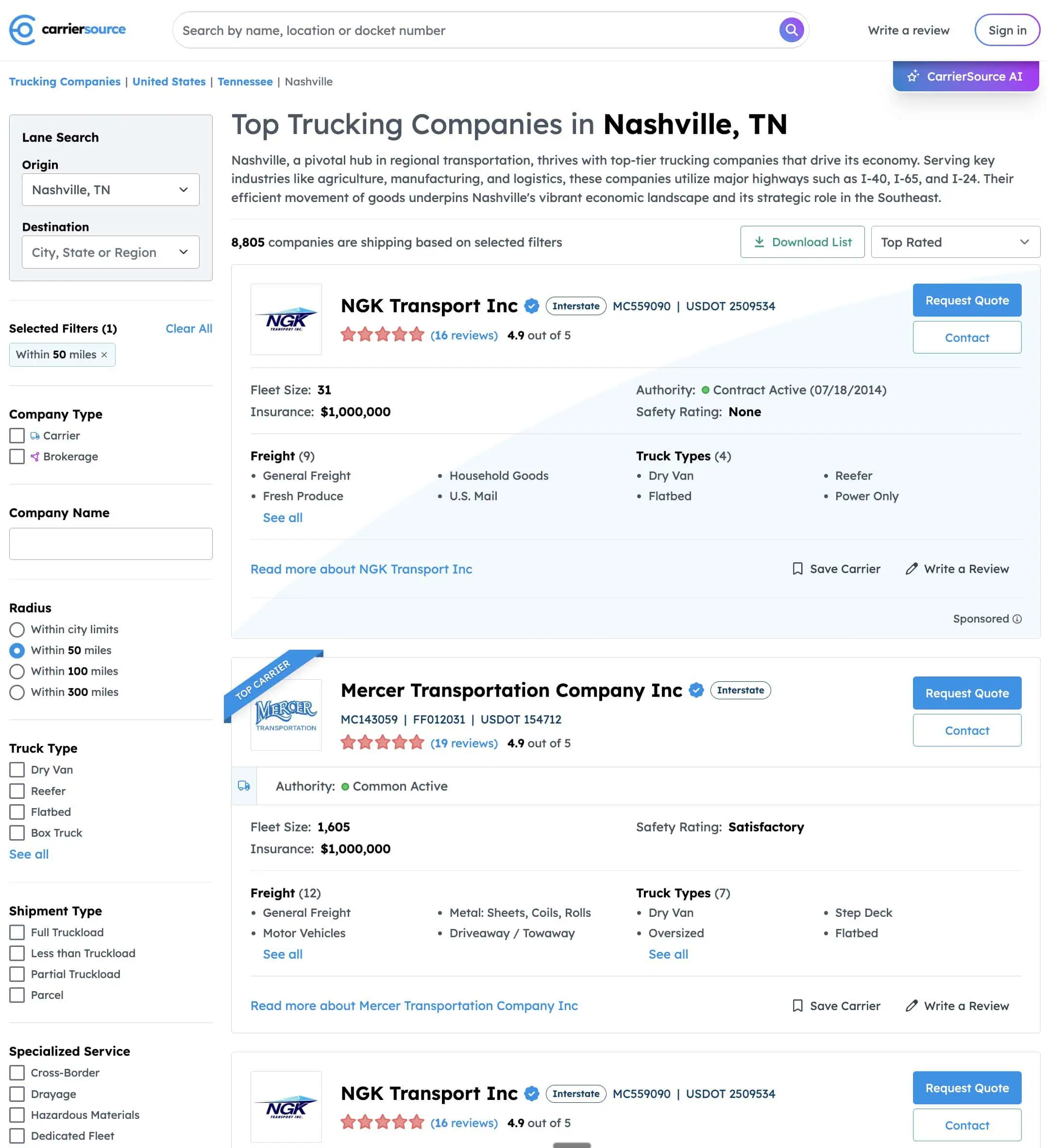
Once you have that info, look up their phone number and give them a call and have a conversation to assess how much demand there is for parking in your area.
If you open a lot, you don’t have to sit around hoping drivers find you. You can mail them. Call them. Email them. Run ads to them. You can put your offer directly in front of the exact people most likely to need it.
Your state DOT traffic map is another free tool.
Most states publish traffic count maps online. Some include commercial vehicle counts, or truck counts.
That number is much more useful than the general car count on the road in front of the property.
If the nearby highway has thousands of trucks passing every day, that’s a real signal.
If the total traffic count looks high but almost none of it is trucks, that’s less meaningful for this business.
Local ordinances are another hidden source of demand.
Look up the residential parking rules in the towns around your site.
Search for terms like:
- commercial vehicle parking
- truck parking residential
- tractor trailer parking
- recreational vehicle and commercial vehicle storage
If the surrounding townships don’t allow semis at home, that’s an important part of the area’s demand story.
It means local drivers are being forced into the market whether they like it or not.
Existing facilities tell you a lot too.
If there are already truck parking lots nearby, don’t automatically assume that’s bad.
Competition can be a sign that the market is real. The better question is whether those lots are full.
If they’re full, have waiting lists, don’t advertise, don’t answer the phone, or look poorly managed, that can be a great sign.
It means the demand exists, and the current options may not be serving it very well.
You can learn a lot by calling them and asking basic questions.
- How much is monthly parking?
- Do they have availability?
- Do they allow trailers?
- Do they require insurance?
- Is there a waiting list?
- Can you park a personal vehicle there while you’re on the road?
You don’t need to be sneaky or weird about it. You’re just trying to understand the market.
This is where the opportunity is hiding.
This business is still overlooked for the same reason it’s hard to evaluate. The information isn’t sitting in one clean place.
You have to piece it together from parcel maps, zoning codes, traffic counts, FMCSA records, local ordinances, competitor phone calls, and your own eyes.
It’s a pain. Believe me, I know it’s a pain… but that’s also the moat.
The person willing to do that work gets a much clearer picture than the person who just watches a few videos and assumes any empty parking lot will work.
In a business where the upfront decision matters so much, that extra clarity can be the difference between a great little cash-flowing property and a very expensive mistake.
Next up, we’ll talk about the part that can kill the deal faster than anything else: zoning, approvals, and what it actually costs to build one of these things.
Continue to Part 3 here.


