



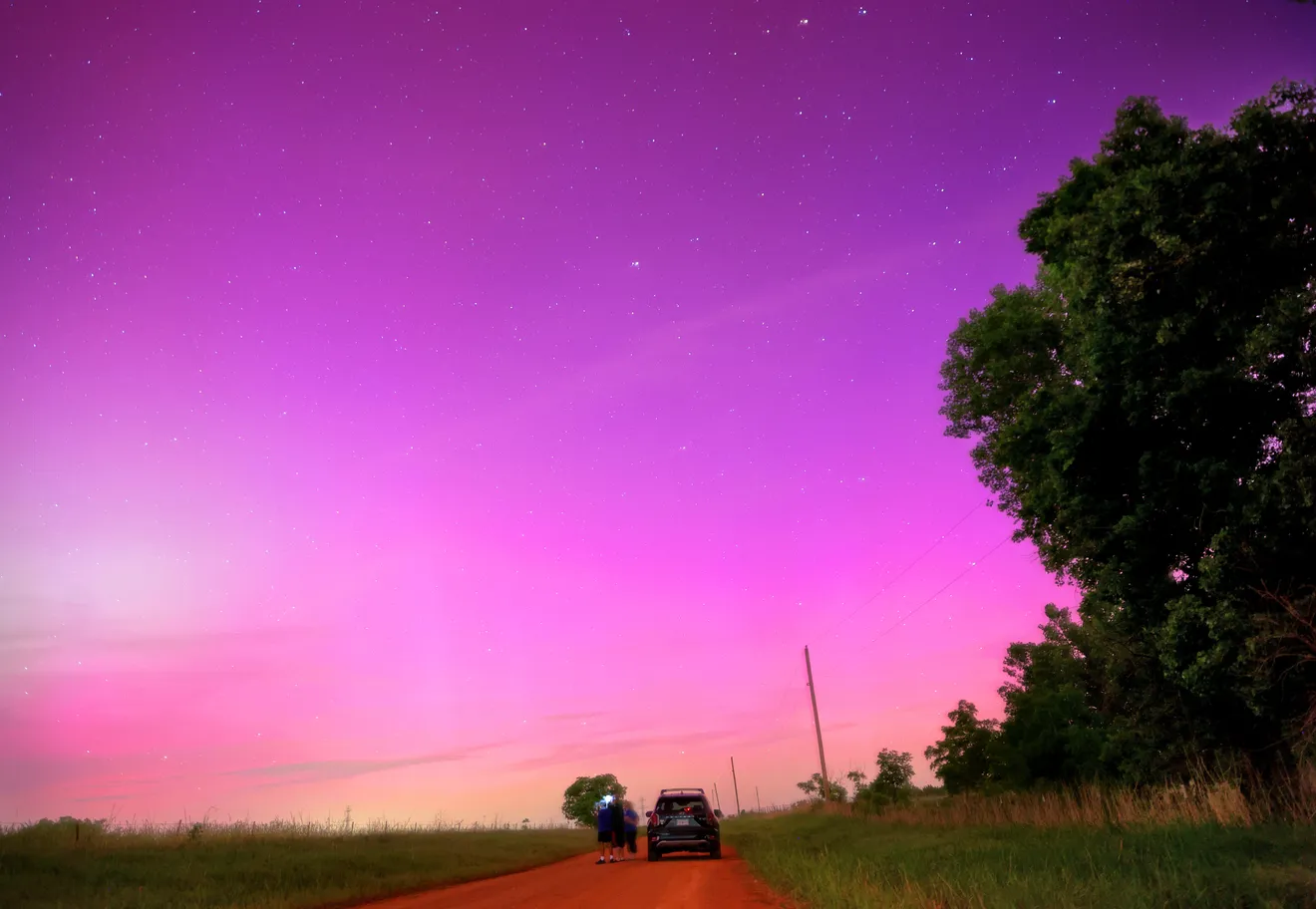

Anybody interested in a free light show? Tickets are free but the performance is fickle.
The northern lights, also known as the aurora borealis, are expected to be visible Saturday night and not as bright Sunday, according to a forecast by the National Oceanographic and Atmospheric Administration. The best seats will be in nearly half the states, mostly along the northern border and in the Midwest.
“Aurora can often be observed somewhere on Earth from just after sunset or just before sunrise,” the agency forecast said. “The aurora does not need to be directly overhead but can be observed from as much as 1000 km away when the aurora is bright and if conditions are right.”
Where will the northern lights be visible?
The darkest areas are always the best places to see the aurora borealis, according to the experts.
Depending on local conditions, the best views are expected in Alaska and along the northern border in Washington, Idaho, Montana, North Dakota, South Dakota, Minnesota, Wisconsin and Michigan, according to the NOAA forecast.
Other states where it’s possible to see the lights include Oregon, Wyoming, Nebraska, Iowa, northern Illinois, Indiana, Ohio, Pennsylvania, New York and New England.
When is the best time to see the northern lights?
Experts have long struggled to accurately forecast exactly when and where the phenomenon will ever occur. Even the best predictions can accurately be made only a few days or even hours in advance.
But as a rule of thumb, if the weather is clear, the best aurora is usually visible within an hour or two of midnight, according to NOAA. And if it looks as if the northern lights will flare up near you, you should get away from cities and travel to dark locations free from light pollution so you can best see them.
The agency also maintains an aurora dashboard that should help skygazers track the phenomenon.
What causes the northern lights?
The auroras are a natural light display in Earth’s sky that are famously best seen in high-latitude regions of the Northern and Southern hemispheres.
The phenomenon is caused when electrically charged particles from space enter Earth’s atmosphere and collide with molecules and gases like oxygen and nitrogen, causing the atmospheric particles to gain energy. To return to their normal state, the particles release that energy in the form of light, according to the University of Alaska at Fairbanks Geophysical Institute website, which tracks the phenomenon.


