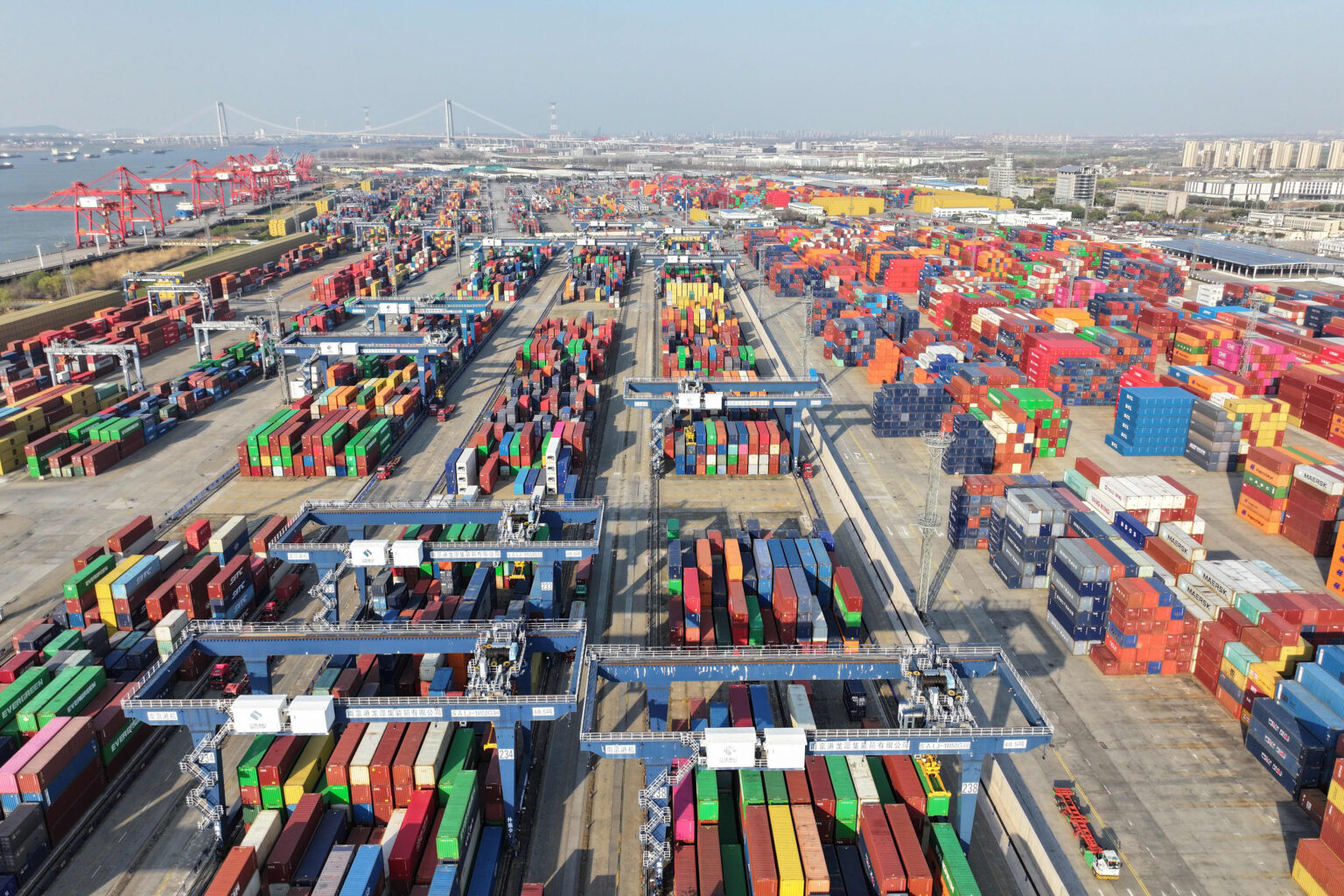

Trade experts tell CNBC that the tariffs announced by President Donald Trump on Wednesday are equivalent to building a trade wall around the U.S. economy of nearly $1 trillion.
With the way tariffs work, the estimated costs of the new tariffs U.S. businesses will be paying is $654 billion a year, according to Trade Partnership Worldwide, and it’s a number that will grow — the figure does not include up to $300 billion more in new tariffs under the International Emergency Economic Powers Act (IEPPA) and Section 232 of the Trade Expansion Act tariffs on steel, aluminum and autos.
American companies will now be on the hook for $1 billion to $2 billion per day, based on estimates using tariff costs paid in 2024.
The U.S. stock market, which saw its worst daily loss since 2020
Trade experts tell CNBC that the tariffs announced by President Donald Trump on Wednesday are equivalent to building a trade wall around the U.S. economy of nearly $1 trillion.
With the way tariffs work, the estimated costs of the new tariffs U.S. businesses will be paying is $654 billion a year, according to Trade Partnership Worldwide, and it’s a number that will grow — the figure does not include up to $300 billion more in new tariffs under the International Emergency Economic Powers Act (IEPPA) and Section 232 of the Trade Expansion Act tariffs on steel, aluminum and autos.
American companies will now be on the hook for $1 billion to $2 billion per day, based on estimates using tariff costs paid in 2024.
In 2024, the United States exported about $2 trillion in physical goods and imported about $3.27 trillion. At face value, that would translate into a trade deficit of about $1 trillion. But for some time now, the U.S. has been exporting through routers: every time a foreigner streams a movie on Netflix or buys an ad on Facebook, the U.S. is exporting.
“We estimate that the U.S. enjoys a trade surplus of at least $600 billion in digital products,” said Hidalgo. “This is comparable to the total exports of France, which is the seventh-largest exporter in the world,” he added.
U.S. exports in digital advertising & cloud computing alone represent about $260 billion and $184 billion, respectively, according to his data. “Which is larger than the exports of the U.S. in crude or refined petroleum, the biggest export products of the U.S.,” Hidalgo said. “It’s reasonable for world leaders to look at U.S. tech for retaliation. If you are in a war with Russia, you target gas and oil. If you are trying to push around Germany, your target is cars. In the case of the U.S., the big export sector is the web,” he said.
Tech services won’t be the only target of trading partners, according to Jason Miller, assistant professor of logistics in the department of supply chain management at Michigan State University’s Eli Broad College. He expects massive foreign retaliation aimed at U.S. aerospace, machinery, food, beverage, primary metals, electrical equipment, computers & electronic products, energy, and especially, agriculture, and says that other nations have leverage in the fact that it’s been decades since the U.S. has had the ability to produce many of the products that other nations supply.
On a collective tariff basis, the hardest hit states in the U.S. will be its biggest economies one of the reddest and bluest states. Texas will see a 9.5-fold jump in tariffs paid by businesses, increasing from a 2024 level of $7.2 billion to new potential costs of $66 billion. California, will see an eight-fold increase in tariffs paid by businesses, from $17 billion last year to potential costs as high as $139 billion.
“The magnitude of these tariffs, their global coverage, and the fact they affect many types of goods for which the U.S. has limited domestic manufacturing capacity, means they will inevitably cause inflation,” said Miller.