



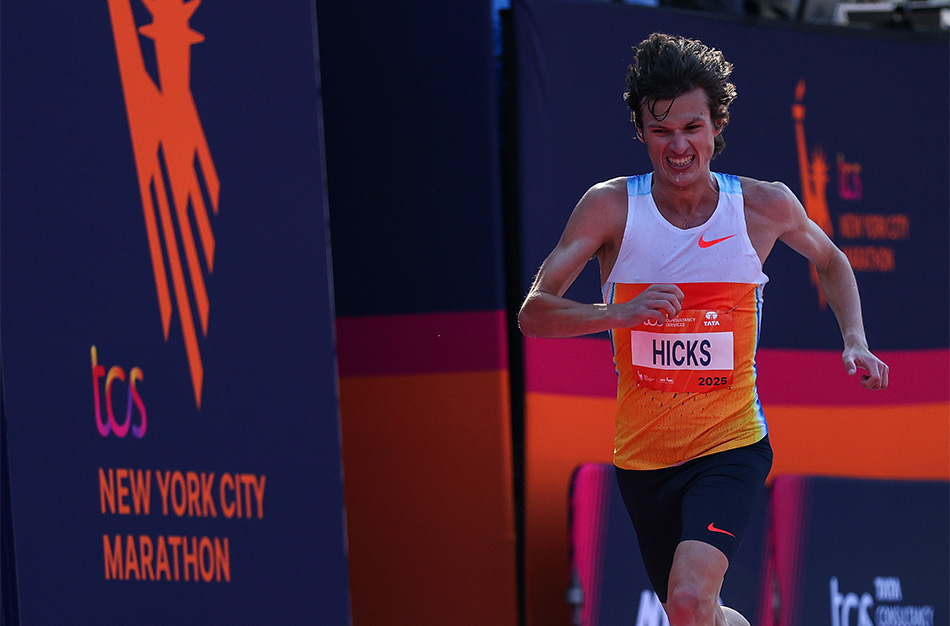

From leaving track and cross country behind to embark on a marathon race to switching his allegiance from Britain to the United States, the 24-year-old talks about some big and very personal decisions.
It’s been a time of change for Charles Hicks. Just 12 months ago he was making final preparations to compete in his first road race, a significant change for an athlete immersed in cross country competition and track fights.
But this was not a sudden dive into the deep end. The idea of becoming a marathon runner had already been taking shape in his own mind, so when his coach Jerry Schumacher presented the same idea to him, he made the decision to hit the road and months of preparation began.
In that first foray onto the asphalt, Hicks impressed at the Cherry Blossom 10-Miler in Washington DC, an event that also serves as the US Championship for that distance. His victory earned him a national title, but his dual citizenship with Great Britain meant that his time of 45:14 would not be an American record. That honor went to second-place finisher Alex Maier, whose 45:15 barely beat Conner Mantz’s previous mark of 45:16.
But there are more changes in the air. In mid-July, Hicks will be eligible to compete for the United States. The 24-year-old was born in London and lived in Fulham for the first 12 years of his life before moving to the United States with his family.
His international career so far has been in the British jersey, with two European under-23 cross country titles and a 5000m gold at the 2023 European Under-23 Championships to his name. But, having lived the second half of his life in the United States and his country of residence looking unlikely to change anytime soon, he admits: “I felt more and more fraudulent the more time I spent outside the UK.” It seemed like the right decision and, if he can make his Olympic dream come true by competing in the Los Angeles Games in 2028, he will do so as a member of the local team.
He’ll no doubt get plenty of support later this month when he takes part in the Boston Marathon for the first time, his second start over 26.2 miles after finishing seventh in New York last November in 2:09:59. It goes against conventional wisdom for someone so young to commit to the distance, but then again, the rules of the marathon are being rewritten more and more with each passing year.
“People, especially outside of the US and the NCAA system, typically don’t try to do marathons as aggressively as we have,” the Stanford University graduate says while speaking to AW via video call from his base in Oregon, sitting in a workspace enclosed by an altitude-generating tent “which is usually set between 10,000 and 12,000 feet.”
“But the beautiful thing is that you’re seeing a lot of guys trying to make this change earlier than people before and that can lead to really exciting performances as people catch on.” [that the marathon] “It’s not something that just destroys you physically.”

Hicks perhaps could have added the words “for longer” to the end of that sentence. Having taken a look at the
Past and seen the tools once used in marathon trading, it is the rapid advancement of technology that he sees as playing an important role in the event attracting a younger competitive audience.
“My personal conspiracy theory, and I don’t know if it’s controversial or not, but I think it has a lot to do with the shoes,” he adds. “One thing I’ve seen from visiting the Nike archives is that the shoes people used to run marathons are horrible.
“I felt like I was in a medieval torture museum looking at instruments of terror and destruction. I understand why you didn’t put a 23 or 24 year old kid in them and make him run 26 miles because I don’t think that developing body would do well.
“But now we have a lot of insulation from the impact forces of the marathon. I can still barely walk after mine, but these shoes return a lot of energy and I think it’s a less destructive force than it used to be. That allows people to take more risks, maybe train a little harder and run a little more aggressively without having to do it.”
“A lot of destruction.”
That doesn’t mean Hicks approaches his next marathon task with a complete throwaway of caution. He maintains a healthy respect for distance and that debut in New York turned out to be an exercise in self-control.
“There was a big move halfway through and looking back I’m not sure if following it could have put me a couple of spots higher or 50 spots lower.” he says. “At that point I decided, ‘I’m running really well. I feel really strong. There’s still 13 miles left and I think there’s a lot to discover, so why don’t we play it safe, run with the second chasing group and still give ourselves a chance to finish in the top 10?’ Running conservatively and having it work very well excites me for the opportunities.”
The plan, with each passing attempt, will be to loosen that leash slightly.
“What I really want to do with every progressive marathon is take it as a base and then throw it away.
“I want to take stock of that form of risk aversion that I had in New York, inject a little risk tolerance into the model and start to figure out where my ceiling is.”
Hicks is clearly an athlete who thinks deeply about his sport and it is the idea of literally going on a journey, rather than running on a track or cross country course, that appeals to him most about the new stage of his career. However, he sees this chapter as an extension of what he first learned (and came to enjoy most) during his off-road adventures.
“What I loved about cross country was just more available on the roads,” he says. “The things I really loved were racing and having competitive placement be the top priority in every race. I’ve found that to be extremely true on the roads. Times are obviously important – there are races where records are chased – but, in every road race I’ve been in, placement has been the top priority and that felt very cross-country.
“And then the other one is doing reconnaissance, having all these new locations, finding the elevations of the hills, figuring out ‘because [on the roads] The course itself is almost like a character in each of these races. There are a lot more things worth thinking about in these races beforehand that I really enjoy.”

All of the above is part of Hicks’ identity, something that was at the center of that very personal decision to switch national allegiances. Like the switch to road racing, it was not taken on a whim and the reaction, he is pleased to report, has been positive.
“I’m sure there are some British fans who are less enthusiastic about this, but as the decision was so personal, I feel much more comfortable.” [and still would] even if the reactions had been overwhelmingly negative,” he says. “I made a decision that was true to who I was and who I wanted to be.
“I was 24 when I made the decision and the reason I started thinking about it was because I moved from the UK to the US and I turned 12 straight after. I had spent 50 per cent of my life in the UK and then 50 per cent of my life in the US. And I thought, ‘If I’m ever going to make a decision, this is a very real turning point for me and what is the rest of my life going to be like?’
“Maybe in college or before that, I thought there was a chance to come back [to the UK]reestablishing roots and all that, but I think the reality that my life has taken shape now and being able to see it so clearly makes me realize that that number will continue to become more American-centric.
“I think that gives more credence to some of those perspectives that were perhaps more negatively biased about whether or not he really embodied what it meant to be British. But I think when I made the decision, [to compete for Britain] When I was 18, I felt much more British than American at the time. I think he might also have simply been reactionary about the move. [to the US] and wanting to retain a sense of stability at a young age.
“In a way, I think the truth of life is that you can never make decisions that make everyone happy, so you might as well make the ones you think are right.”
And so, to Boston, that beastly route and a marathon challenge like no other. What lessons learned in New York does Hicks think he’ll take with him on this next East Coast adventure?
“The main thing I learned is that you have to have a kind of less sense of urgency when you compete. [the marathon]” he says. “When people make moves, you can think things through before responding, whereas at 5,000 or 10,000m, you’re operating in milliseconds and have to take a lot more risks. I think what really benefits me is an analytical approach, trying to make sure that when I react to things, there’s a justification behind it.
“Being an experienced cross country runner prepared me well to progress in the marathon. I think it’s very easy to say, ‘I want to run faster, I want to go higher in every race,’ but the course will be totally different, the marathon style will be totally different.
“This is my chance to go out there, get as many experiences as possible, race as hard as humanly possible, maybe be a little more aggressive than New York, start pushing those limits and see where they are.”


