



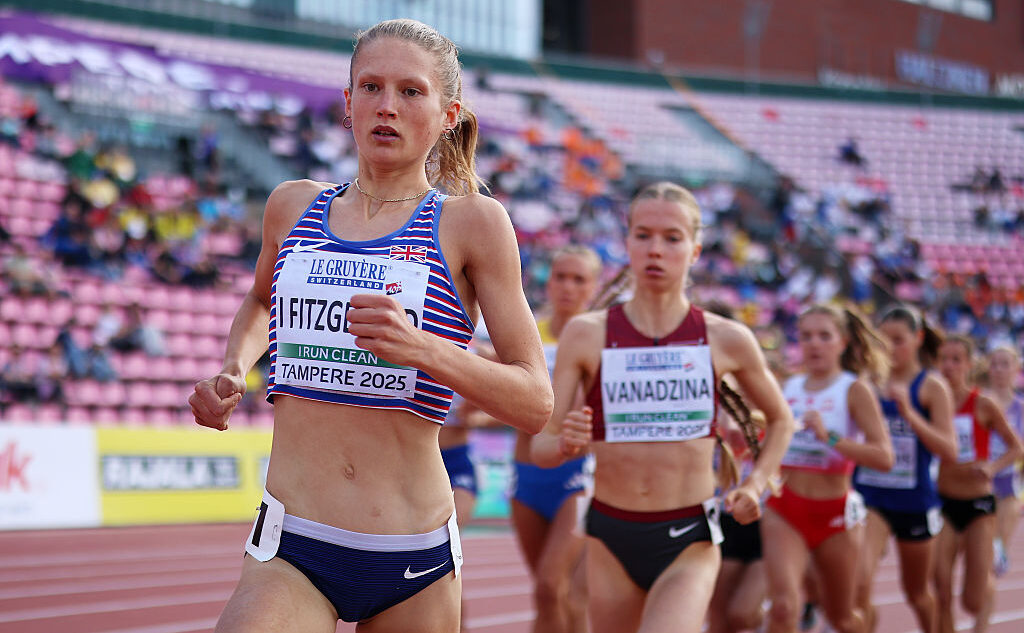

The British distance runner talks about a year in which she won continental gold medals, set new standards and got her first taste of competition on the senior world stage.
At the start of the year, Innes FitzGerald was looking at his British Milers Club (BMC) career options and planning the season as he normally did. Although she was already a double European under-20 cross country champion and one of Britain’s most established young middle-distance talents, the initial structure of her season was familiar: choosing BMCs, developing pace, preparing for the summer. But this time, his coach Gavin Pavey didn’t offer him the usual guidance.
“I remember I was trying to plan what races I was going to do,” he says. “I was telling my coach, ‘Should I get into these BMCs?’ And he stayed pretty quiet. I was like, ‘What’s going on? Surely we need to have a slightly broader plan.” And now I know that he didn’t want me to underestimate myself a little bit.”
Only later did FitzGerald realize that Pavey had been leading her toward something different. Instead of local meets, he imagined her taking the Diamond League stage. The change made sense as the year progressed: her progression from an established junior athlete to a world-class senior competitor came not by surprise, but through a season that continued to rise through the ranks: from national bronze in the 5000m to double European under-20 gold, to taking her place on the start line of a senior World Championships.
“When the year 2025 arrived, I didn’t really know what awaited me,” says the 19-year-old. “I didn’t expect the season to go the way it did, but I’m incredibly grateful for all the opportunities and I gained a lot of experience.”
FitzGerald is only now beginning to understand the magnitude of what he accomplished on the track. He took his first big step in the European Indoor Championships, competing in the 3,000 meters thanks to his third place in the British indoor event. Apeldoorn marked his debut with a senior British vest.
“Jake Smith was giving me a lift after training and I remember him saying, ‘What’s the European indoor standard?’ and I said, ‘Oh, I’m never going to get that.’ Then suddenly I made it to the senior team. It’s different when you get to the senior level as everyone seems a little more focused and in their element.”
Despite the change, FitzGerald achieved her goal of simply making the final and finished eighth in 8:57.00.
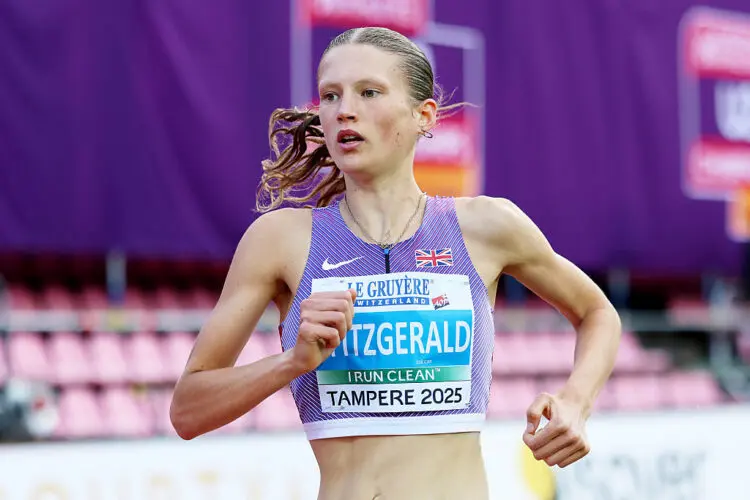
“Rarely, as athletes, do we come away from races feeling satisfied with ourselves. But the overwhelming feeling was pride,” he says. “That championship was important heading into the summer, especially heading into those Diamond League races where suddenly you’re alone in a different country. It was important to have experiences like that.”
Pavey’s reluctance to encourage the BMC plan suddenly made sense when Diamond League opportunities began to arise. That environment allowed the University of Exeter Sport and Exercise Science student to compete at a high level without the tactical pressure of a championship environment, finishing third in Stockholm (3000m), 12th in London and 15th in Brussels (both in the 5000m).
London was the highlight and the biggest race of the year for FitzGerald. In front of a packed crowd, he broke the European under-20 5,000m record in 14:39.56, surpassing Zola Budd’s 1985 mark of 14:48.07. After the aforementioned third place in the 5,000m at the British Championships (winning her first senior national outdoor medal), she was brought to Tampere for the European Under-20 Championships.
The change in environment required a different mindset, but she welcomed the change.
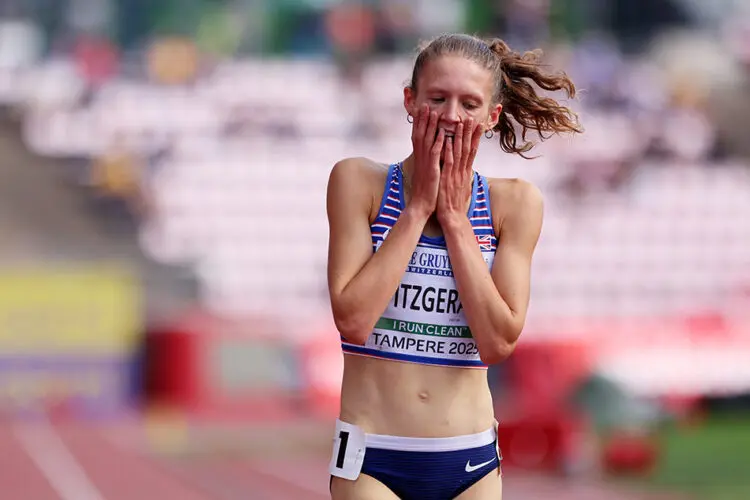
“It’s a completely different atmosphere,” he says. “It’s more of a team thing. More talkative. More relaxed.”
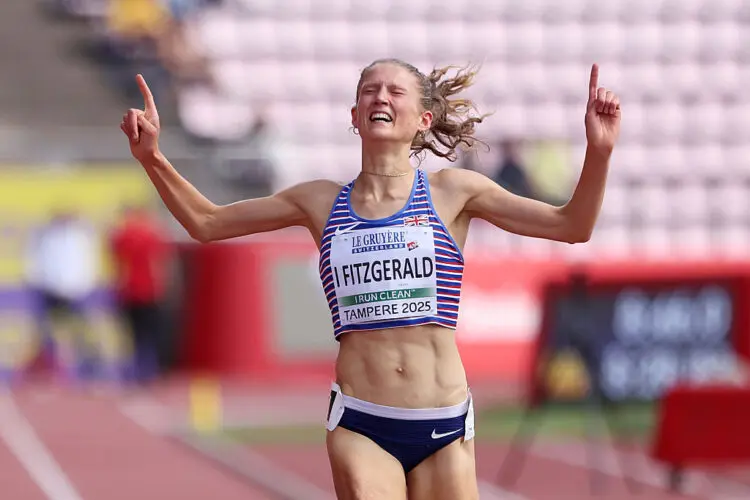
But there was a clear objective. After finishing fourth at last year’s U20 World Championships in the 3,000m, she was aiming for gold in both the 3,000m and 5,000m. The Brit delivered exactly what she intended: two commanding, winning performances and a championship record of 8:46.39 in the 3000m.
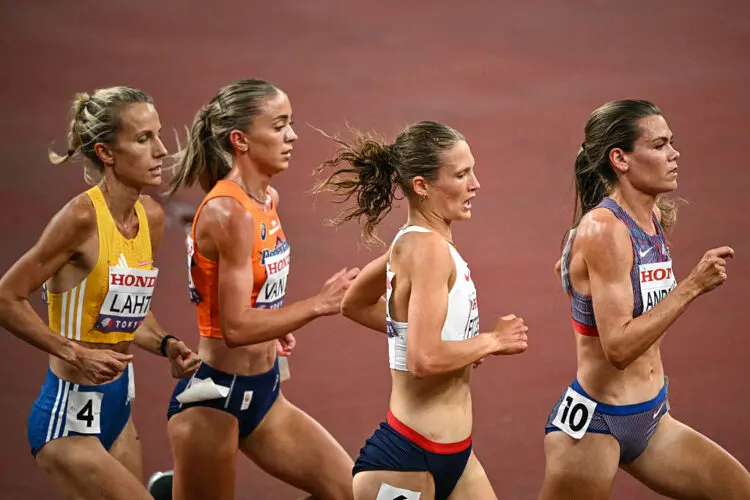
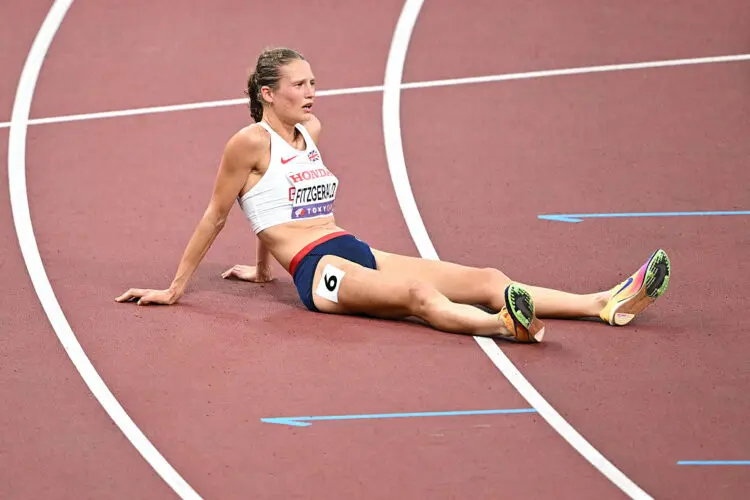
If London was the emotional peak and the under-20 double gold its expected triumph, then the World Championships in Tokyo proved to be the most formative experience of all. Making it to the senior British team at such a tender age was a huge achievement.
FitzGerald may not have made the 5,000m final there, but she says: “Just being there, racing at that level, was something I was really grateful for. The whole experience was very different. The call rooms, the timing, the structure… it all feels like a step forward. I left feeling like I understood a lot more about what it takes to be competitive at that level. It made me feel very excited about the future. I left it all out there and went out feeling satisfied to have reached the champions. I know there will be much more to come in the years to come.”
However, FitzGerald’s competitive year is not over yet. He moved straight into the cross-country season, winning the Cross Challenge events in Cardiff and Liverpool, with the latter booking his place at the European Cross Country Championships in the Algarve, where he hopes to win his third U20 title.
With all the traveling Fitzgerald has done this year to compete at higher levels, sustainability has become an increasingly important consideration, something he has spoken openly about.
“I guess it’s something that’s still very close to my heart and always has been,” he says. “I think you can always do more.”
Next year, the UK will host the European Championships and Commonwealth Games, bringing more than just logistical convenience.
“I think it will be fantastic for us as Brits,” he says. “But it is also an area that many European countries can access quite easily.”
Being closer to home also opens the door for your family and friends to watch your competitions without the environmental impact of long-haul flights.
“I never want to encourage my family or friends to have to fly to come watch me race, because I don’t think that’s necessarily the right decision,” he says. “But having them in the UK next year will be very special, because I hope to have a lot of family and friends there watching. And I think the rest of the Great Britain team who end up going will probably think the same.”


