





Ideally, students take a sequence of three or more courses in fields such as health, construction, or education. Many also earn early college credit or make significant progress toward industry certifications, and some participate in internships or apprenticeships.
Researchers from RTI International, a nonprofit research organization, tracked more than 6,000 graduates who had completed at least two courses in a career field and surveyed them to see what they were doing in the years immediately after high school.
Three-quarters of students surveyed were enrolled in college or another postsecondary training program after graduating, which is higher than the national average for 63 percent. But less than half were still studying or working in the field they had chosen in high school.
For example, among students who completed a degree in architecture and construction, less than 20 percent questioned construction-related careers. Instead, many switched to fields such as science and engineering (40 percent), business (8 percent), or healthcare (6 percent).
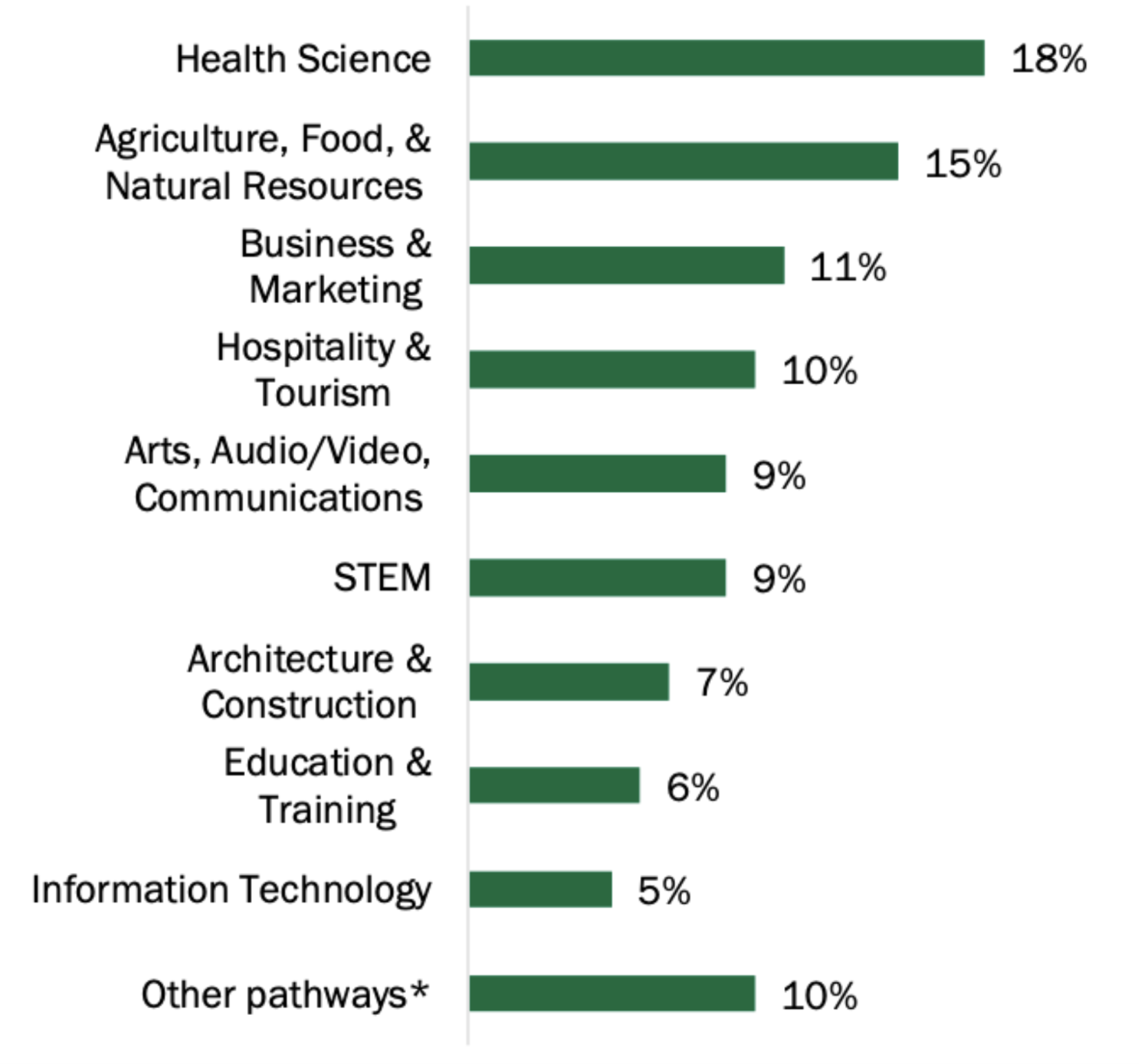
Most Popular High School Pathways in Delaware
That mismatch is not necessarily a failure. For some students, the wrong path was illuminating.
“When students talked to us about this, they really saw value in learning something they didn’t like,” said Sandra Staklis, lead author of the RTI report. “One student told us, ‘Oh, my mom and my aunt are nurses. So I tried it. And it turned out it wasn’t for me, but it was good to know.'”
Students also talked about how to acquire a broader set of skills that are useful in any field. “Students said they were learning job skills like time management and working with other people on a project,” Staklis said. “A lot of academic work has traditionally been more individual, like reading a book or taking a test.”
Still, the findings raise a fundamental question: Are pathways meant to guide students toward specific career fields or help them discover what they don’t want to do?
Students also described how much they valued the mentorship they received from their instructors, many of whom spent their professional lives not in schools but in industry. One student profiled in the report, Kwame, said his professors in the healthcare field showed him how to break down dense medical material so he could study to earn his paramedic certification. He is now majoring in public health at a four-year university and hopes to become a surgeon.
Two lessons stood out from the Delaware study.
- Workplace experience It is what matters most, but it is the most difficult for schools to achieve. The report found that students who participated in internships or apprenticeships were more likely to continue in their field. Another student named James, also described in the report, followed an educational path in high school and, during his senior year, shadowed a teacher, which taught him a lot about how to manage behavior in the classroom. He is now pursuing an associate degree in elementary education.
But these opportunities are difficult for schools to provide, requiring coordination with employers as well as scheduling and transportation solutions.
Workplace learning was more common at vocational high schools, where students often complete core courses earlier and may spend more time outside the building during their senior year. In contrast, one-off experiences, such as guest speakers or field trips, had less impact but were easier for schools to organize.
- Students need better orientation especially when they want to change direction. Once students begin a path, it can be difficult to change. “If you are a junior and you want to switch to a different path, you would have to retake classes that are mostly freshmen and sophomores, and logistically it becomes difficult to allow that,” Staklis said.
Luke Rhine, vice president of postsecondary success at Rodel, which commissioned the analysis, said the findings were encouraging but point to the need for more robust counseling, which he calls “navigation support.”
The report also points out more questions for future research.
It is unclear how much of the higher rate of college attendance can be attributed to the trajectories themselves. The study is not causal, Staklis said, and students who complete these sequences may have already been more likely to continue their education. Other incentives to pursue higher education could also play a role, including Delaware’s generous scholarship programs, which cover tuition at Delaware Technical Community College and Delaware State University for many students.
While most students were working, most had part-time jobs in retail, delivery or fast food that fit in with their studies. Long-term outcomes, including careers and income, remain unknown.
Some researchers question the structure of the routing model in a rapidly changing economy. Kerry McKittrick, co-director of the Harvard University Workforce Project, published a report last week: “Pathless Pivots: Career Navigation in a Fragmented Labor Market“, based on an analysis of community college students and young adults. McKittrick said it may not make sense to require young students to go through a sequence of technical training classes for jobs that may not exist in five years.
“Itineraries are a powerful option, but this linear path to a career is really the exception,” McKittrick said. “In a world where jobs continue to change, we also need to equip students and workers with the skills they need…I’m talking about adaptability and decision-making, information literacy and networking.”
Those skills, especially McKittrick, are not learned in the classroom, but through trial and error. The most important thing, according to McKittrick, is that young people have the opportunity to explore careers beyond those of the adults in their families and develop networks.
In particular, it agrees with one of the central findings of the Delaware report: workplace experience may be the most valuable component of a pathway program.


