




La Mina Cantina Bar sits in full view of the Gateway to the Americas International Bridge that connects the banks of Laredo, Texas, and Nuevo Laredo, Mexico. Every day over 11,000 pedestrians, and over 2,000 passenger vehicles traverse the 1,050 foot-long concrete isthmus to go to work and school, to run errands and to go out at night. In the mornings, they can stop by La Mina to pick up breakfast tacos and coffee. In the evenings, the bar offers post-work drinks, homestyle Mexican fare, and karaoke. Just outside its entrance, the crosswalk is monitored by Customs and Border Patrol agents, which are just as fixed into the landscape as the muddy waters of the Rio Grande or the security fencing around the bridge above it.
Enrique — “Quique” — and his brother Arturo have owned La Mina for almost four years. They purchased the space for cheap in the aftermath of the pandemic, which decimated Laredo’s once-vibrant city center.
“I don’t want to complain,” Quique says of his circumstances while bartending over a counter framed by twinkling Christmas lights and neon homages to Cerveza Estrella Jalisco, Tecate, and the second-most venerated entity in Mexico: La Selección, the national soccer team. Costs were “always expensive,” he says of the last few years of business in the region, but now things are going “very poorly and I think it will probably get worse.”

La Mina Cantina Bar in Laredo, Texas.
Nikki McCann Ramirez for Rolling Stone
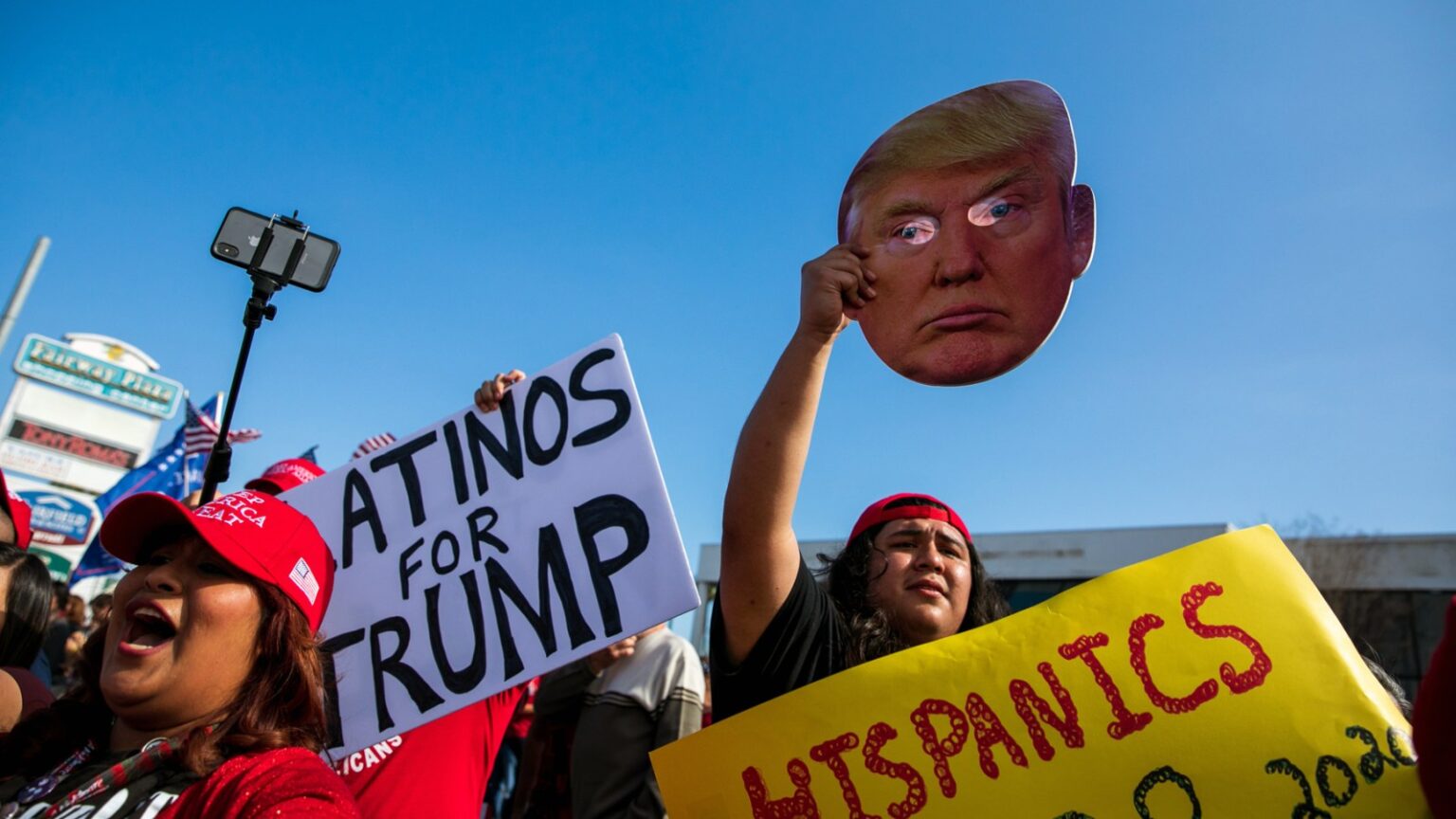
Laredo is the beating heart of Webb County, a 95-percent Hispanic district that swung over 25 points toward Trump from 2020 to 2024, voting Republican in a presidential election for the first time since 1912. It wasn’t an anomaly. Almost every county throughout the Rio Grande Valley and along the border swung toward Trump by double digits in his comeback election. The shift felt like a culmination of a years-long, rightward lurch among Hispanic voters, who harbored concerns about the region’s economic future and felt the impact of immigration policies more directly than perhaps anywhere else in the nation. Even though Trump won by slim margins in South Texas, the fact that he won them at all is cause for alarm among Democrats.
The pendulum may now be swinging in the other direction, though, as Trump’s chaotic, tariff-fueled economic agenda and brutal anti-immigration push have wrought havoc on Hispanic communities. This is especially true across the Rio Grande Valley, where Rolling Stone recently spoke with residents — many of whom voted for Trump in past elections — who did not mince words about how bad things have gotten since the president retook office a year ago.
“There’s not a lot of optimism,” says Jerry Garza, a local news anchor for over 20 years and the current president of the Laredo Hispanic Chamber of Commerce. “It was a fraction of a percent that ended up turning the county red. I think there was this sense of hope that maybe the change of administration would ease things. Not only have things not gotten better, they’ve gotten worse.”
“God squeezes, but he doesn’t strangle”
The dissatisfaction is measurable. Polling in Texas shows that the president’s first year of governance may be eroding the gains he made among Hispanic voters in the state. According to an October survey from the Texas Polling Project — a nonpartisan research outfit at the University of Texas at Austin — only 19 percent of Hispanic voters in the state “approve strongly” of the president, with 13 percent “approving somewhat” and a whopping 51 percent “disapproving strongly.” Last February, those numbers stood at 26 percent, 18 percent, and 37 percent, respectively. In other words, the percentage of Texas Hispanics who really don’t like Trump’s performance jumped almost 15 points in less than a year.
Separate polling by UnidosUS, a Latino civil rights and advocacy group, found in November that among 3,000 registered Latino voters, “64 percent disapprove of his job performance,” and “of those who voted for him, 13 percent say they would not vote for him again.” The Pew Research Center, meanwhile, found that 70 percent of Latinos disapprove of Trump. Pew also found that upwards of 60 percent disapprove of Trump’s approach to immigration and believe he has made the economy worse. The share of Latino Trump voters who approve of his job performance declined from 93 percent at the start of his term, to 81 percent as of November.
Quique, La Mina’s owner and a two-time Trump voter, says he regrets voting for Trump in 2024, and that he’s not alone.
“Lots of people like me voted for [Trump]. The first time, I felt the country needed a change,” he explains, noting that he voted for him again hoping for much-needed economic growth, and that immigration and frustration with the Democratic Party also factored heavily.
“I don’t think he knows what he’s doing,” Quique says, pointing to cruelty in his immigration enforcement and the chaotic tariff and trade policies. The bar’s costs are higher, people have less to spend, and the neighborhood is still struggling to recover from lockdown-era stagnation. He sees Trump as an aging, sickly figure, surrounded by yes men. In a city that straddles the border, he’s watched good, hardworking people who legally cross the bridge outside his bar every day become “spooked” at the possibility of losing their status, permits, or jobs. He jokes that at least in Mexico, the people are clear-eyed about the failures in their government.
“What I hear from patrons is not necessarily that they want to just go back to a Democratic president,” Quique says, as the last of that night’s regulars pay their tabs and depart for the bridge. “They want a more just government.”
He remains hopeful that things will get better eventually — just maybe not under Trump. “Dios aprieta, pero no ahorca,” he tells me. “God squeezes, but he doesn’t strangle.”
“It’s been rough, to say the least”
In a warehouse across town, customs broker J.D. Gonzalez, chair of the National Customs Brokers and Forwarders Association of America, is feeling the pressure.
“As a business, I was doing quite well, and right now I’m probably down about 3,000 shipments year over year,” he says. The vision of a Laredo Tejano — with slick hair and a sport coat paired with full quill ostrich-leather cowboy boots — Gonzalez is one of hundreds of specialized customs brokers in the city who help importers and exporters manage the intricacies of inspections, taxes, approvals, and logistics involved in cross-border commerce. It’s a critical job in one of the busiest ports in the nation, through which over $339 billion worth of goods passed in 2024.
“Laredo has grown [economically] anywhere from five to seven percent on a yearly basis. This year, we’re down one percent,” Gonzalez says. Driving the downward swing are Trump’s schizophrenic tariff-centric international trade disputes, and the uncertainty is persistent and costly.
Gonzalez’s business is small compared to JAMCO, one of the largest brokerage and logistics firms operating along the U.S.-Mexico border. “I think we’re just really looking for some stability of understanding,” JAMCO President Rahul Oltikar says at their company headquarters, a nondescript building nestled within the maze of enormous warehouses and shipping centers that dispatch thousands of trucks a day. He and Gonzalez both note that warehouse space — usually highly in demand and easy to fill — has seen a sharp increase in vacancies.
Virtually every aspect of the cross-border supply chain has been negatively impacted since Trump retook office. Over 9,000 freight truck drivers have been pulled from service after failing new English-language proficiency requirements instituted by the Department of Transportation. In August, the Department of Homeland Security paused the issuance of foreign visas for truck drivers — a decision that disproportionately impacted inland border ports like Laredo — after an undocumented driver caused a deadly crash in Florida.
“Local markets, smaller players have definitely suffered, on having to let people go,” Oltikar adds, noting that the domino effect is being felt in virtually every local industry. “Things like fast food chains that are local, that had employees on both sides of the border, they all of a sudden had raids that eliminated 20 percent of their workforce.”
“I have a lot of friends who are die-hard Trumpers,” Gonzalez adds. “Everybody wanted a change because they saw what the Biden administration was doing. Now with the current Trump administration, a lot of people — when I go to D.C. and I have my discussions out there — they’ll say I voted for him, but I didn’t vote for this.” Looking towards 2026, Gonzalez says the industry is hoping for some more “checks and balances” on the president.
“We want to see Trump succeed, but we don’ t know how long we can hold on”
Outside of the busy entry ports of South Texas, the landscape changes drastically. The hum of loading docks and warehouses gives way to long, quiet country roads lined with cattle ranches and farms. Every so often at an interior checkpoint, an immigration officer gives you a once over and asks, “Are you a citizen?” Here, the speculative optimism of city tradesmen dissolves into the generational slough of a perpetually burdened agricultural sector — and support for the president intensifies.
Rio Farms has seen the ebb and flow of farming around the Rio Grande. After nearly 100 years in operation, times have rarely felt more dire. “We’re all suffering,” says Matt Klosterman, Rio Farms’ president and general manager. “We wanna see Trump succeed but we don’ t know how long we can hold on.”
Established in 1941, Rio Farms operated for decades as a research facility, startup, and incubator for farmers in South Texas. Over 1,000 farmers, including the heads of some of the most productive operations in the region, graduated from the program. Some valley farmers and ranchers have recently turned to wind farming, with turbines able to net about $15,000 in energy revenue a year, but their love of Trump has complicated the push for green energy.
“A lot of the farmers, when Trump came out and spoke negatively of the wind, everybody’s opinion [on the turbines] changed, like, overnight,” Klosterman says.
Rio Valley Farms Inc, in Monte Alto, Texas
Nikki McCann Ramirez for Rolling Stone
The area’s agricultural industry is now in a race against time, however, fighting collapsing commodity prices, a water shortage, rising costs of machinery and fertilizers, and labor scarcity resulting from Trump’s immigration crackdown.
Trump’s tariff regime shocked commodity crop values across the country, which had been floundering for years. The tax on countries like China, Brazil, and Mexico — major buyers of staple crops like cotton, soybean, sorghum, wheat, and corn — became a financial vice on an already struggling industry. The already high costs of machinery, fertilizer, and other inputs rose even further, and demand for American agricultural products plummeted.
Farmers are struggling to just keep their heads above water. “I think for us, we’re all going to play the ‘least risk’ game,” Klosterman says. “Put the least amount [of money] into it and try to lose as little as possible, which is not a great business model.”
“Until either the cost of inputs come down, or the price of our commodities go up, we’re going to be in this pickle,” Klosterman adds.
Farmers have been hit so hard — not just in South Texas but across the U.S. — that in December Trump gave them a $12 billion bailout. It will likely not be enough, and it definitely doesn’t resolve the underlying issues driving farm closures. “Nobody’s not going to take the money,” Klosterman says, but in his community of growers “most of the sentiment is that this is a very short term fix.”
“This doesn’t help next year,” he adds, describing the payments as a “bridge” to prevent more bankruptcies and closures. “We would rather do it the old fashioned way, where we didn’t have to have this, but with the inputs upside down and the sales price on those commodities, even the best growers lost money. So something needed to happen.”
“Trump has good intentions but doesn’t see the domino effect”
The notion that Hispanics — both along the border and throughout the country — oppose immigration restrictions is a pervasive myth that continues to cloud attempts to understand the demographic’s electoral habits. In South Texas, a region where nearly the entire population has some ancestral, social, or financial connection to Mexico, the specter Trump has raised of the undocumented migrant leaching off the good, taxpaying Latinos who came to the country the “right” way hits particularly hard.
Jerry Maldonado, of the Laredo Motor Carriers Association, says that while his politics align more with Republicans, he’s of a split mind when it comes to the president.
While Maldonado is not thrilled about how Trump’s tariffs have affected freight load volumes, he doesn’t begrudge the president’s immigration policies. The child of Mexican immigrants, Maldonado sees deportation as an intrinsic risk of undocumented migration. “It’s no different than you running a stoplight and getting into an accident or speeding down the highway and hoping the cop doesn’t catch you,” he says. “It is the same risk at the end of the day. And some people forget that part.” He firmly believes taxpayer dollars should go only to American citizens, and that in an imperfect political system, you just gotta pick the party you feel “will do right by you.”
Trump is “doing a good job,” Maldonado says. “The rest of the world, whether they like him or not, we can all agree that they fear him. And having a leader that is feared, I believe, is important.”
But when it comes to the effect of Trump’s immigration policy on business, the fallout is turning some away from the president.
A worker we’ll call Paul, a left-leaning home builder who did not vote for Trump, agreed to speak on conditions of anonymity for fear of backlash from other firms and the administration. He says that “deep down” a growing number of fellow construction-company owners have a sense of buyer’s remorse. “But few will say it out loud.”
Construction in South Texas was booming leading into 2025. According to Paul, when the first ICE raids began targeting work sites and projects, the general attitude among the industry was that it was a temporary show of force by the administration.
“We can weather this.”
“Promises made, promises kept.”
“This is what I voted for,” he recalls his peers saying.
As time went on, it started getting personal. The laborers being rounded up and deported were workers and contractors that had been in the community for decades, “people in the industry they have relationships with,” Paul says, people whose weddings, quinceñeras, and baptisms they attended. “People who are padrinos to their children.” The attitude shifted, to a feeling that “Trump has good intentions but doesn’t see the domino effect” of his policies.
In late November, the South Texas Builders Association (STBA) hosted a symposium on immigration for its members and local lawmakers, and the collision of commerce, politics, and regional identity were on full display.
“Business is down significantly, and if we continue on this trajectory, this direction, we will see a lot of businesses fail,” says Ronnie Cavazos, president of the STBA. “Most of us were born and raised here. We are multinational. We’re multilingual, and we’re multitalented. Sons and daughters of immigrants, and some of us immigrants ourselves. Let me tell you something about immigrants in this country: Nobody believes in the American dream more than them, nobody is willing to work harder for it.”
“There is no Plan B for us,” he adds.
At the meeting, speaker after speaker walked a tightrope between expressing outright criticism of the administration, and conveying the reality of their frustrations. One man recalled that a friend of his who is employed as an ICE agent told him that the valley is regularly targeted by raids because its low-hanging fruit to meet detention quotas. Another noted that the over tenfold increase in funding for ICE operations under the Trump administration was not them “looking to make this better or help us out,” it’s “10 times more harshness.” Others described migrants and day laborers at work sites with documentation and work permits being detained, leading to financial losses for constructors and a climate of fear among workers.
Paul notes that while the industry is still reluctant to put blame squarely on the White House, the “behind the scenes” discontent among supporters of the president is crystallizing rapidly. “All the investments that would typically prop up the market aren’t happening,” Paul says. Funding from Mexican firms and investors building and financing projects in the United States has dried up.
“I don’t expect [Trump] to do a 180,” he says. “We just gotta batten down the hatches and ride out the next three years.”
“What they wanted to hear”
Driving through Hebbronville, a slowly crumbling majority-Hispanic town whose most colorful feature is its plushie-and-flower encrusted cemetery, a sign jumps out at passers by: “SAVE TEXAS, SPAY AND NEUTER YOUR DEMOCRATS.”
Disillusionment with Trump may be growing, but the president and his party still enjoy a loyal contingency of voters in the region.
Texas Polling Project Director James Henson says it’s not necessarily that Hispanic voters are “becoming more permanently Republican,” but “that their party affiliation is becoming less fixed.” In a region where voters are already quite comfortable splitting their ticket, the share of independent voters is growing, and the framework of unconditional party loyalty among voters is cracking. Businesses and locals predict harder times to come, and while many are growing dissatisfied with Trump, Democrats are also historically unpopular. The blame game has yet to be retested on a ballot.
The hard lesson learned over the last decades, one that much of the Democratic political machine around the country seems yet to recognize, is that a reliance on outrage over the president’s actions and policies is not a substitute for a party platform. As Quique explains over a plate of brisket tacos at La Mina, many lifelong Democrats who decided to split their ballot or outright defect from the party did so under the feeling that they had no other choice.
Democrats were the “ones responsible for the people looking for someone like Trump,” who would “tell them what they wanted to hear” from their elected officials, he says. Times were hard and getting harder, and in 2024 the resounding economic message being put out by the campaigns of former President Joe Biden, and later former Vice President Kamala Harris, was that things were actually not that bad.
Texas is at the heart of Trump’s efforts to tilt the electoral map in his favor ahead of the 2026 midterms. At the same time, the state is gearing up for what promises to be a contentious round of Senate primaries in the spring. Some reliably Republican districts may have been diluted to the point of attainability for Democrats in a wave year — potentially denying the GOP the full set of five extra congressional seats they tried to carve out of the state in an off-cycle redistricting. But as Hispanics in South Texas reevaluate if their faith in Trump has paid off in the expected dividends, the minority party would do well to remember that the vote is earned, not owed.
Interviews throughout this piece have been translated from Spanish and edited for clarity.


