





What I’m thinking about: The widening gap between active buyers and sellers in the American real estate market.
And notably, the absolute number of active buyers is the lowest on record (data goes back to 2013), apart from a small pandemic episode in 2020.
Buyer activity has followed a downward trend during three years in a row.
(FYI, seller activity may not be recorded due to sellers staying on the sidelines or removing listings.)
In Western US and Sunbelt markets (including my hometown of Austin) sellers outnumber buyers. ~2X.
It’s worth noting that the strongest sellers’ markets in the Midwest and Northeast do not feature 2X ratios in the reverse direction (closer to ~1.5X in the best sellers’ market), supporting the overall lack of buyers nationally.
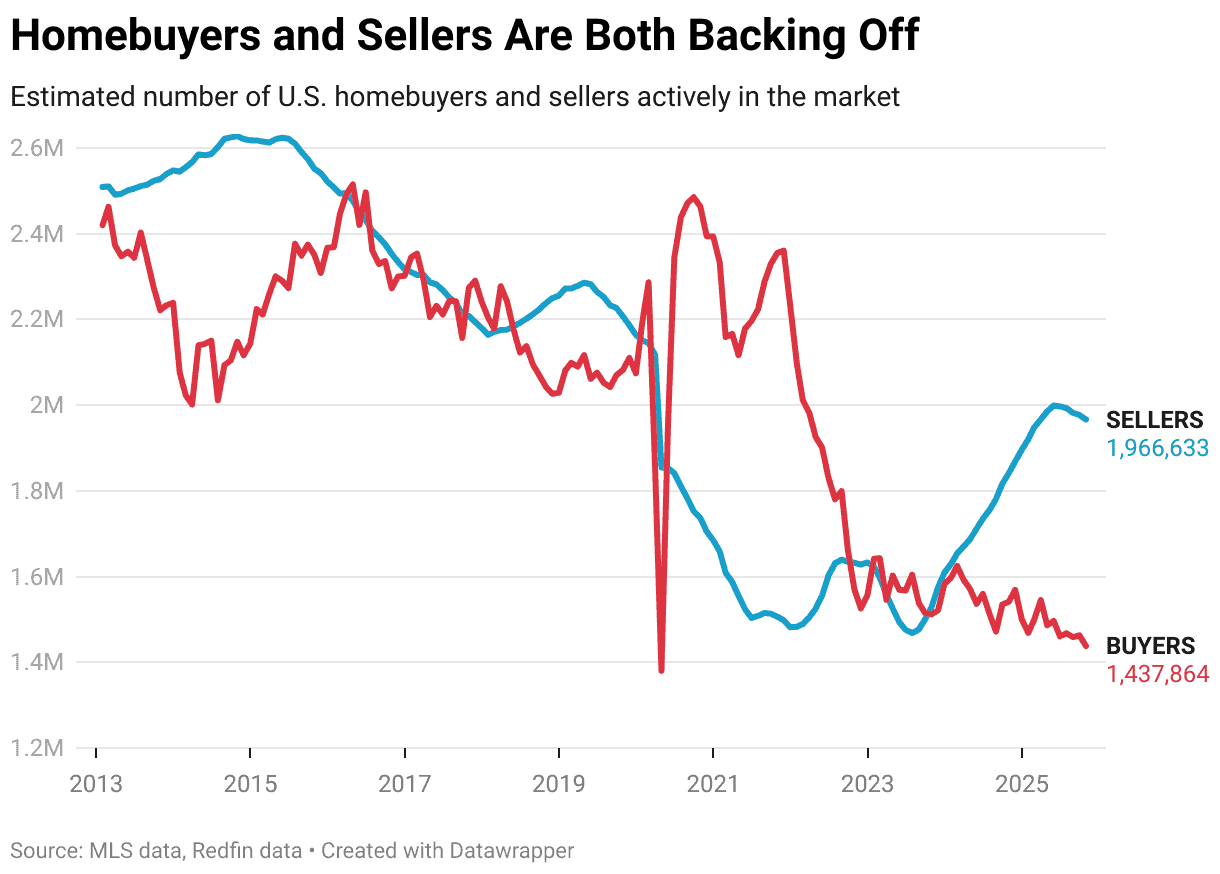
This is not subtle. This is about as brutal as the buyer’s market can get.
(While I’m sure they exist, I don’t know any real estate investors who aren’t feeling the effects of this.)
With all of this in mind, and as we target more complex and higher value deals, our underwriting process continues to evolve to mitigate as much risk as possible.
How we use Reventure to avoid disasters
Every deal we fund now is executed through the Reventure App (no affiliate relationship) as part of our standard due diligence.
For context: Reventure pulls up-to-date data from Zillow, government-level data, and proprietary analysis of real estate trends. Like LandID, you can find most of this data for free if you want to search multiple sources. But Reventure presents it in an easy-to-navigate layered solution.
I won’t break down all the available data points. Instead, I’ll focus on the ones we use the most… and how we apply them in practice.
The granularity of the data varies from the national to the ZIP code level (although not all ZIP codes are represented due to lack of population or data reporting to construct a reliable trend).
We’ll use Travis County (which includes Austin, TX) as a primary example.
The history of Austin: rise, fall, bottom
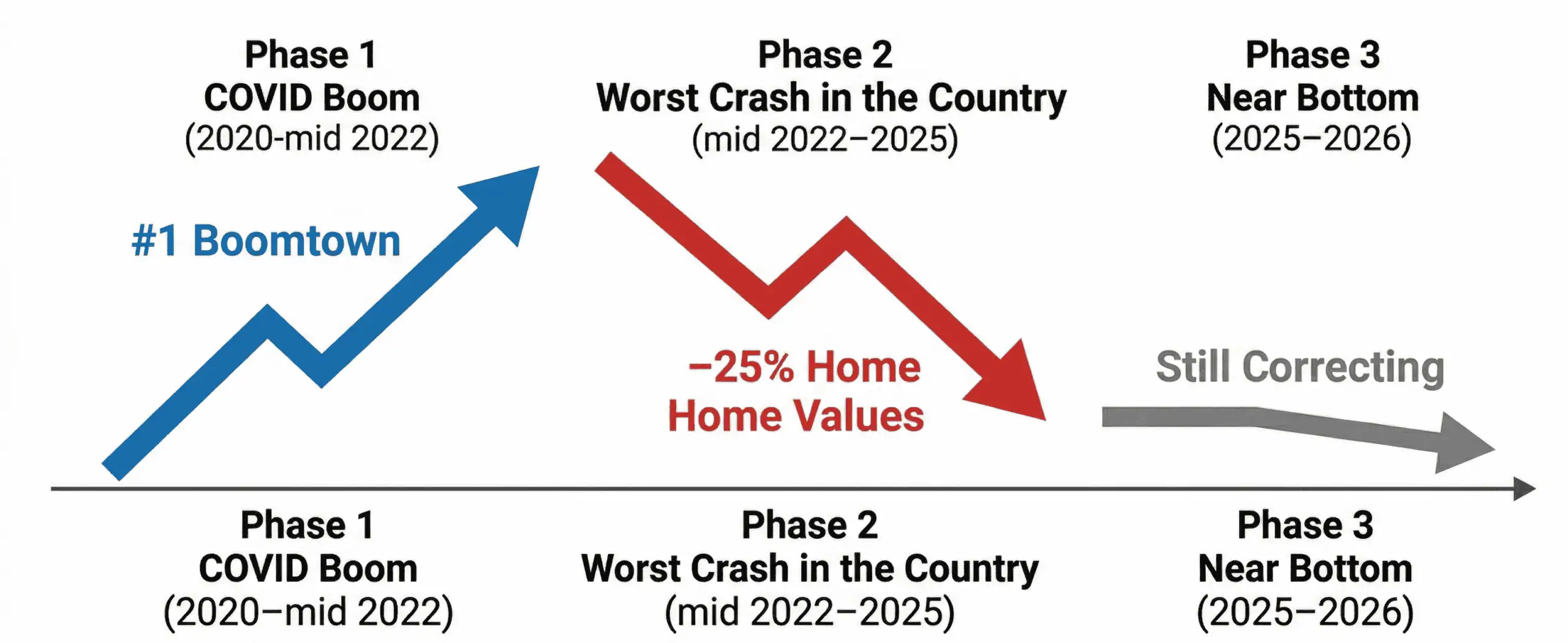
Austin was, by most metrics, the number one booming city during the COVID bull run.
Then it suffered the worst crash in the country: a 25% drop (and counting) in home values from mid-2022.
The city became a national punching bag… and it is true that there were headaches.
But the market has almost bottomed out. The livability of the city has improved. And I still prefer not to be anywhere else for about 8-9 months of the year.
The long-term promise remains, and I see Austin as one of the most technologically progressive cities in the world over the next 50 years, real catnip for a futurist like me.
(The trend has been: Silicon Valley designs it, Austin implements it. At this point, literally I can’t drive more than 10 minutes without seeing a driverless Waymo on the road… the shock value hasn’t worn off yet).
But in the short term? We are still in a correction.
Data Point #1: Home Price Forecast Score
This is the first metric we check.
Reventure’s home price forecast scoring projects anticipated average home values over the next 12 months. They have great historical accuracy on this metric (you can read about their history on their website).
Travis County: It is forecast to fall another 6.3% over the next year.
Data Point #2: Overvaluation Percentage
This compares median home values to local median incomes.
At the end of 2021, Travis County was 40% overrated. Awesome.
Today? 0.9% overrated.
Revenue increased. Home values fell. The market is much closer to equilibrium.
In comparison: DFW and Houston have not corrected as strongly as Austin or San Antonio. But currently they are 15-20% overrated (which tells me I should be more careful before investing there).
How do we combine these two numbers?
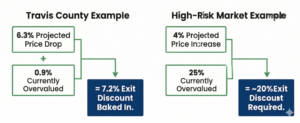
While it’s not an exact science, we add the home price forecast and the percentage of overvaluation to determine how conservative we should be with prices.
Example from Travis County (early April 2026):
- Expected fall of 6.3% in the next 12 months
- 0.9% currently overvalued
- Total: 7.2% discount incorporated into the subscription (we round up to 7%)
Translation: If we are purchasing an asset in Travis County with a 12-month front-end hold, we must price our exit. at least 7% below the current market value to protect the disadvantage.
Another example: a county where home prices are expected to rise increase 4% about next year, but overrated by 25% (not uncommon in much of the US at this time). In that case, I would like to bake in about a 20% departure discount from current market value due to lack of affordability.
Other data points we review
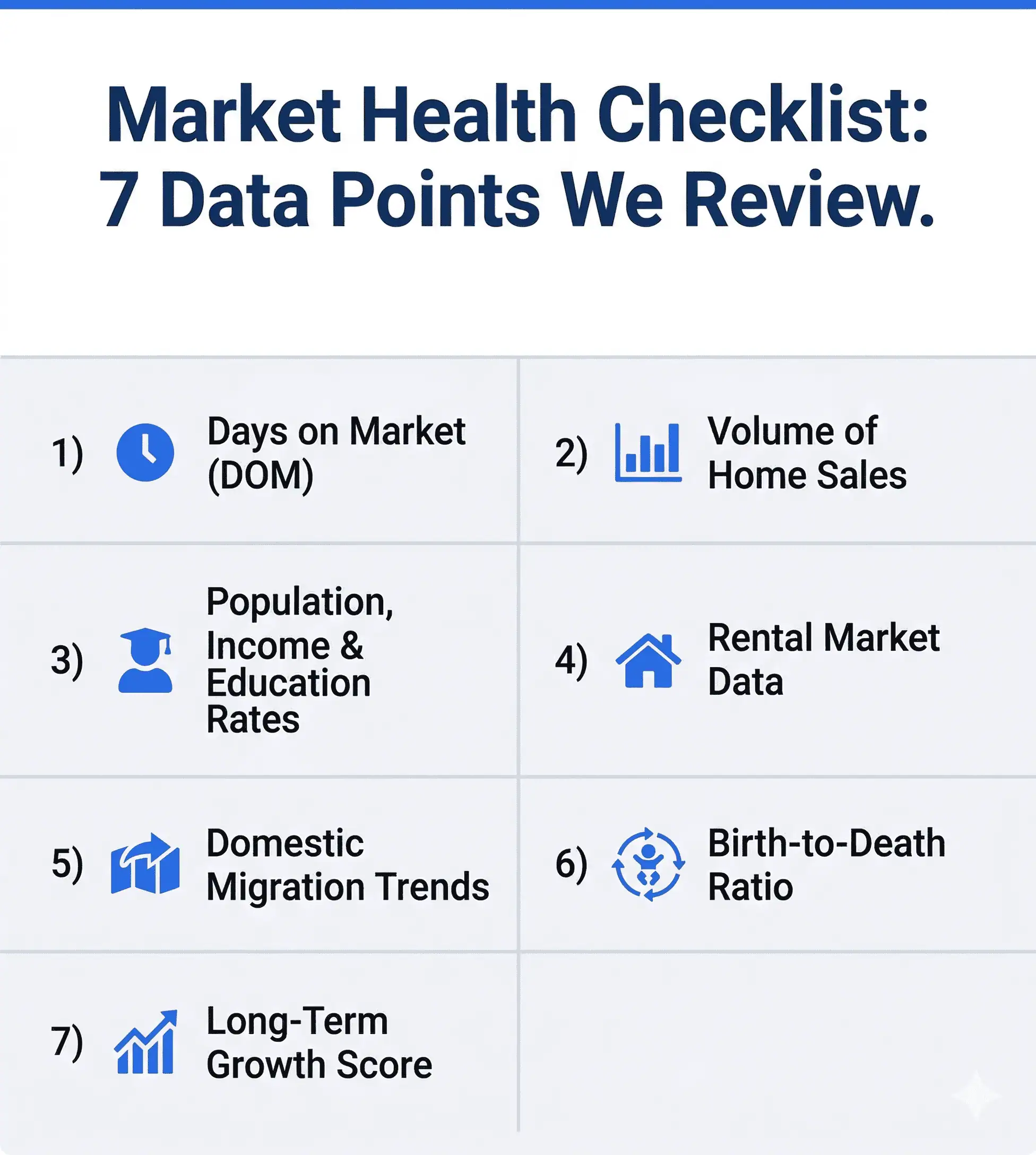
Days on Market (SUN): As of January 2026, Travis County currently has an average of 87 DOM (highest on record). You can also compare the DOM with the local historical average.
Home sales volume: We compare current performance to historical averages (or recent trends) to measure market speed.
Population growth, income growth, college degree rates: Populations with higher incomes and more education tend to be more resistant to economic crises. Additionally, to an even greater degree than purchasing a home, our country’s buyer demographic needs discretionary income to purchase luxury assets like land.
Rental market dates: Austin’s rental market plummeted along with home prices. now it’s in the The Five Most Affordable Rental Markets in the US (a complete change from a few years ago). More relevant for multifamily or BTR (Build-to-Rent) operators, but worth mentioning.
Internal Migration: Travis County loses 13,500 citizens to internal emigration in 2024. Many COVID boom cities have experienced an internal exodus. Population growth was underpinned by international migration… but due primarily to federal policy changes over the past year, total net incoming migration has reversed for the first time in at least 50 years. Regardless of political opinion, the implications of this will surely be felt in (real estate and jobs).
Side note: most international immigrants are initially renters. Over time, they contribute to organic growth and become future home and land buyers.
Ratio of births and deaths: This is excellent insight into long-term regional potential and anticipated real estate demand. Austin has a robust 2.48 births for every death (the highest ratio in a major US metropolitan area outside of Salt Lake City…to no one’s surprise).
Compare this to many Florida counties along the Gulf, which attract older populations but are not particularly friendly to young families. Several have birth-to-death ratios of around 0.5 or worse.
Long-term growth score: Another proprietary metric from Reventure that indicates where home prices could be headed over the next 5-10 years based on underlying fundamentals. Travis County has a score above average due to an educated population, strong organic growth and expected real estate appreciation. (A good sign personally, since my wife and I bought our house at the end of 2022…)
The limits of this data
These data points don’t tell the whole story.
They relate to housing prices (which correlate with land but are not 1:1).
For example, they do not distinguish between existing home sales and new construction (or even at a more granular level, the variation between different builders’ housing stock). That’s a key consideration for rights projects and major subdivisions, as one savvy land operator recently told me.
But Reventure’s review of market data certainly fills in many gaps.
And in a market this brutal…You can’t be too careful.
Why financing from a fellow real estate operator who is constantly improving our best-in-class underwriting system with a profitable track record to back it up?
We issue checks from $50K+. We close 100% of the businesses we commit to. And most importantly…Us. Never. Give. Above.
Let’s grow together.
Analyze your property today
Originally published in https://seriousland.capital on January 29, 2026.


