



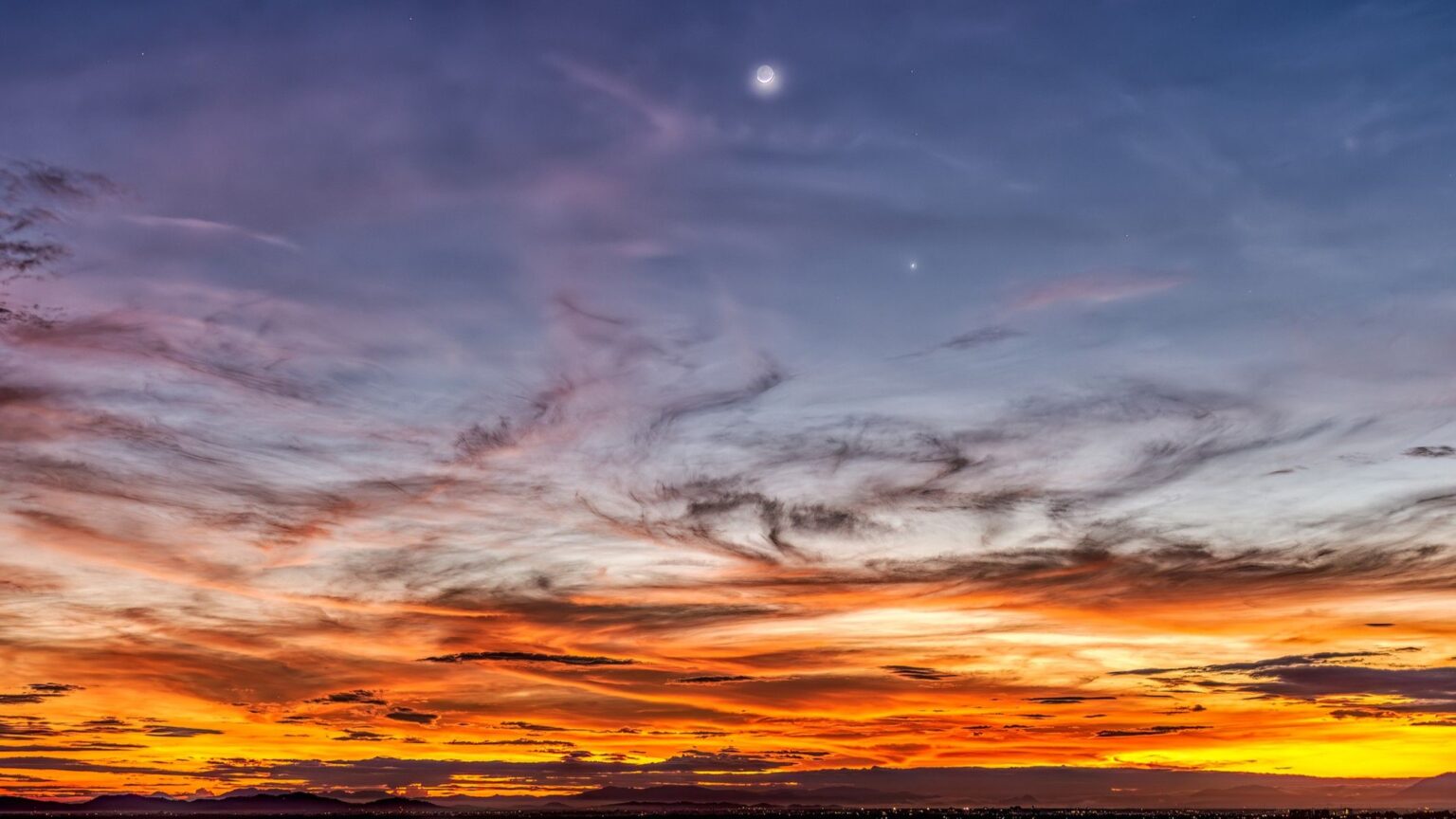

The moon passes directly in front of Venus during a rare daytime occultation on June 17, 2026, creating one of the most unusual and technically challenging skywatching events of the month.
For most of North America, the moon will slide Venus mid afternoon. The chances of witnessing this rare event are good, as long as the sky is clear and deep blue.
There is one major drawback: the event takes place in broad daylight. Between approximately 3:30 pm and 5:00 pm EDT, the sun will still be high in the sky, while the moon and Venus will be located about 38 degrees from it. Anyone using binoculars or a telescope should be very careful not to accidentally cross the sunwhich can cause instant and permanent eye damage.
You never scan the sky during the day with binoculars or a telescope without knowing exactly where the sun is. To view occultation safely, place your telescope in the physical shadow of a building so that the sun is completely blocked by the roof line.
Read more: How to safely observe the sun (and what to look for)
The moon will be a very thin crescent, about 2 to 3 days old and about 11% to 14% illumination. Venus, meanwhile, will be burning in magnitude -4.0.
While Venus is technically bright enough to be seen with the naked eye during the day if you have 20/20 vision and know exactly where to look, daylight eliminates much of the contrast. What you need here is some binoculars or a telescope. The crescent moon acts as a perfect celestial guide to help locate the planet, and the optics will provide a spectacular view of Venus slipping behind the unlit edge of the lunar disk.
Through a telescope, watching the dull, jagged edge of the lunar crescent slowly consume the bright white disk of Venus against a blue daytime sky is an unforgettable sight.

If you prefer not to explore the sky during the day, the night sky has another delight in store. The crescent moon will be located near the Beehive Cluster (M44) in the cancer constellation.
Once the sky is completely dark (about 45 to 60 minutes after sunset), look up at the moon. Just a few degrees away, you’ll find a patch of dim, blurry light. That’s the Beehive group. Through binoculars, it completely transforms into a brilliant scattering of dozens of faint bluish-white stars. Spanning roughly the width of three full moons, the cumulus and crescent moon will fit comfortably in the same binocular field of view, creating a spectacular view.
The bright, sunlit portion of the moon will be dazzling, but the rest of the lunar globe will visibly glow from sunlight reflected by Earth’s oceans and clouds returning to the moon. Known as earthshine, the effect makes the Moon appear strikingly three-dimensional through binoculars.
The Moon and Beehive Cluster also provide an excellent target for a quick wide-field astrophotography project. Mount a DSLR camera with a 135mm lens on a tripod and expose long enough to capture the bright Beehive star swarm while keeping the exposure short enough to preserve the earthshine on the dark side of the lunar crescent.


