



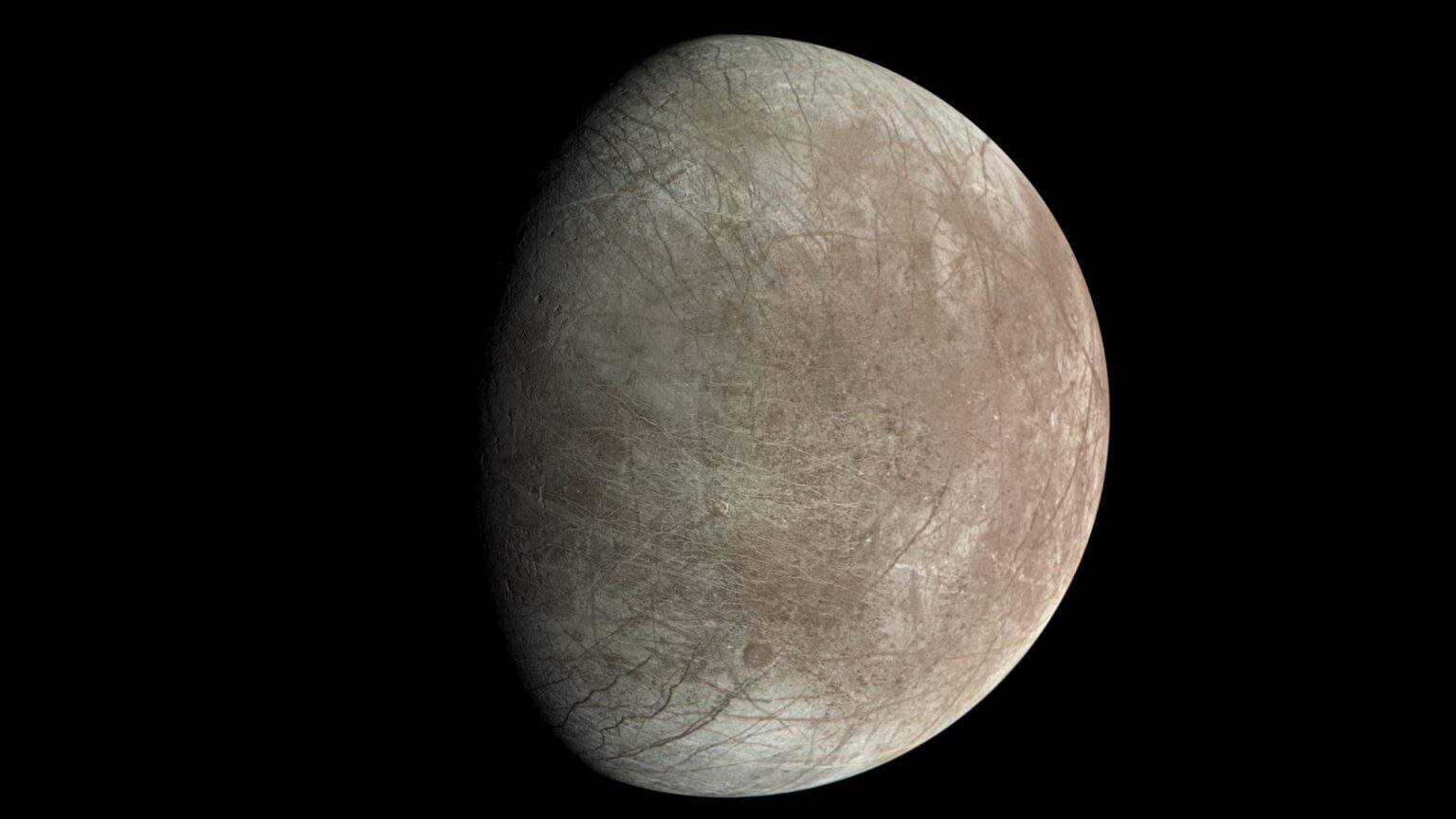

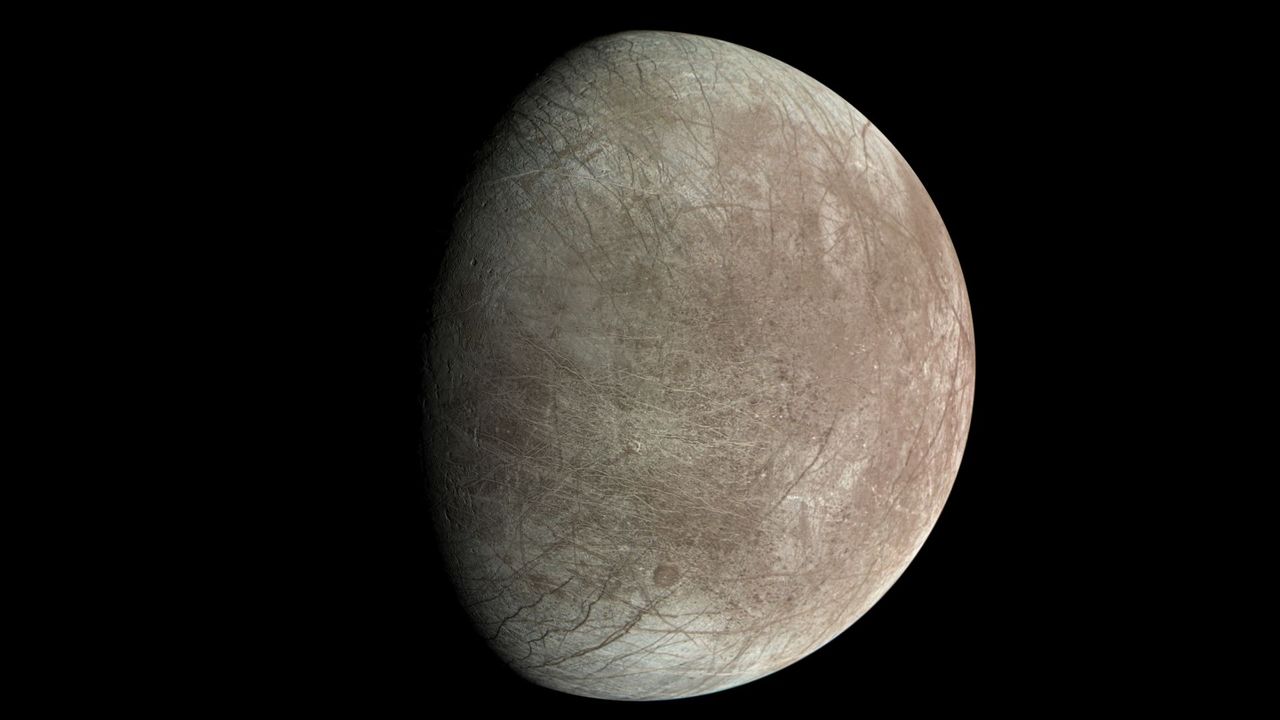
After years of debate, NASA researchers have focused on the thickness of Europa’s ice sheet.
We first discovered that the surface of Jupiter’s moon appeared icy in 1979, when Voyager 2 flew by. Another NASA mission, Galileo The Jupiter orbiter later confirmed the ice cap while surveying the giant planet. Europeand other Jovian moons during the 1990s.
Since then, scientists have been on two sides, arguing contradictory theories about the thickness of Europa’s ice sheet. One theory holds that the shell, which is believed to hide a huge buried ocean of liquid water, is less than 1.6 kilometers (1 mile) thick, while the other postulates that it extends for tens of miles.
Now it looks like we have an answer. Using data the Juno Jupiter orbiter rendezvoused in 2022 using its microwave radiometer instrument, NASA researchers Jet propulsion laboratory (JPL) in Southern California estimates the shell to be about 18 miles (28.9 km) thick.
“The 18-mile estimate relates to the cold, rigid, conductive outer layer of a pure water ice sheet,” said Steve Levin, Juno project scientist and co-investigator at JPL. a statement from NASA on Tuesday (January 27).
“If a slightly warmer inner convective layer also existed, which is possible, the total thickness of the ice sheet would be even greater,” Levin continued. “If the ice sheet contains a modest amount of dissolved salt, as some models suggest, then our estimate of the sheet’s thickness would be reduced by about 3 miles [5 km]”.
Understanding the composition and structure of Europa’s icy surface is important, because NASA researchers (and many other scientists around the world) want to know if the moon hosts extraterrestrial life. Previous research suggests that the The ingredients for life could exist. in the underground ocean of the moon.
“The thickness of the ice sheet and the existence of cracks or pores within the ice sheet are part of the complex puzzle in understanding Europa’s potential habitability,” Scott Bolton, Juno principal investigator at the Southwest Research Institute in San Antonio, said in the NASA statement.
And a thick layer of ice might not be good news for Europa’s potential as a seat of life. This feature “implies a longer route that oxygen and nutrients would have to travel to connect Europa’s surface with its subsurface ocean,” NASA officials wrote in the statement.
This new view of Europa will provide useful context for the two spacecraft currently en route to the Jovian system. POT Europe Clipper should reach orbit around Jupiter investigate the habitability of Europe in 2030, and the European Space Agencies Juice (JUpiter ICy moons Explorer) He will arrive there a year later.
The new Europe results They were published on December 17 in the journal Nature Astronomy.


