



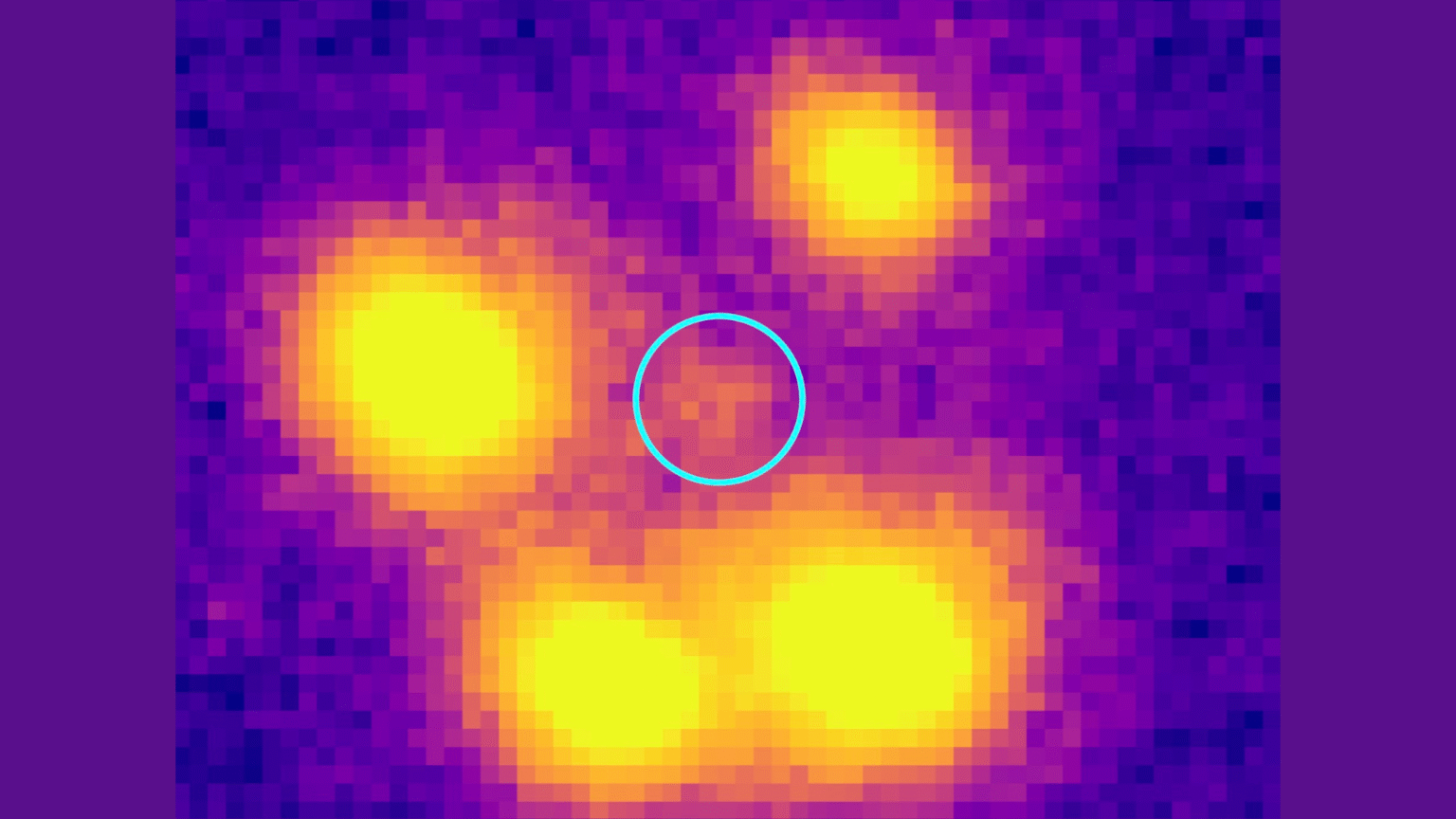

Astronomers have discovered a rare gravitational lens called the “Einstein Cross,” revealing a young galaxy with surprisingly mature stars.
The galaxy in question is J1453g, an elliptical galaxy that is the first gravitational lens at a large cosmic distance that astronomers have been able to accurately “weigh.” J1453g focuses light from a more distant quasar, a region of space dominated by a voraciously feeding supermassive black hole, magnifying it and causing it to appear multiple times in the same cross-shaped image.
“The discovery of this exceptional object has allowed us to precisely study the nature of the stars at the center of an elliptical galaxy in a remote era of the universe, when the galaxy was still young,” team leader Quirino D’Amato, a researcher at the Italian National Institute of Astrophysics (INAF), said in a statement. “It is surprising that its composition is very similar to what we see today in the Milky Way, in a completely different environment and time.
“This tells us that we are still far from fully understanding the processes of galaxy formation and evolution, and represents an important point for the development of future models.”
What is gravitational lensing?
This research would not have been possible with a quirk of the cosmos first proposed by Albert Einstein in his 1915 masterpiece, the theory of gravity, general relativity.
General relativity suggests that objects with mass give rise to a curvature in the very fabric of space and time, united as a four-dimensional entity called “spacetime.” The greater the mass of an object, the greater the curvature it generates, and we experience these warps in space-time as gravity. Therefore, the greater mass an object has, the greater its gravitational influence.
And when light passes through warps in space-time, something fascinating happens. The normally straight path of light curves along the warp, and the degree of curvature depends on how close to the mass object the light passes.
That means that when a high-mass object comes between Earth and a more distant object, light from that background object can reach our telescopes at different times. These intermediate bodies can cause background objects to be magnified or “gravitational lensed.” In fact, this phenomenon is used with great success by the James Webb Space Telescope (JWST) to observe ancient and distant galaxies.
Occasionally, the difference in arrival time can cause a background object to also appear multiple times in the same image. These multiple manifestations of the same background body can adopt circular arrangements, or Einstein Rings, and can also appear as more rare Einstein Crosses.

In the case of this Einstein Cross, the gravitational lens is the galaxy J1453g in near perfect alignment with Earth and a distant quasar, the active region at the heart of the galaxy, which is powered by a feeding supermassive black hole.
Gravitational lenses are not only useful for viewing objects that are normally beyond our vision; The lensing effect can also tell scientists a lot about the body doing the lensing. In this case, the team was able to use the cross-shaped manifestations of this quasar to determine the mass distribution of J1453g stars with an unprecedented level of precision. That revealed something that defines what current models suggest.
Scientists typically expect the central bulges of elliptical galaxies to form rapidly and therefore be dominated by low-mass stars. However, it appears that J1453g has a configuration similar to that of the Milky Way, which is a barred spiral galaxy, meaning that some elliptical galaxies may form more slowly with higher-mass stars at their centers. Another possibility is that J1453g was transformed in its early history by a violent incident, such as a collision and merger with another galaxy.
As such, the team’s results not only represent one of the most robust measurements of star birth in the universe’s adolescence, but also represent a new window into the formation and evolution of massive cosmic structures. In fact, the research suggests a more dynamic and complex history of galaxies than previously thought possible.
The team’s research was published Thursday (April 2) in the journal. Nature astronomy.


