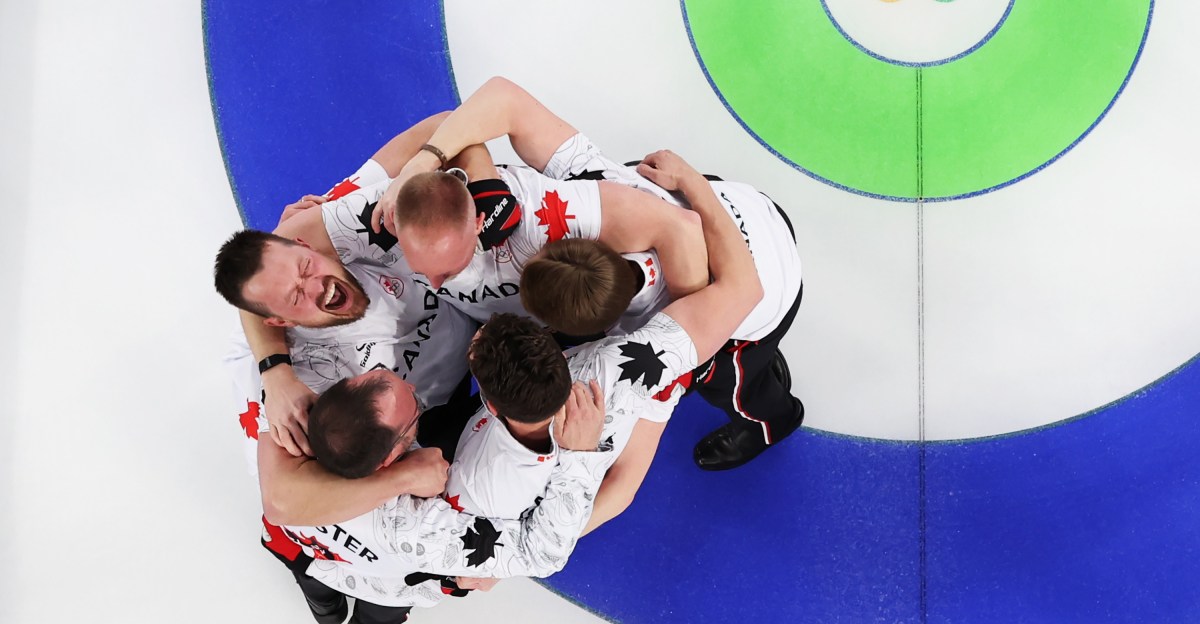

The Canadian men’s curling team began its 2026 Olympics with controversy, but ended it with Gold.
Men’s curling’s biggest prize has returned to the country that has largely dominated the sport over the past few decades. For the first time since 2014, Canada won the Gold Medal at the 2026 Winter Olympics in Milan-Cortina, Italy, defeating Great Britain 9-6 in a thrilling match between two of the best teams on the planet.
Canadian Brad Jacobs and Scotsman Bruce Mouat were at their best during Saturday’s match in Cortina. The two teams traded hammer points throughout with neither team leading by more than one point until after the ninth end, when a series of half-misses by the Scots helped Canada take control with a three-point finish. That gave Canada an 8-6 lead, but in the tenth with Great Britain holding the hammer, Jacobs had his team throw rock after rock at the house, giving Mouat little chance to score multiple points. In the end, Mouat’s last shot, a double serve attempt, failed to clear both Canadian rocks, leaving Canada scoring a point for the victory.
The victory was a return to glory for Jacobs’ team, three of whom won gold for Canada in Sochi in 2014. It came on the heels of the team being a frequent target of criticism from opponents and fans alike, when vice Marc Kennedy got into a fight with his Swedish counterpart at the start of the round-robin portion of the tournament. The Swedes accused Kennedy of touching a rock twice after reaching the pig line, and one photograph appeared to show Kennedy doing just that, even grazing the granite, which is never allowed under any circumstances. That led to a heated argument on the ice and then the deployment of officials to the hog lines for a brief period, although their presence was short-lived.
In the end, Canada also did its job in many tense game situations, returning a gold medal to Canada just hours after the country’s women’s team claimed a bronze in a victory over the United States.
The men’s bronze went to Switzerland, whose team was undefeated with a 9-0 record in the round-robin. However, on Thursday night they fell to Great Britain in the semi-finals 8-5, handing the Swiss their first loss of the entire tournament and forcing them to play for bronze. Mouat was on the other end of that experience in the mixed doubles tournament, as he and Jennifer Dodds took first place but lost to Italy in the semi-finals. This time, Mouat and the Scots he escaped a potentially disastrous finish in the seventh when he triple-served to go up.He then went ahead 6-5 in the eighth and stole two in the 10th to hold on for victory and claim a medal.
Switzerland then dominated Norway in the bronze medal game, controlling the match early and posting a 9-1 victory. Norway had lost to Canada in the other semifinal match in one of the closest matches of the week. That match went to an extra end after Norway scored a pair in the 10th end to tie the score at 4-4, and the Norwegians had a tough shot trying to find a steal. Skip Magnus Ramsfjell failed to convert the in-off, leaving a Canadian stone on the button and sending Brad Jacobs’ team to the final with a 5-4 victory.
Brad Jacobs (jump/4th), Marc Kennedy (vice/3rd), Brett Gallant (2nd), Ben Hebert (lead), Tyler Tardi (substitute)
Bruce Mouat (jump/4th), Grant Hardie (vice/3rd), Bobby Lammie (2nd), Hammy McMillan Jr. (lead), Kyle Waddell (alternate)
Benoit Schwatz-van Berkel (jump/4th), Yannick Schwaller (vice/3rd), Sven Michel (2nd), Pablo Lachat-Couchepin (leader), Kim Schwaller (substitute)
How the medal round took shape
It was a largely stress-free week of curling for the Swiss team, which made it through the round-robin with few challenges. Seven of their nine matches were separated by 4 points or more, and only China (9-7) and Great Britain (6-5 in an extra final) kept the matches close.
The center of controversy during this Olympic tournament was the Canadian team, particularly vice-president Marc Kennedy. Early in the tournament he got into a shouting match with Swedish vice-president Oskar Eriksson, who accused Kennedy of illegally touching a rock across the pig line at the end of the match. The incident generated abundant videos and memes and generated opinions from across the curling community. It also raised questions within the sport about whether independent officials should be available to monitor rule violations rather than relying on competitors themselves to police the game.
Still, Canada was unaffected and cruised through the round-robin to earn second place in the semi-finals. Their second loss came in the final match, when Norway beat them to secure their own spot in the semi-finals and set up a rematch in the medal round.
It took Norway until the final day of the round-robin to clinch a spot, and their big 8-6 win over Canada allowed them to qualify. Norway’s jumper Magnus Ramsfjell made a perfect double serve with his last stone, leaving Canada with no path to score two points with the hammer and sending Norway to pass.
However, the road there was complicated. They started well, going 3-1 during the first few days, but those three wins came over some of the teams that finished in the bottom half of the standings. They finished 2-3 with wins over Great Britain and then Canada to take third place. If Norway had lost to Canada, that would have created a four-way tie for fourth place at 4-5 and Team USA would have earned the final semi-final spot thanks to the tiebreaker procedures.
Bruce Mouat’s team, the highest ranked team in the world reaching the Olympic Games, also took its qualification to the medal round until the last moment. The Scots fared quite well from the start, as Team Great Britain started 4-1 before losing three games in a row to the other three semi-finalists before bouncing back to earn their playoff spot with a 9-2 victory over Team USA in the final match.
In that game, American Daniel Casper struggled, allowing a 4-point steal in the final third when he sent a draw deep and through the house. Combined with Italy’s loss to Switzerland at the same time, GB secured the final spot and a semi-final match against Switzerland, who had previously beaten GB 6-5 in an extra final on Sunday afternoon.
Final round robin standings
- Switzerland (9-0)
- Canada (7-2)
- Norway (5-4)
- Great Britain (5-4)
- United States (4-5)
- Italy (4-5)
- Germany (4-5)
- Czechia (3-6)
- Sweden (2-7)
- China (2-7)